AI Chatbot Philippines: What They Cost, What They Actually Do, and How I Run One for ₱500 a Month
Almost everything written about AI chatbots in the Philippines is written by people selling a subscription. This is not. I run AI chatbots on my own businesses every day — they handle the bulk of my Facebook Messenger inquiries in English, Tagalog, and Taglish, around the clock, for roughly ₱500 to ₱900 a month in running cost. So when I tell you what an AI chatbot actually is, what it costs here, and which businesses it works for, I am telling you what I have personally seen, not what a sales page wants you to believe.
This is the overview — the page I wish existed when I started. It covers what an AI chatbot is in the Philippine context, the one thing that makes the Philippine market different from every guide written abroad, what it really costs to build versus buy, the industries it fits, and how to get one. Where a topic deserves its own deep dive — training, the technical build, the cost comparison against Tidio and Intercom — I link to the full breakdown.
What Is an AI Chatbot in the Philippine Context?
An AI chatbot in the Philippines is a software system connected to your Facebook Messenger (and often your Page comments) that reads each inquiry in natural language and sends an intelligent, accurate reply in seconds — in whatever language the customer used, including the Tagalog-English mix almost everyone here actually types.
It is not the Meta "instant reply" that fires one canned message to everyone. It is not a ManyChat button menu that forces customers to tap through options you pre-wrote. Those are rule-based — they only work when the customer uses the exact words you programmed. A real AI chatbot understands intent. When someone types "magkano po for 4 pax this Dec 28-30, may parking ba?" it understands the dates, the headcount, and the parking concern, and answers all three correctly. Rule-based tools answer the question you expected; AI answers the question the customer actually asked.
Why AI Chatbots Work Differently in the Philippines
Three things make the Philippine market unlike anything in the guides written for the US or Europe.
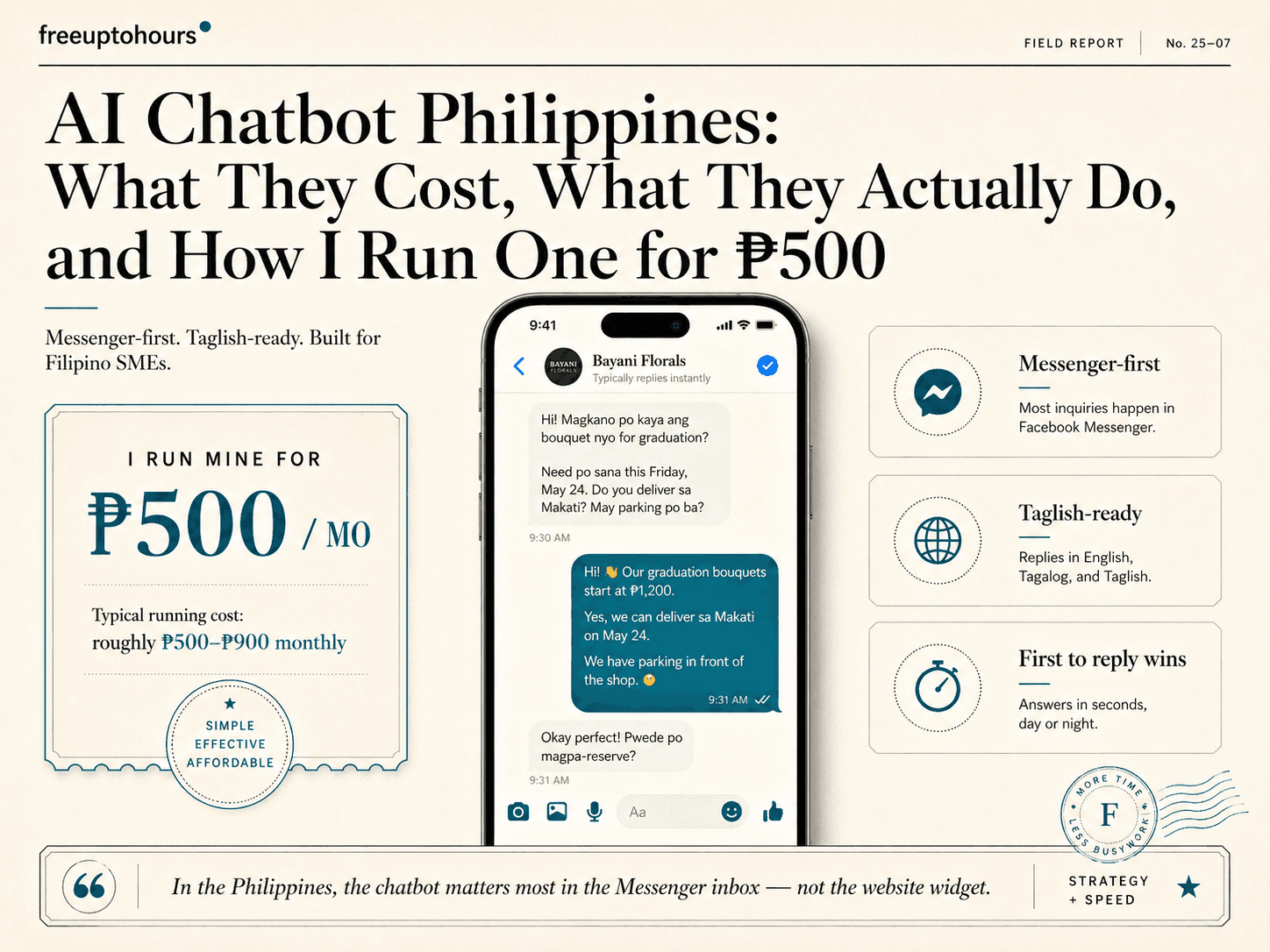
- The channel is Messenger. Most Filipino SMBs get the majority of their inquiries through Facebook and Messenger, not a website live-chat widget and not email. A chatbot that only lives on your website is fishing where there are no fish. The bot has to be on Messenger, and ideally auto-reply to Page comments too — because that is where leads leak most at 11 PM.
- The language is Taglish. Customers do not write in clean English or clean Tagalog. They write "pwede po ba mag-reserve, paano ang payment?" A chatbot that defaults to formal English feels cold and foreign. The model has to mirror Taglish naturally, which modern models do well with one instruction in the system prompt.
- First to reply wins. Filipino customers message three or four businesses at once. If you reply in 4 hours and a competitor replies in 3 seconds, they book the competitor. This is the entire economic argument for a chatbot here: it is not about saving labor, it is about not losing the booking to whoever answered first.
This is why imported chatbot playbooks underperform here, and why a system designed around the Messenger inbox and Taglish outperforms a generic website widget every time.
What Does an AI Chatbot Cost in the Philippines?
This is where most owners are quietly overcharged. There are two paths, and the price gap between them is enormous.
| Approach | Typical monthly cost | What you are paying for |
|---|---|---|
| SaaS platforms (Tidio, Intercom, Crisp, Meta Business AI) | ₱2,500 – ₱40,000+ | A dashboard, per-conversation or per-seat fees, vendor margin |
| Custom-owned build (DeepSeek / Claude + Messenger webhook) | ₱500 – ₱900 | The AI model calls only — no platform fee, no per-conversation charge |
The intelligence — the actual model that reads and answers — costs cents per conversation. Everything above that on the SaaS platforms is interface, seats, and margin. I run a system that handles 20,000 messages a month for around $4 (~₱230) in model fees, where the equivalent on Intercom Fin would run into the tens of thousands of pesos a month. If you are an SMB paying ₱2,500 to ₱40,000 a month for a Messenger chatbot, you are mostly paying for a UI. I broke the full platform-by-platform math down separately — it is the most detailed cost comparison in the linked post below.
Which Philippine Businesses Does an AI Chatbot Actually Work For?
An AI chatbot earns its keep in any business that gets repeated inquiries on Messenger where the first fast, accurate answer wins the customer. In the Philippines, that is a long list:
- Transient houses and short-stay rentals — rates, availability, parking, directions, booking. This is where I started, and where the case is strongest.
- Dental and medical clinics — schedules, services, pricing, appointment setting.
- Spas and salons — bookings, service menus, promos, slot availability.
- Car rental — unit availability, rates, requirements, pickup details.
- Real estate — unit inquiries, viewing schedules, pricing, requirements.
- Restaurants and event venues — reservations, packages, capacity, rates.
The common thread is not the industry — it is the pattern: high volume of repeated questions, on Messenger, where speed decides who gets the sale. If that describes your business, a chatbot is one of the highest-leverage systems you can add. If you get five inquiries a week, fix your website and content first; a chatbot solves a volume problem you do not have yet.
How an AI Chatbot Actually Works (The Honest Build)
Behind the scenes, a real AI chatbot for a Philippine business is four parts working together: a Messenger webhook that receives each message, an AI model that reads it against a document of your business FAQs, a reply sent back through the Messenger Send API, and a Google Sheet that logs every booking and lead automatically. No drag-and-drop builder required — and owning the build is what keeps the cost at model-only pricing.
Two things decide whether the chatbot is reliable or embarrassing. First, the FAQ document: under about 100 well-written entries, it escalates too often and frustrates customers; at 150 to 200 entries drawn from your real message history, it handles full conversations on its own. Second, a hard escalation rule: if the model is not certain from the document, it must say "let me check with our team" rather than guess. A confident wrong answer about a rate or a date does more damage than an honest "I will check." Both of these have their own deep-dive guides linked below.
Build, Buy, or Hire — How to Actually Get One
There are three honest paths. Build it yourself in a tool like Claude Code if you are technical and have a week of evenings — the cash cost is tiny, the time cost is real, and the hardest part is writing 150+ good FAQ entries from your own business knowledge. Buy a SaaS platform if you want to start today and do not mind the compounding monthly bill and the per-conversation pricing trap at volume. Or hire someone who has already shipped this on real Filipino Messenger pages to set it up on the same low-cost, owned foundation and hand it to you running.
Whichever path you pick, the destination is the same: a system that answers in seconds, in Taglish, 24/7, captures every lead, escalates the tricky ones to you, and costs model-fees rather than platform-fees to run. That is what an AI chatbot in the Philippines should be — and what almost nobody selling you one will price honestly.
Update — June 2026: WhatsApp and the AI Receptionist
Two things have moved since I first published this guide, and if you are starting in 2026 they change how you should build. First, Messenger is no longer the only channel — I now run a single bot connected to both Messenger and WhatsApp, so customers without a Facebook account can reach the business too, at the same running cost because both share one backend. Second, the chatbot has grown into a full AI receptionist: using LangGraph and Google Sheets, it holds state across an entire booking, checks availability, takes the order, collects a GCash deposit, and hands off to a human at payment. The advice below still holds — but build for both channels from day one, and design it as a receptionist, not just a question-answerer. Both are covered in the deeper guides linked below.
What Is an AI Chatbot for a Transient House in the Philippines?
The deep dive on the business where the case is strongest — 16 hours a day on Messenger down to 1, with the real before-and-after numbers.
Property Management System Philippines: Run 15 Rooms for ₱2,000/Month
How the same automation approach runs an entire 15-room property — bookings, calendar, and leads — not just the chatbot.
Custom Chatbot vs Intercom, Crisp, Tidio, Drift & Meta — Full Cost Comparison
The platform-by-platform math: why I pay ~$4 for 20,000 messages that would cost tens of thousands of pesos on SaaS.
How to Train a Chatbot on Your Business FAQs
The method that takes a chatbot from frustrating to reliable — including the trick that generates all 200 questions for you.
How to Connect Claude API to Facebook Messenger
The technical build behind the Messenger webhook, model selection, and escalation system — running in production.
How to Handle 100+ Messenger Inquiries Automatically
What the full system looks like at high inquiry volume, day and night.
WhatsApp Chatbot for Business in the Philippines
Running the same bot on WhatsApp as well as Messenger — the second channel and why it matters.
How I Build an AI Receptionist on WhatsApp With Node.js, LangGraph, and Google Sheets
The next step up from a chatbot — a stateful receptionist that takes bookings and payments end to end.
AI Chatbot — Done-for-You Setup
If you would rather have it built and handed to you running, trained on 200+ FAQs from day one.
Frequently asked questions
How much does an AI chatbot cost in the Philippines?
What is the best AI chatbot for a Filipino small business?
Can an AI chatbot reply in Tagalog and Taglish?
Do I need a website for an AI chatbot, or just Facebook?
Which businesses in the Philippines benefit most from an AI chatbot?
Should I build my own AI chatbot or buy a SaaS subscription?
Need this for your business? I build exactly this kind of system for small business owners.
AI Chatbot for Messenger →Want the same system for your business?
I'll set up AI automation for your business — just like I did for mine.