The Backlog Was Never the Messages, It Was the Photos: How I Automate Customer Service for a Small Business in the Philippines
Most people picture a customer-service backlog as unanswered text. Mine was not, or at least not the part that actually hurt. The part that piled up hardest and stung the most was images. Guests sending a photo of their valid ID, a screenshot of a GCash payment, a picture asking "is this the room, is this what I am paying for?" Text you can half-answer with a canned line and get away with it. A photo sits there, unread, and the guest knows it. That was my real breaking point, not some vague sense that I was "too busy to reply."
During busy stretches the inquiries do not trickle in, they flood. And in that flood, images are the ones that get buried first, because they take more attention to open and judge than a one-line text does. So they wait. And a guest holding a booking together with an ID photo and a payment screenshot that nobody has acknowledged is a guest one bad hour away from asking for a refund, or worse, leaving a public comment about it.
That is the actual story behind this post. Not "I was busy so I automated." Specifically: photos were the leak, and fixing that leak is what pushed me to finally build a real system instead of just trying to type faster.
The System I Built
I did not buy a chatbot platform. I built one, in Node.js with LangGraph as the brain, coded inside Claude Code on Opus 4.8. That is the tool I use to write and fix the system itself. The model that runs the conversations in production, the one answering guests every hour of the day, is a different and much cheaper one: DeepSeek V4 Flash. That split matters, because conflating "the AI that builds it" with "the AI that runs it" is where a lot of people overspend.
The real number, not a marketing round figure: about 30,000 messages a month runs me roughly ₱300, call it $6. I have seen quotes for dedicated bot platforms at that same volume land anywhere from $300 to $1,000 a month. That is not a small gap. It is the difference between a rounding error and a part-time salary, for the exact same job.
| Approach | Monthly cost at ~30,000 messages | What you actually get |
|---|---|---|
| Custom stack (Node.js + LangGraph, DeepSeek V4 Flash) | ~₱300 (~$6) | You own it, you can change anything, cost barely moves as volume grows |
| Dedicated bot platforms (Tidio, ManyChat, Intercom-style) | $300 to $1,000 | You rent it, you are boxed into their menu, cost climbs with volume and seats |
What Happens When a Message Comes In
Here is the real sequence a guest goes through right now, not a diagram:
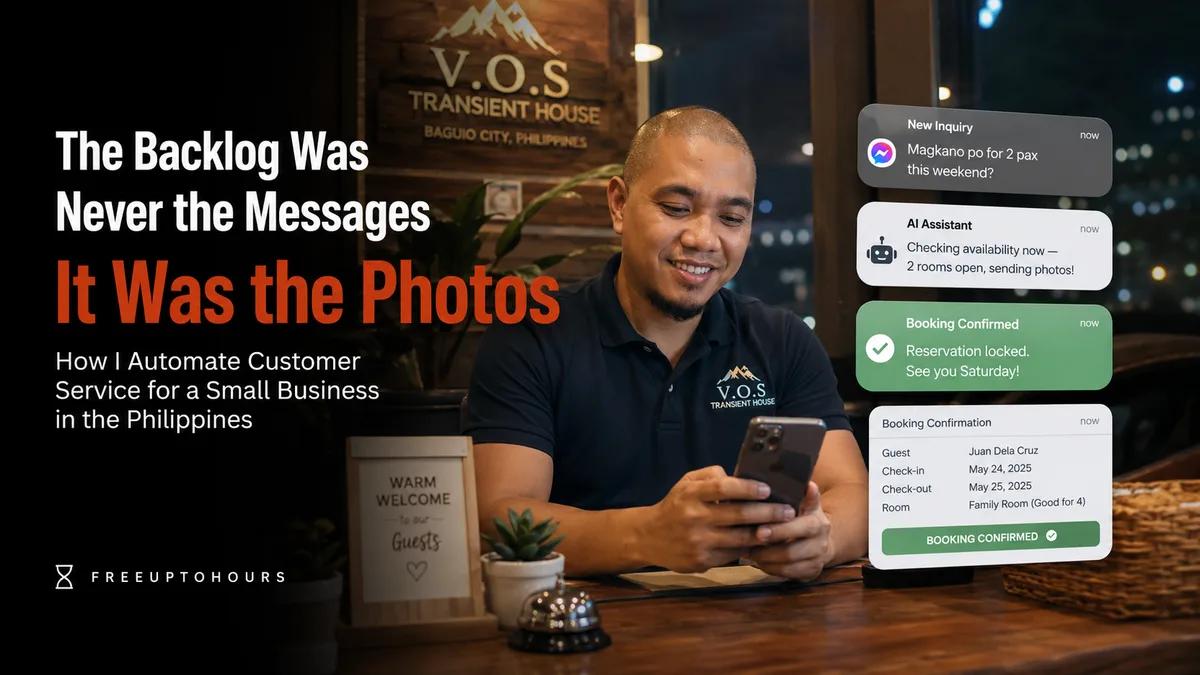
- The bot asks the basics first — how many pax, what package.
- It asks for the date.
- It checks my Google Sheet in real time for what is actually open on that date.
- It recommends the room or package that best fits, based on what is available.
- It sends photos and video of that room so the guest can see exactly what they are booking.
- It sends the reservation details so the guest can lock it in.
On day one, that flow has holes. A lot of them are FAQ gaps — a question I never anticipated, a phrasing I did not train it on. When that happens, it escalates to me, I add the answer, I save it, and the bot gets better. I have been running this version for about two months now, and honestly, I cannot go back to a platform-based bot. After that much steady correction, it stops feeling like a tool and starts feeling like an employee who never forgets what you taught them and never has an off day.
The One Thing It Still Cannot Do
This is the part I will not oversell, and it loops right back to how this whole post started. DeepSeek V4 Flash, the cheap model that runs my chatbot, cannot read images yet. So when a guest sends that same photo that used to pile up unread, the bot cannot look at it either. What it can do is handle that gracefully: it asks the guest to describe what they sent in text instead. "Sorry, hindi ko pa kayang basahin ang photo, pwede mo bang i-type ang tanong mo?" That conditional logic is a workaround, not a fix. A higher-quality vision model could read the photo directly, but it costs meaningfully more, and at my volume that expense is not worth it yet.
I am telling you this instead of hiding it because the whole pitch of this post is honesty over sales. If someone tells you their cheap chatbot reads every photo perfectly at $6 a month, be skeptical. Mine does not, and I would rather you know the real limitation than find out the hard way.
Who Should Not Automate Customer Service Yet
If you are still starting out and your business has few or no inquiries, do not spend your first peso on a chatbot. Fix your marketing first. Get your SEO and blog content working, get your Facebook page actually posting, and run Meta ads with the pixel installed so you can see what is converting. Automation solves a volume problem. If you do not have volume yet, there is nothing for the automation to catch.
The moment this becomes worth it is the moment your inquiries are already a burden — when you are the bottleneck, not the demand. If you have a steady flow of Messenger questions every day and you are the one typing every reply, that is the signal. Before that point, a chatbot is a solution looking for a problem you do not have yet.
Most "AI Experts" Are Just Good Prompt Writers
Here is how I actually run this. DeepSeek V4 Flash for the chatbot backend, because it is cheap and more than good enough for FAQs and bookings. Claude Sonnet 5 for content: blog posts, Facebook posts, anything that represents my brand in writing, where quality shows. Claude Code for building the apps and chatbots themselves, and I am watching Fable 5, Anthropic's newest model, closely as a candidate for that job once it is stable enough for production use. And for images, ChatGPT-family models are still the strongest option I have found. No single model does everything well. The skill is knowing the cost and the quality ceiling of each one, and pointing the right one at the right job.
Two Months In: What Changed
The clearest change is what happens while I sleep. I wake up and bookings are already made, payments already sent, and my job in the morning is to audit and confirm, not to chase. The system runs 24/7 in a way I physically cannot. There is no version of me that hand-chats 30,000 messages a month. That is not a skill issue, it is an hours-in-a-day issue. And at that volume, this still costs me a fraction of what a dedicated platform like Tidio or ManyChat would, while doing more of the work.
The Realistic Path If You Are Not Technical
If you have no coding background and terms like LangGraph or "API" mean nothing to you, the realistic path is not to DIY a no-code bot builder and hope it scales. It is to invest in getting a custom system built, one piece at a time, with someone who can wire the cheap model in directly. That upfront investment is the better long-term bet, because a custom system scales from 30,000 to 100,000 messages a month for maybe another $10, while a platform-based bot scales its price right alongside your growth, straight into ₱20,000 to ₱30,000 ($300 to $400) a month territory. You are not paying more because you are doing better. You are paying more because the platform charges by usage and you have no way around it.
My Advice If You Are Starting Today
If you already have real volume, something close to my own benchmark of around 30,000 messages a month, automate now. You are past the point where doing it by hand makes sense. If you are still starting out, put your money into marketing first: SEO, Facebook content, Meta ads with the pixel installed, so you actually generate the leads worth automating. And before any of that, look at your own business and find the repeatable, boring tasks you do every single day. That list, not a chatbot demo, is where automation should start.
Tourism Crashed and a War Was On. I Rebuilt My Baguio Business With $20 of AI — Now I Am Booked Solid
The full crisis story behind why I trust cheap, custom AI over expensive platforms in the first place.
How to Handle 100+ Messenger Inquiries Automatically (From Someone Who Gets 1,000 a Day)
What this same system looks like at true flood volume, and the exact stack that keeps it from breaking.
Custom AI Chatbot vs Intercom, Crisp, Tidio, Drift, and Meta — I Pay $4 for 20,000 Messages a Month
The full platform-by-platform math behind the cost comparison in this post.
Frequently asked questions
What is the real cost to automate customer service for a small business in the Philippines?
Can an AI chatbot read photos guests send, like IDs or payment screenshots?
Should every small business owner in the Philippines automate customer service?
What does an automated customer service bot actually do end to end?
Is it better to use one AI model for everything or mix models?
What is the realistic path for a non-technical business owner to automate customer service?
Need this for your business? I build exactly this kind of system for small business owners.
AI Lead Automation →Want the same system for your business?
I'll set up AI automation for your business — just like I did for mine.