Custom AI Chatbot vs Intercom, Crisp, Tidio, Drift, and Meta — I Pay $4 for 20,000 Messages a Month
On April 6, 2026, Meta sent me an email that triggered this entire build. "Your free access to Business AI ended April 6, 2026. To resume using your AI agent to respond to all chats, subscribe to a monthly plan." The cheapest monthly plan that covers my actual volume — 20,000 conversations — is $225 a month on web, $265 on Android, $321 on iOS. That is $2,700 to $3,852 a year for the AI replies Meta used to provide for free.
So I built my own. Last month's API bill for the custom chatbot running our Baguio accommodation Messenger pages was $4. Twenty thousand real production messages. Not a load test. Not a sandbox. Actual guests asking about rates, availability, parking, bonfire inclusions, and check-in times, in English, Tagalog, and Taglish, around the clock.
The whole thing came together in Claude Code in a few evenings — DeepSeek V4 Flash for the model layer, a free Render.com instance for hosting, Meta's Messenger Platform (the transport pipes are still free) wired up through a Node.js webhook. The same 20,000 monthly conversations on Intercom's Fin AI agent would cost roughly $19,800 a year at $0.99 per resolution. On Drift Enterprise (now Salesloft) it would clear $30,000. On Tidio's Lyro tier it would still cost more in a single month than my system costs in a full year. And on Meta's own Business AI — the one that pushed me to build this in the first place — it would be 56x to 80x more expensive than what I now pay.
What the System Actually Does (Capabilities I Shipped)
Before the price comparison, here is what is running. I want this concrete so the comparison is fair — I am not comparing a toy script to enterprise SaaS. The features below are live, in production, on Facebook Pages receiving real guest inquiries every day.
- 200 FAQ entries trained on my actual business — rates, inclusions, house rules, directions, deposit instructions, cancellation policy, parking, bonfire, corkage, check-in and check-out edge cases. Built from a year of manual Messenger replies, not invented in a sandbox.
- Real-time booking availability check connected directly to my Google Sheets booking calendar. When a guest asks "available ba December 26 to 28?", the bot reads the live sheet and answers with actual occupancy — not a generic "let me check."
- Auto lead capture into Google Sheets. Every Messenger inquiry — name, PSID, message, timestamp, source — gets logged into a sheet as a row, so I never lose a warm lead and I can see exactly which inquiries turned into bookings.
- Shortcode-triggered media replies with unlimited videos and images of every room. When the bot detects a guest asking to see a specific room or the property, it sends the matching gallery directly inside Messenger. No links, no redirect, no friction.
- Auto-reply to Facebook Page comments. When someone comments on a post — "magkano po?" under a room photo — the system replies on the comment publicly and pushes the conversation into Messenger inbox automatically. This is where most page owners leak the most leads, because nobody monitors comments at 11 PM.
- Two-way AI handoff control with a single command on the thread. I can pause the AI mid-conversation when I want to step in personally, then reactivate it when I am done. The major SaaS platforms can technically do this — Intercom Fin has a "Hand back control to AI assistant" macro, Crisp has a "Run again" button, Tidio Lyro uses online/offline routing rules — but each one takes extra clicks, training, or rule setup. And critically, Facebook Business Suite by itself has no native handback UI at all: getting it requires a developer to wire up Meta's Handover Protocol API. On my custom build the pause-and-resume is one keyword in the thread, no rules engine to configure.
- Language matching: replies in the language the guest used, including Taglish. One line in the system prompt handles English / Tagalog / Taglish without any special configuration.
- Hard escalation rule: if the model is not certain, it tells the guest "let me check with our team" and a notification fires to me. Never a guessed answer about a rate or a date.
- Prompt caching on the 200-FAQ system prompt block — this single optimization is what drops the cost from ~$40/month to ~$4/month at 20k messages, because the FAQ document is cached and reused instead of re-billed on every call.
- Meta webhook with HMAC signature verification, sub-3-second reply latency at any hour, deployed on Render free tier. The full stack costs $0 in hosting.
Total build time in Claude Code: about a week of evenings. Total recurring cost: $4/month for the DeepSeek V4 Flash model, $0 for hosting, $0 for Meta's Messenger Platform, $0 for Google Sheets. The capability surface — comment auto-reply, real-time availability, gallery shortcodes, lead capture, multilingual replies — is what SaaS vendors charge $50–$500/month for, and most of them do not include comment-to-inbox automation at all.
The Honest Cost Math — Why $4 Is Real, Not Marketing
Twenty thousand messages a month means an average of roughly 660 messages a day. Each call sends the cached FAQ system prompt (charged at the cached input rate, which is a fraction of normal input pricing), the last ten messages of conversation, and a 60–200 token reply. On DeepSeek V4 Flash, cached input is essentially free, normal input is about $0.27 per million tokens, and output is about $1.10 per million tokens.
Run that math at 20,000 calls and the bill lands between $3.50 and $4.50 depending on how chatty guests are that month. There is no platform fee, no per-seat license, no per-conversation surcharge. The Render hosting stays inside the free tier. Meta's Messenger Platform itself charges nothing for the messaging API on a Page you own and admin.
Meta's Own Business AI — The Pricing Change That Pushed Me to Build My Own
This is the section I am writing from direct personal experience, because the email I got from Meta on April 6, 2026 is the exact reason this entire chatbot exists. Up until that date, Meta's Business AI was free for Page owners — it would auto-respond to Messenger chats and Instagram DMs at no charge. Then Meta sent the notice: "Your free access to Business AI ended April 6, 2026. Your AI agent can now only respond to chats started from ads that click to message. To resume using your AI agent to respond to all chats, subscribe to a monthly plan."
The new Meta Business AI pricing is tiered by AI conversations per month, and the cost varies by which platform you subscribe through (web is cheapest, iOS is most expensive because of Apple's 30% cut):
| Tier | AI conversations / month | Web | iOS | Android |
|---|---|---|---|---|
| Tier 1 | 500 | $10/mo | $14/mo | $12/mo |
| Tier 2 | 2,000 | $30/mo | $43/mo | $35/mo |
| Tier 3 | 20,000 | $225/mo | $321/mo | $265/mo |
At my volume — 20,000 conversations a month — Meta's own AI now costs $225/month on web, $265/month on Android, or $321/month on iOS. That is $2,700 to $3,852 per year for the exact same workload my custom DeepSeek build handles for $48 a year. And critically, Meta's Business AI is the most restricted of all the options on this list: you cannot bring your own model, you cannot deeply customize the system prompt the way you can with a Claude or DeepSeek build, and you cannot connect arbitrary tools like Google Sheets booking lookup or shortcode-triggered media replies. You are paying $225/month for less capability than my $4/month system delivers.
The underlying Messenger Platform API itself — the transport layer at developers.facebook.com/docs — is still free for sending and receiving messages on a Page you own. That is what my custom build uses. The "free Messenger Platform" headline is technically true: the pipes are free. The brain is what now costs $225–$321/month if you let Meta provide it. The whole point of this post is that the brain costs $4/month if you build it yourself or hire someone who has.
Tidio with Lyro AI — The Real Cost Is Much Higher Than the Headline
Tidio is the most common starting point for Filipino SMBs because the free tier looks generous. The reality is that Lyro (the AI agent) is a separate paid add-on layered on top of a Tidio base plan, and the conversation caps are low. Lyro starts at $39/month for 50 AI conversations. Realistic small-business volume (500–1,000 chats) lands in the $79–$149/month Lyro tier, on top of a Tidio base plan: Starter ($29), Growth ($59), or — and this is the catch — Plus at $749/month, with nothing in between.
At 20,000 conversations a month, the Tidio plan stack does not cover you on Growth — you are pushed to Plus ($749/month) or quoted custom Premium pricing that third parties peg around $2,999/month. Annualized at Plus with sufficient Lyro AI capacity: roughly $9,000–$12,000 a year. Most owners do not realize this until they outgrow Growth and discover there is no middle tier. The honest comparison vs. my $48/year is somewhere between 188x and 250x more expensive.
Crisp with the AI Add-On — €295/month for Unlimited AI
Crisp's current public plans are Free, Mini (€45/mo), Essentials (€95/mo), and Plus (€295/mo). AI is heavily rationed on Essentials (only 50 AI uses per month — useless at SMB Messenger volume). Unlimited AI-powered resolutions only unlock on the Plus tier at €295/month, which is roughly $320 USD at current rates.
Annualized for the tier that actually handles 20,000 Messenger conversations with AI: roughly $3,840 a year. That is 80x what my custom build costs. Crisp is a solid product — the multi-channel inbox is genuinely good — but you are paying enterprise prices for SMB-scale inquiry handling. The earlier draft of this post quoted Crisp at $1,140/year, which was wrong: that number was based on an older Pro tier that no longer exists in their public pricing.
Drift (Salesloft) — Being Sunset on March 6, 2026
Important update I want to flag honestly: Clari and Salesloft publicly announced that Drift will be sunset on March 6, 2026. As of this post being written, Drift is being wound down — existing contracts continue but no new growth investment is going into the product. I am leaving Drift in the comparison only for historical reference. If you were on a Drift contract, you are now on a migrating product.
For the historical record: Drift Premium started at $2,500/month billed annually ($30,000/year) for the small-business tier. Advanced ran $4,000–$6,000/month, Enterprise $6,000–$10,000+/month. Drift was never really competing for SMB Messenger automation — they were competing for enterprise demo booking on B2B websites. The 20,000 conversations my $4 system handles would have cost 625x to 2,500x more on Drift Premium. The sunset announcement is a separate reason to avoid this stack entirely going forward.
Intercom + Fin AI — The Per-Resolution Trap That Hits at Volume
Intercom is the most interesting comparison because Fin AI is genuinely good — it is one of the few enterprise AI agents that consistently resolves issues without escalation. But the pricing model is dangerous at SMB volume.
Fin charges $0.99 per resolution, with a 50-resolution monthly minimum. On top of that, if you use Fin inside Intercom's own helpdesk you need at least one paid Intercom seat starting at $29/seat/month — so roughly $348/year per seat before Fin fires a single time. A resolution is roughly "Fin answered and the conversation ended without escalation to a human." Customers explicitly asking for a human do not count as billable resolutions.
Now stack Fin on top of 20,000 monthly conversations. Even if only half of those count as resolutions, that is 10,000 × $0.99 × 12 = roughly $118,800 a year in Fin charges alone. Take a more conservative 5,000 resolutions/month: $59,400/year. Being extremely generous and saying only 1,667 resolutions/month qualify, you are still at roughly $19,800/year just for Fin, plus the seat fee.
My total cost for the same workload: $48 a year. Intercom Fin would cost roughly 412x more at the conservative estimate and over 2,400x more at the realistic one. The per-resolution model is fine if you have ten conversations a day. It is a financial trap if you have hundreds.
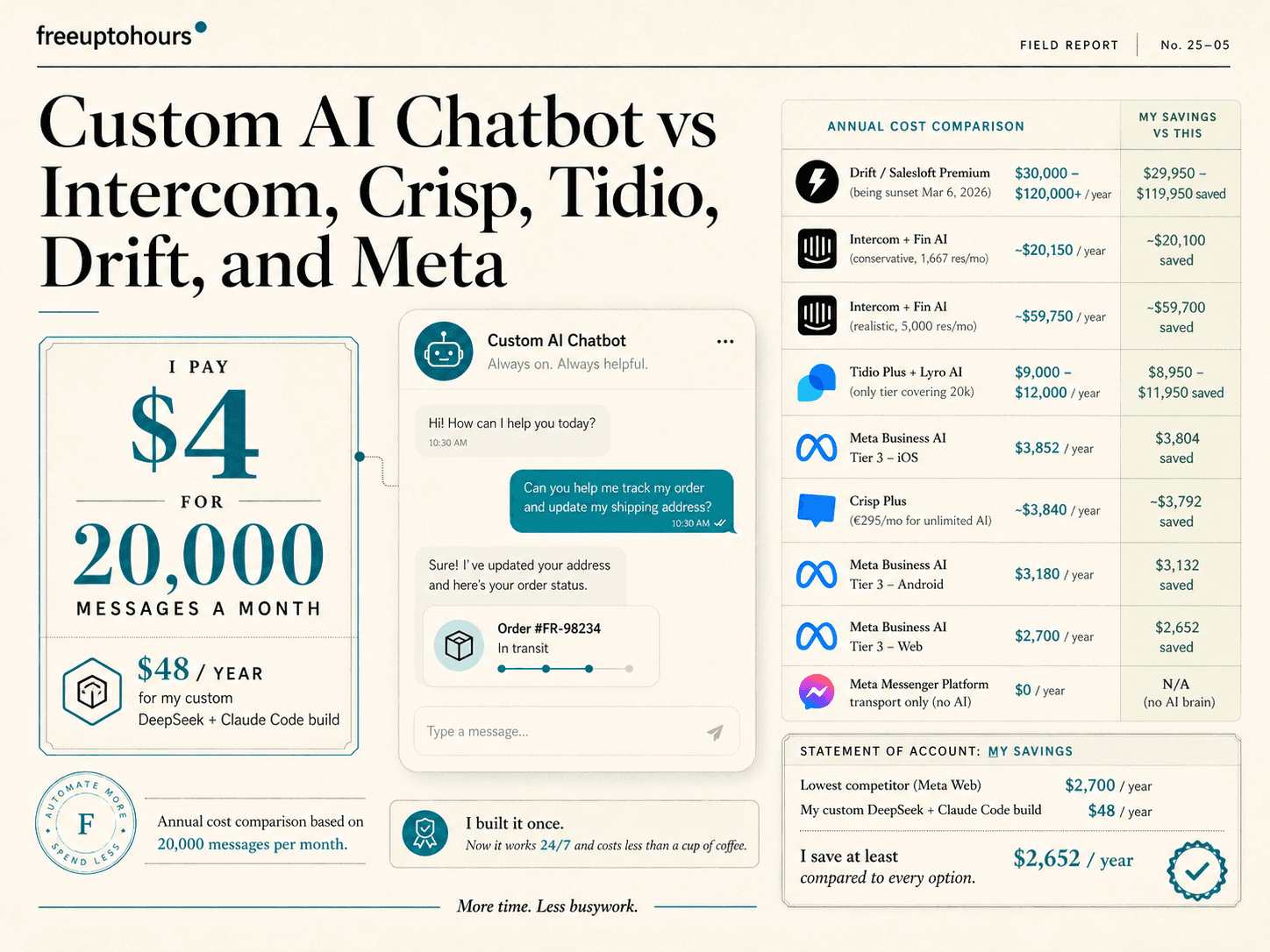
The 1-Year Cost Cut for an SMB Doing 20k Messages a Month
| Stack | 1-year cost | My savings vs this |
|---|---|---|
| Drift / Salesloft Premium (being sunset March 6, 2026) | $30,000 – $120,000+ | $29,950 – $119,950 |
| Intercom + Fin AI (conservative, 1,667 res/mo) | ~$19,800 + ~$348 seat = ~$20,150 | ~$20,100 |
| Intercom + Fin AI (realistic, 5,000 res/mo) | ~$59,400 + ~$348 seat = ~$59,750 | ~$59,700 |
| Tidio Plus + Lyro AI (only tier covering 20k) | $9,000 – $12,000 | $8,950 – $11,950 |
| Meta Business AI Tier 3 — iOS subscription | $3,852 | $3,804 |
| Crisp Plus (€295/mo for unlimited AI) | ~$3,840 | ~$3,792 |
| Meta Business AI Tier 3 — Android subscription | $3,180 | $3,132 |
| Meta Business AI Tier 3 — Web subscription | $2,700 | $2,652 |
| Meta Messenger Platform transport only (no AI) | $0 (you build the AI) | N/A — equivalent only if you build the brain |
| My custom DeepSeek + Claude Code build | $48 | — |
The pattern is consistent: the further you go up the SaaS pricing ladder, the more you pay for UI, dashboards, and seat licenses — not for intelligence. The intelligence itself, at 20,000 conversations a month, costs $4. Everything beyond that is the vendor's margin and their sales team's commission.
My Honest Opinion — When SaaS Still Wins
I am not against SaaS. If you are a 50-person team running 12 brands across 4 channels with strict compliance needs and a dedicated CX team, Intercom's dashboards and audit logs probably justify the price. If you need Stripe-grade reliability with someone on the other end of a contract, the SaaS layer earns its fee.
But if you are a single Baguio transient house owner, a dental clinic, a small clothing brand, or a coach — and you mostly need a chatbot that answers FAQs on Messenger and escalates the tricky ones to you — paying $50–$500/month for that is buying a Ferrari to drive five blocks. The same capability runs for $4 a month on a stack you own.
The Owner Question — Build, Buy, or Hire Someone Who Already Has
There are three honest options. Build it yourself in Claude Code: free in cash, but real in time — expect a week of evenings if you are technical, longer if you are learning. Buy SaaS: fast to start, slow to escape, and the per-month bill compounds. Or hire someone who has already shipped this stack on real Filipino SMB Messenger pages and is willing to set it up for you on the same DeepSeek + Render foundation.
My pitch for that third option is simple: I run this exact system on my own Baguio accommodation Messenger pages, every day. The chatbot you are reading about answered an inquiry while you were reading this paragraph. I am not selling you software I demo in a sandbox. I am selling you the system I trust on my own income.
Related Reading From This Build
AI Chatbot Philippines: Costs, What They Do & How I Run One for ₱500/Month
The complete overview of AI chatbots for Filipino businesses — costs, the Messenger-first reality, and which industries they fit.
How to Connect Claude API to Facebook Messenger — Built and Running in Production
The technical walkthrough of the webhook architecture this chatbot runs on — verification, conversation memory, model selection.
How to Train a Chatbot on Your Business FAQs — The Method That Actually Works
How I built the 200+ FAQ document that powers the $4/month system — including the Claude trick that generates the questions for you.
AI Chatbot for Messenger — Done-for-You Setup
If you would rather have this built and handed to you than spend the week of evenings — what is included and how to start.
The Bottom Line
A custom Facebook Messenger chatbot in 2026 is not a science project. The model layer costs cents. The hosting fits inside a free tier. The Meta Messenger API is free on your own Page. The only real cost is the time and judgment it takes to assemble the pieces and write the FAQ document well.
If you are paying Tidio, Crisp, Drift, or Intercom $50 to $500 a month to handle Messenger inquiries that fit on one page of FAQs, the math says you are leaking money. The 1-year cut is between $660 and $19,750 depending on which platform you are on today. Reinvest that into ads, content, or another property — not a vendor dashboard you log into twice a year.
Frequently asked questions
Is $4 a month for 20,000 chatbot messages really achievable?
How does the custom build compare to Intercom Fin at 20,000 conversations per month?
Is Meta's Messenger Platform actually free?
Why did Meta start charging for Business AI in 2026?
When does paying for Tidio, Crisp, or Intercom actually make sense?
Can I build this myself in Claude Code, or do I need to hire someone?
What happens if DeepSeek pricing changes or the model is deprecated?
Can I take over a conversation manually and then hand it back to the AI?
Need this for your business? I build exactly this kind of system for small business owners.
AI Chatbot for Messenger →Want the same system for your business?
I'll set up AI automation for your business — just like I did for mine.