The Salon That Stopped Losing Bookings at 11 PM: An AI Booking Chatbot and Facebook Lead Automation for Salons, Spas, and Local Businesses in the Philippines
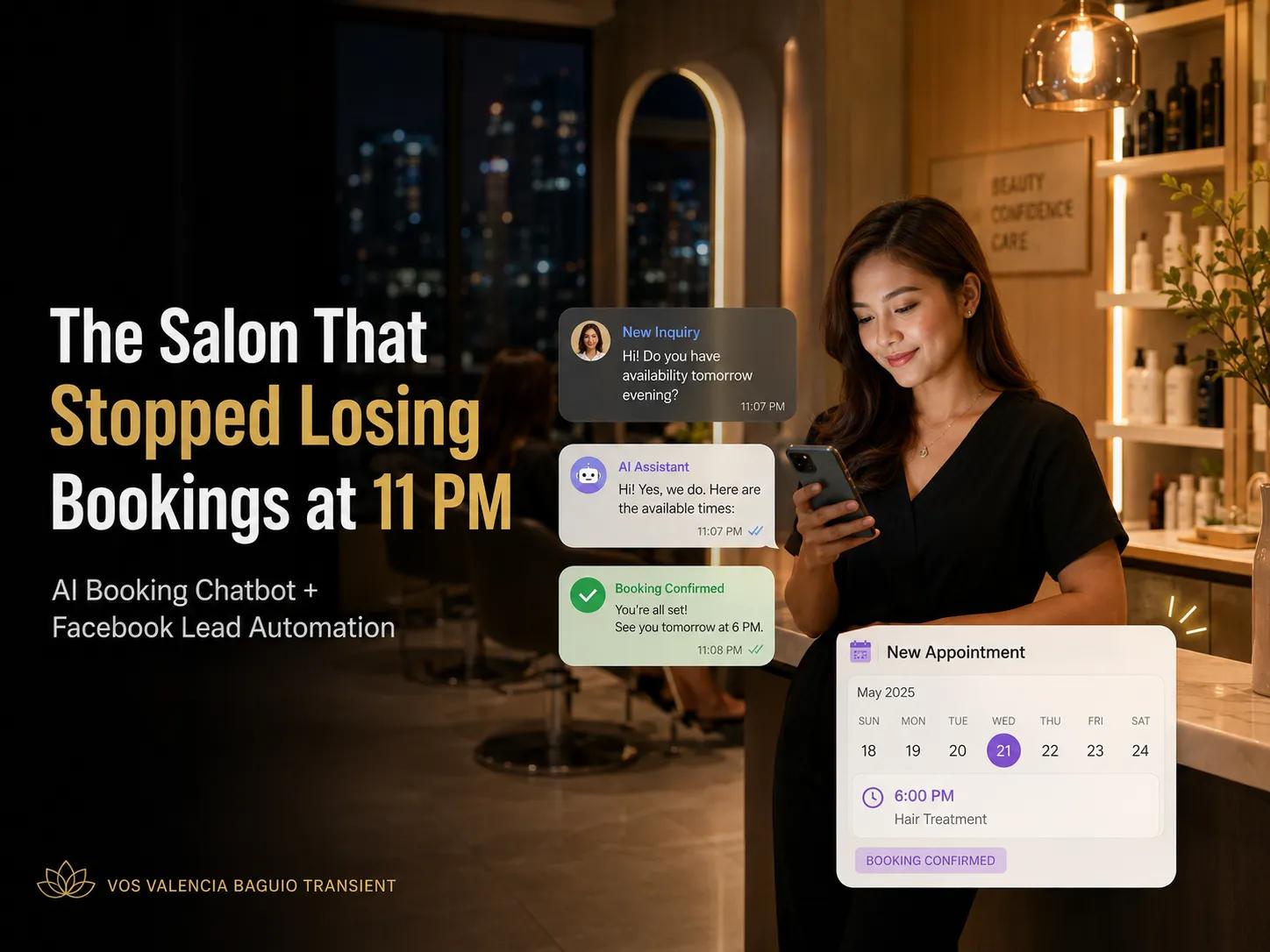
It is 11 PM on a Tuesday. A woman whose sister just got engaged is lying in bed scrolling Facebook, and she messages a salon she found: "Hi, available pa kayo this Saturday for hair and makeup? Pang-wedding po ng kapatid ko." She is ready to book. She has the budget. She just needs a yes.
The owner is asleep. The page replies at 11 AM the next morning. By then she has messaged three other salons, and one of them answered in ten seconds, sent a price list, and locked her Saturday slot. That salon did not have better stylists. It just answered first.
I have watched this exact thing happen to good salons and spas all over the Philippines, including here in Baguio where I am based. The work is genuinely excellent. The haircuts, the massages, the nails, all of it. But the booking happens on Messenger at odd hours, and Messenger does not wait for your office hours.
This post is about closing that one gap. Because once you close it, a surprising number of the other things you have been quietly struggling with start fixing themselves.
The Problem Was Never the Haircut
Ask most salon and spa owners why they are not fully booked and they will blame the competition, or the prices, or the slow season. Then I look at their Messenger inbox and the real story is sitting right there, unread.
- Messages that came in at 9 PM, 11 PM, 2 AM, all answered the next afternoon, long after the customer has already booked somewhere else.
- A paper notebook or a single staff group chat for the schedule, which is how two stylists end up promising the same 3 PM chair to two different clients.
- One receptionist, or the owner herself, trying to reply to fifty messages while also doing a client's hair, so half the messages get a one-word answer and the other half get nothing.
- Comments on a boosted post that just say "how much?" and never get a reply, which is paid reach quietly turning into nothing.
And underneath all of it sits the quieter problem: the page barely brings in new people to begin with. The online presence looks alive, but it does not actually produce leads. It is a digital tarpaulin, not a front desk.
What Happens When You Reply in Ten Seconds, Every Time
Here is what changed for the businesses I set this up for. The first thing is boring and obvious: every message gets answered instantly, any hour, in a warm voice that sounds like the salon and not like a robot. No more lunchtime backlog. No more "sorry po, just saw this."
The second thing is not obvious until you watch it happen. When a page answers instantly and confidently, people book on the spot, while they are still excited. The calendar starts filling from the slots that used to leak away overnight. A couple of the owners I work with went from chasing bookings to running a weekend waitlist, and started asking me how to handle the overflow. That is a very good problem to have.
The third thing is the one owners get emotional about. The leads finally show up. The same Facebook page that felt dead now turns comments and ad clicks into real names in the calendar. The business did not change. Nothing falls through the cracks anymore, that is all.
What the AI Agent Actually Does at the Front Desk
When people hear "AI chatbot" they picture an annoying widget that answers one question and then says "let me connect you to an agent." This is not that. The agent I build runs the whole front desk:
- It answers the real questions instantly. Magkano ang rebond, gaano katagal ang service, saan kayo, may parking ba, anong oras kayo bukas. The repetitive questions that eat your entire day.
- It books the appointment into your actual calendar. It shows real open slots, confirms the date and time, and writes it down, so two clients never get handed the same chair.
- It captures and qualifies the lead before any handoff. Name, number, what service, preferred day. So even when a human needs to step in, they step into a warm, half-finished booking instead of a cold "hi po."
- It sends the reminder the day before. This is the cheapest way in existence to cut no-shows. A spa losing two no-shows a day is bleeding real money, and a simple reminder recovers most of them.
Where the Leads Come From: the Facebook Part Most People Skip
A chatbot with nobody to talk to is useless, so half the job is feeding it. On Facebook there are four doors, and I wire the agent to sit behind all of them.
- Messenger auto-reply. Every DM gets answered in seconds, around the clock, even at 2 AM while you sleep.
- Comment-to-DM. Someone comments "how much?" on your post or boosted ad, and the agent automatically slides into their messages and starts the booking. This one alone rescues a shocking amount of wasted ad spend.
- Click-to-Messenger ads. You run an ad, the click opens Messenger, and the agent carries the conversation from hello to booked without you touching the phone.
- Facebook lead ads. The lead form feeds straight into instant follow-up, so nobody fills out a form and then waits three days to hear back.
Put together, that is what "Facebook lead automation" actually means for a local business. Not a vague funnel diagram. A specific machine that catches a person at the exact second they raise their hand, and does not let go until they are booked.
"But What If the AI Double-Books Me or Says Something Wrong?"
This is the real fear, and it is a fair one. Nobody wants a bot promising a 50% discount you never offered, or booking two brides into the same Saturday. It is worth being precise here, because this is exactly where the cheap, generic bots fall apart.
I do not build these on a drag-and-drop template that guesses. I build them as custom agents in Node.js and LangGraph, mostly inside Claude Code, which lets me put hard rules around what the agent is allowed to do. It does not invent prices; it reads your real price list. It does not invent open slots; it checks the real calendar before it confirms anything. If a request is unusual or high value, like a full bridal package, it is built to collect the details and hand off to a human instead of winging it.
The line between a toy chatbot and a booking agent you can trust is right here. A generic bot will happily make something up to sound helpful. A properly built agent knows what it does not know. That is the part most people skip, and it is the part that matters most.
Why a Small Salon Can Now Out-Reply a Big Chain
Here is the part I find genuinely exciting. For years the big, well-funded salons won on speed. They could afford the staff to answer messages fast and the budget to stay visible. A small independent spa could not compete on response time, so it lost the customer who just wanted a quick yes.
That gap is gone. A one-chair salon in Baguio with a properly built AI agent now answers faster than a chain with a call center, because the agent never sleeps, never takes a break, and never gets buried under fifty messages at once. The playing field leveled, and it leveled in favor of whoever sets it up first.
I am not theorizing. I rebuilt my own Baguio business on roughly twenty dollars of AI and went from quiet to booked solid, and the same engine that did that for me is what I now build for other local businesses. Small does not mean slow anymore. It just means you actually have to do this.
It Pays for Itself Faster Than You Expect
Owners brace for this part, expecting an agency-sized retainer. The honest version is simpler: it pays for itself fast, usually out of bookings you were already losing.
Count it in the unit you actually feel. One recovered booking a week that would have ghosted you overnight. One spa client a day who no longer no-shows because a reminder reached them. A weekend that fills because the agent answered the 11 PM bride before your competitor even woke up. Stack a month of those back together and the system has paid for itself several times over, and it keeps working while you sleep.
Now compare that to the alternative, which is hiring another person just to sit on Messenger. The agent costs less than that person, works all night, and never calls in sick. That math is not close.
This Is Not Only for Salons
I am using salons and spas as the example because the booking pain is so vivid there. But everything above applies to almost any local business in the Philippines that takes bookings or inquiries on Facebook. Dental and derma clinics. Gyms and studios. Transient houses and resorts. Car rentals. Aesthetic and wellness centers. If your customers find you on Facebook and message you to book, you have the same leak, and the same fix is sitting right there.
The businesses pulling ahead right now are not the ones with the fanciest service. They are the ones who answer first and never drop a lead. That is a choice you can make this month.
I Rebuilt My Baguio Business With $20 of AI, Now I Am Booked Solid
The case study this whole post stands on. How twenty dollars of AI took my own Baguio business from quiet to fully booked.
Facebook Leads Chatbot vs Airbnb and Agoda: Why Direct Booking Wins
The deeper look at why a Facebook-fed chatbot beats renting your customers from a booking platform.
How to Handle 100 Messenger Inquiries Automatically in the Philippines
For the owner whose inbox is already drowning. How the agent answers everyone at once without dropping a single lead.
Frequently asked questions
What does an AI booking chatbot do for a salon or spa in the Philippines?
How does Facebook lead automation work for a local business?
Will the AI chatbot double-book clients or give wrong prices?
Is an AI booking agent affordable for a small salon or spa?
Does this only work for salons and spas?
Need this for your business? I build exactly this kind of system for small business owners.
AI Chatbot for Messenger →Want the same system for your business?
I'll set up AI automation for your business — just like I did for mine.