Why I Don't List on Airbnb, Agoda, or Booking.com — and I'm Still Fully Booked in Rainy Season
Every accommodation owner in the Philippines hears the same advice: list on Airbnb, Agoda, and Booking.com, or you might as well not exist. I have run a Baguio property since 2020 and welcomed more than 10,000 guests, and I do the exact opposite. I am not on any of the big listing sites. I never have been. And through Baguio's rainy season — the months I am supposed to be hurting — I stay fully booked.
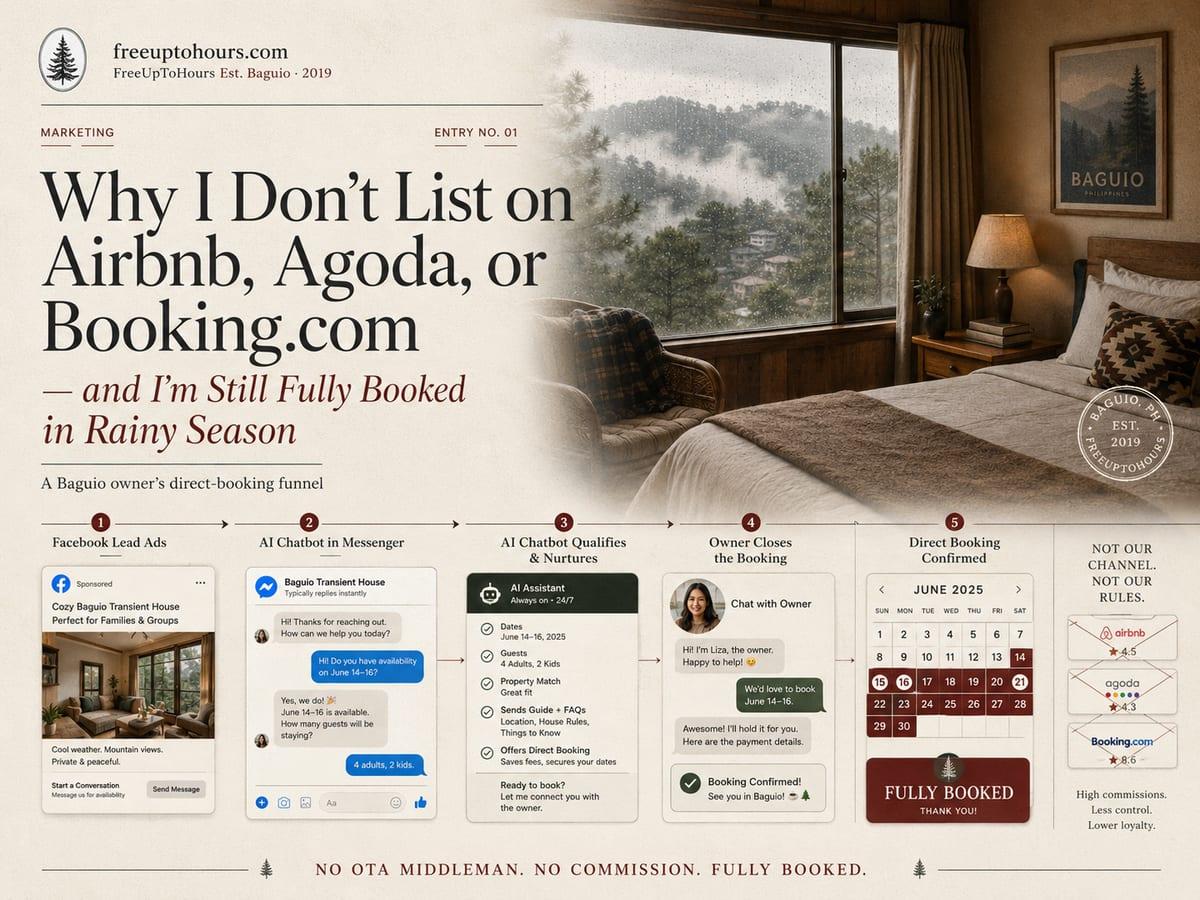
My funnel is simple to describe and, for most owners, terrifying to trust: a Facebook lead ad drops the person straight into Messenger, my AI chatbot answers in seconds in Taglish, and then a human — me or my wife — closes the deal. That is the whole machine. No OTA in the middle, no commission, no being one of forty identical listings sorted by price. This is the honest reasoning behind why I built it that way, and why it keeps working when the weather and the market are both against me.
The Funnel I Actually Use — Ad to Messenger to Chatbot to Human
Before the why, here is exactly what happens when someone in Manila decides they want to go to Baguio and sees my ad. There are four steps, and every one of them is designed to keep the booking close to me instead of handing it to a platform.
- A Facebook lead ad catches them at the moment of intent — scrolling, dreaming about a trip, seeing a clean room and a real price. The ad's only job is to start a conversation, not to send them to a listing.
- They tap through straight into Messenger. No landing page detour, no app download, no account creation. They are now in a one-to-one chat with my business — the most personal channel on the internet for a Filipino customer.
- My AI chatbot replies in seconds, 24/7, in English, Tagalog, and Taglish. It answers the repetitive questions — rates, location, what is included, is the date open — instantly, at 2 PM or 2 AM, so no inquiry ever goes cold waiting for me to wake up.
- A human closes the deal. Once the lead is warm and the easy questions are answered, me or my wife step in to handle the real conversation — the special requests, the reassurance, the final yes. People do not send a deposit to a logo. They send it to a person who answered them well.
That sequence is the entire business. The ad buys attention, Messenger owns the relationship, the chatbot wins on speed, and the human wins on trust. An OTA listing breaks every link in that chain — which is exactly why I do not use one.
Why I Send Leads to Messenger Instead of a Listing or a Booking Link
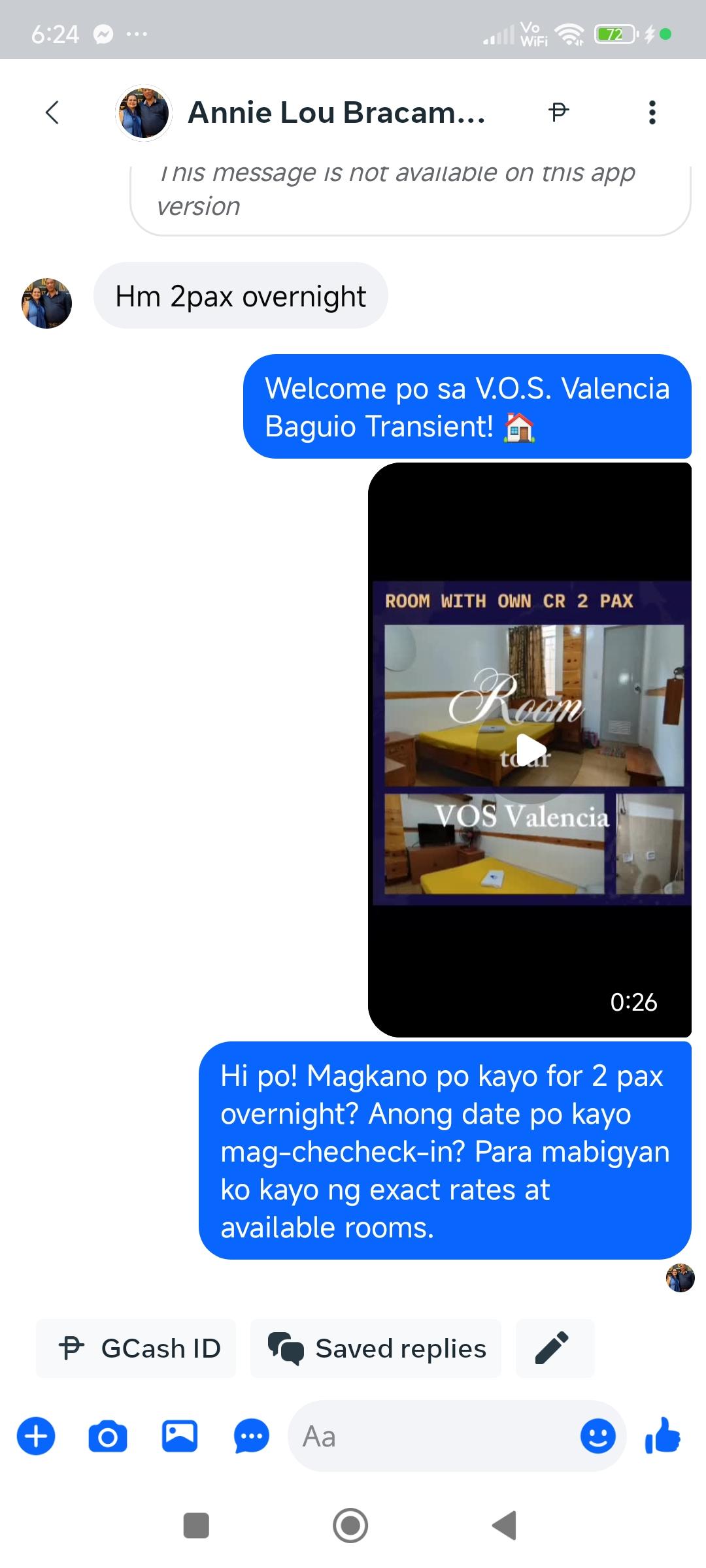
The first instinct of most owners is to send ad traffic to their Airbnb listing or a booking link. I send it to Messenger on purpose, and the reason is speed-to-reply. In the Philippines, accommodation lives and dies on who answers first. The guest messaging you at 11 PM is messaging three other places too, and the booking goes to whoever replies fast, clearly, and like a human being. A listing page cannot do that. It just sits there.
Messenger also gives me something a listing never will: the conversation itself. I keep the contact. I can follow up. I can answer the one worried question that turns a maybe into a yes. When a guest books through an OTA, the platform sits between us and guards that relationship like it is theirs — because to them, it is. In Messenger, the guest is mine, the chat history is mine, and the next booking comes straight back to me with no commission attached.
Why I Refuse to List on Agoda, Airbnb, and Booking.com
I want to be precise here, because "OTAs are bad" is lazy and untrue. They are powerful tools that work for plenty of people. They are simply the wrong trade for the business I want to run. Here are the three reasons I will not make that trade.
1. The 15–20% Commission Is Rent on Money You Already Earned
The big OTAs typically take somewhere between 15% and 20% of every booking. Think about what that actually is: it is a fee charged on a guest who, in many cases, would have found and trusted me anyway. On a single peak-season month, that commission can equal the entire cost of running my Facebook ads for a quarter. I would rather spend a fraction of that money acquiring a lead I own forever than hand a fifth of every night to a platform that rents me back my own customers. A Facebook lead costs me less than the commission a single OTA booking would have taken — and that lead stays mine for every future booking.
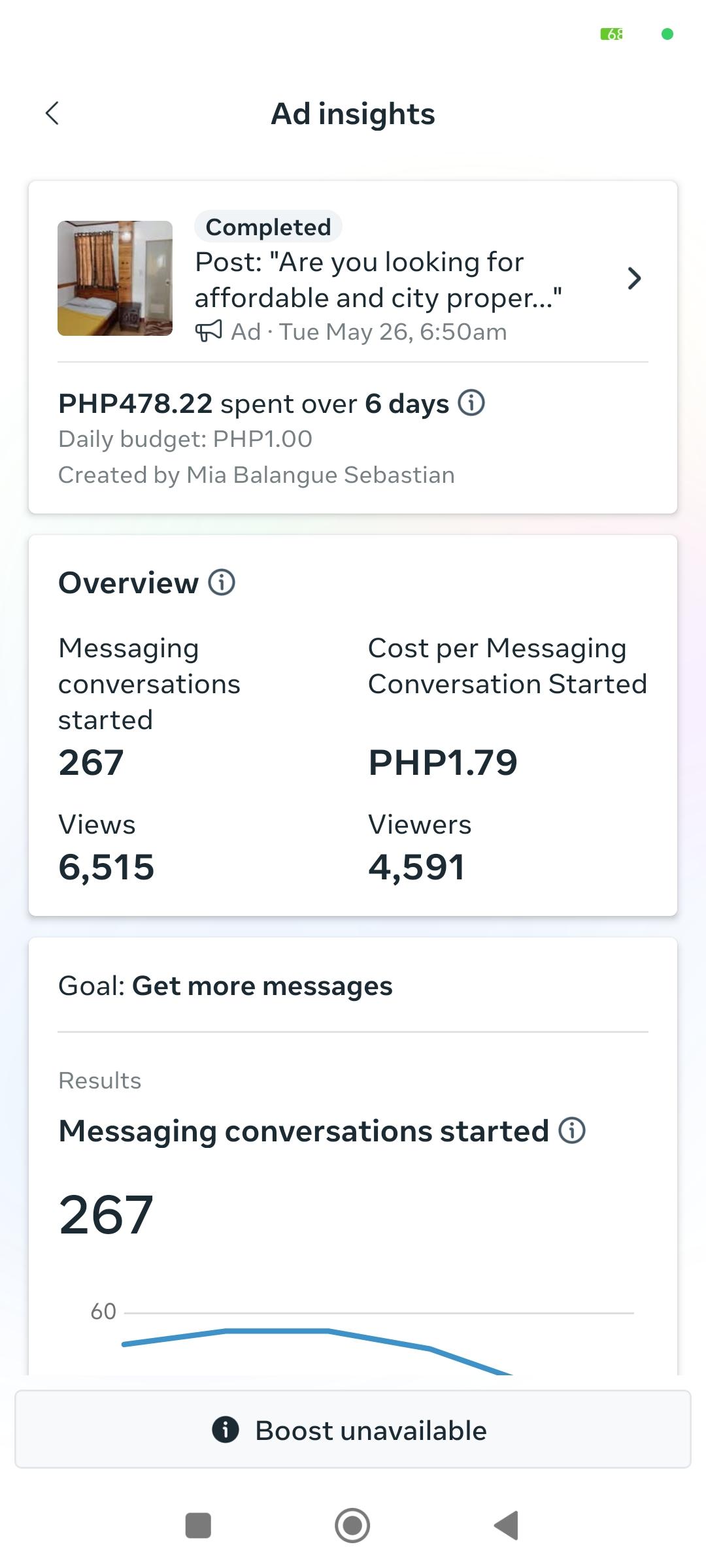
I am not asking you to take that on faith — here are the real numbers from one of my ads. I spent PHP 478.22 over six days and it started 267 Messenger conversations. That works out to PHP 1.79 per conversation, from 6,515 views and 4,591 viewers. Sit with that math: a single OTA commission on one peak-season booking can be more than I spent to start all 267 of those conversations. Every one of those is a guest who came straight into my Messenger — mine to answer, mine to close, mine to rebook for free.
2. OTAs Are a Race to the Bottom on Price
On a listing site, you are one of dozens of near-identical rooms in a grid, and the grid sorts on price. That structure quietly forces everyone downward — drop the rate to rank, then drop it again when the next owner undercuts you. You stop competing on what makes you good and start competing on who is willing to earn the least. I refuse to enter that race. Off the platform, I compete on trust, speed, and a real human relationship — things a price-sorted grid cannot show and cannot reward.
3. They Erase the Relationship That Is My Whole Advantage
My single biggest edge is that I am a real owner who answers personally and remembers my repeat guests. OTAs strip exactly that away. They standardize you into a listing, hide the guest's contact details, and discourage direct rebooking, because the relationship is the asset they are selling. When my advantage is being human and reachable, signing up for a system designed to erase that is self-sabotage. I would be paying 15–20% for the privilege of becoming a faceless commodity.
| What matters | My funnel (FB → Messenger → chatbot → human) | Airbnb / Agoda / Booking.com |
|---|---|---|
| Cost per booking | Ad cost only — no per-booking cut | 15–20% commission on every booking |
| Who owns the guest | I do — contact, chat history, follow-up | The platform — contact often hidden |
| How I compete | Trust, speed, personal service | Mostly price, in a sorted grid |
| Speed to reply | Seconds, 24/7, in Taglish | Limited by platform messaging + your hours |
| Repeat bookings | Come straight back to me, free | Often routed back through commission |
| Brand & relationship | Mine to build | Standardized into a listing |
The Scammer Problem — and Why Guests Still Trust Me
Here is the honest objection to my whole approach: Facebook is now full of accommodation scammers. Fake pages, stolen photos, "send the full deposit to this GCash" and then they vanish. If I am asking guests to book through a Facebook page and Messenger instead of a "safe" platform like Booking.com, why does anyone trust me? It is a fair question, and the answer is the entire point. I out-signal the scammers on the things they can never fake.
- A real, verifiable address on Google Maps. My property is at a specific street address with a real map pin, reviews, and Street View. Scammers never give a checkable address, because they do not have one. Asking "what is the exact address?" filters them out instantly — and I answer it openly.
- I rank #1 on Google with deep, original content. A scam page cannot build authority. It cannot write dozens of genuinely useful guides, rank for the searches real travelers type, and show up consistently for months. When a guest finds me at the top of Google and reads content only a real owner could write, that is a trust signal no fake page can manufacture.
- A real track record — since 2020, 10,000+ guests, real reviews. Scammers have no history. I have years of it, with repeat guests and reviews a stranger can read. A first-time guest is borrowing the confidence of the thousands who came before them.
- A human owner who answers personally. Me or my wife will get on a call, send a voice message, answer the oddly specific question only a real owner could answer. Scammers avoid real human contact because it exposes them. I lean into it, because it is exactly what closes the booking.
So the scammers are not a reason to hide behind an OTA. They are the reason my authentic, verifiable presence converts so well. In a sea of fakes, being demonstrably real is the strongest sales tool I have.
Why I Build Authority Content (SEO + GEO) Instead of Renting a Listing Spot
The other half of this strategy is content. Instead of paying to appear in someone else's listing grid, I build my own authority on my own site and Facebook — guides, answers, real local knowledge — optimized for both classic Google SEO and the newer GEO, generative engine optimization, so that AI search tools like ChatGPT, Perplexity, and Google's AI Overviews recommend me too. The difference is ownership. An OTA listing is rented visibility that disappears the day you stop paying or the day they change their algorithm. An authority site is an asset I own that compounds every month.
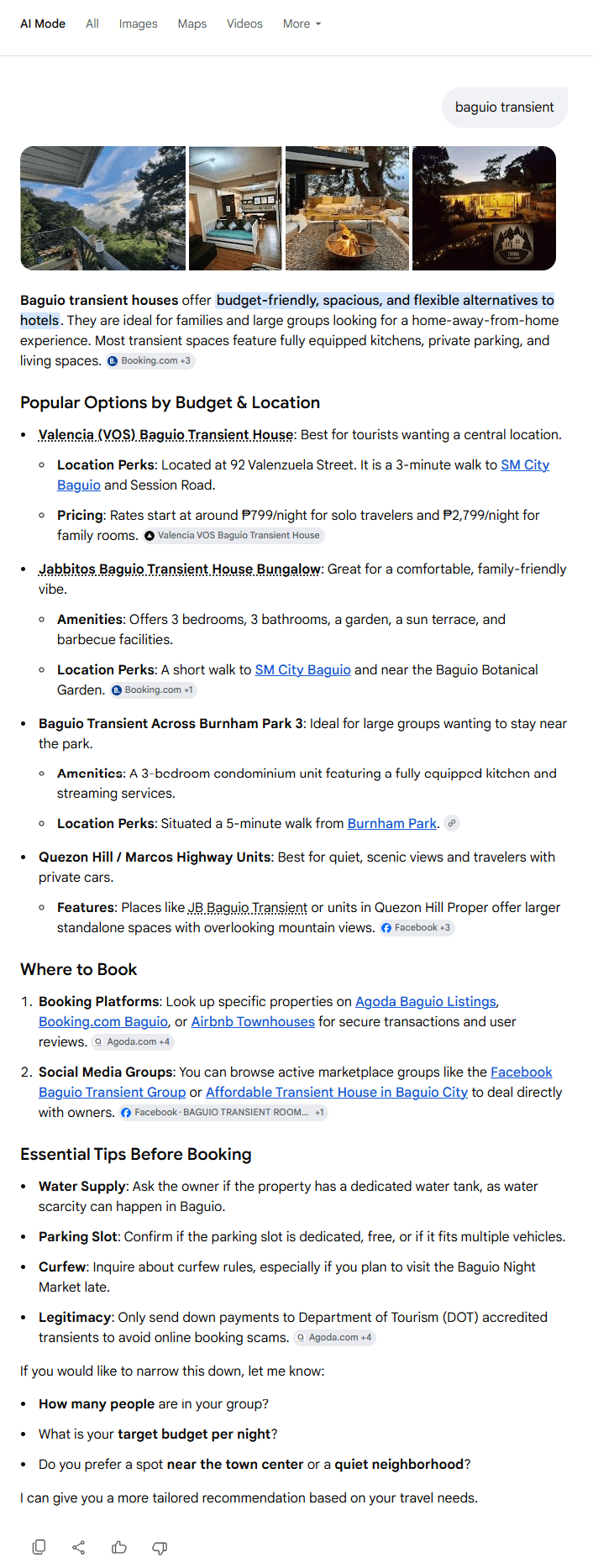
This matters more every year, because search is splitting in two. Some travelers still type into Google; a fast-growing number now ask an AI assistant "where should I stay in Baguio near SM?" and trust the answer it gives. If your only presence is a listing inside Agoda, you are invisible to that second group — the AI is not going to surface your buried listing. But if you have built genuinely helpful, well-structured content under your own name, you can be the answer the AI hands back. I optimized to be that answer. Renting a slot on a listing site can never get you there.
Why This Still Works in Rainy Season — the Proof
Here is the part that makes owners stop arguing: through Baguio's rainy season, when tourism goes soft, I stay fully booked — weeks at a time. Rainy season is when I am supposed to discount on the OTAs and fight for scraps in the price grid. Instead, my system keeps selling because it does not depend on the season — it depends on catching intent, replying faster than anyone else, and being trusted enough to close.
When demand drops, every inquiry matters more because there are fewer of them. That is exactly when speed-to-reply and trust win the most, and exactly when a 15–20% commission hurts the most. My funnel is built for the hard months, not just the easy ones. The weather did not improve. The market did not improve. My machine simply does not need them to.
What I Would Tell Another Owner
I am not telling you to delete your Airbnb account tomorrow. If the OTAs are filling rooms you could not fill otherwise, use them — but use them with your eyes open about what they cost you and who really owns your guests. What I am telling you is that the most valuable thing you can build is a direct funnel you control: attention you pay for once, a conversation you own, a chatbot that wins on speed, and your own real, verifiable authority that converts on trust.
I built exactly that for my own property before I built it for anyone else, and it is why I am booked solid in the rain. If your business runs on inquiries and bookings that need to happen faster than a human can manage — and you are tired of paying a fifth of every booking to be a faceless listing — that is the machine I would build for you, on the same foundation that keeps mine full.
Tourism Crashed and a War Was On. I Rebuilt My Baguio Business With $20 of AI — Now I'm Booked Solid
The full case study behind this funnel — how a $20 AI subscription and 17 years of judgment turned a collapsing business into a fully-booked one.
Stop Missing Bookings on Messenger at Night — Transient House Owners
Why the 11 PM Messenger inquiry is the booking you keep losing, and how the chatbot in this funnel catches it.
SEO Services for Baguio City Small Business — What Actually Works
How the authority content and local ranking half of this strategy actually works — and what wastes your money.
Frequently asked questions
Why not just list on Airbnb, Agoda, and Booking.com like everyone else?
How does the Facebook-lead-to-Messenger funnel actually work?
With so many Facebook accommodation scammers, why do guests trust a Facebook page over an OTA?
What is GEO and why optimize content for it instead of listing on an OTA?
How are you fully booked during Baguio rainy season without OTAs?
Should I delete my OTA listings to do this?
Need this for your business? I build exactly this kind of system for small business owners.
AI Chatbot for Messenger →Want the same system for your business?
I'll set up AI automation for your business — just like I did for mine.