Tourism Crashed and a War Was On. I Rebuilt My Baguio Business With $20 of AI — Now I'm Booked Solid.
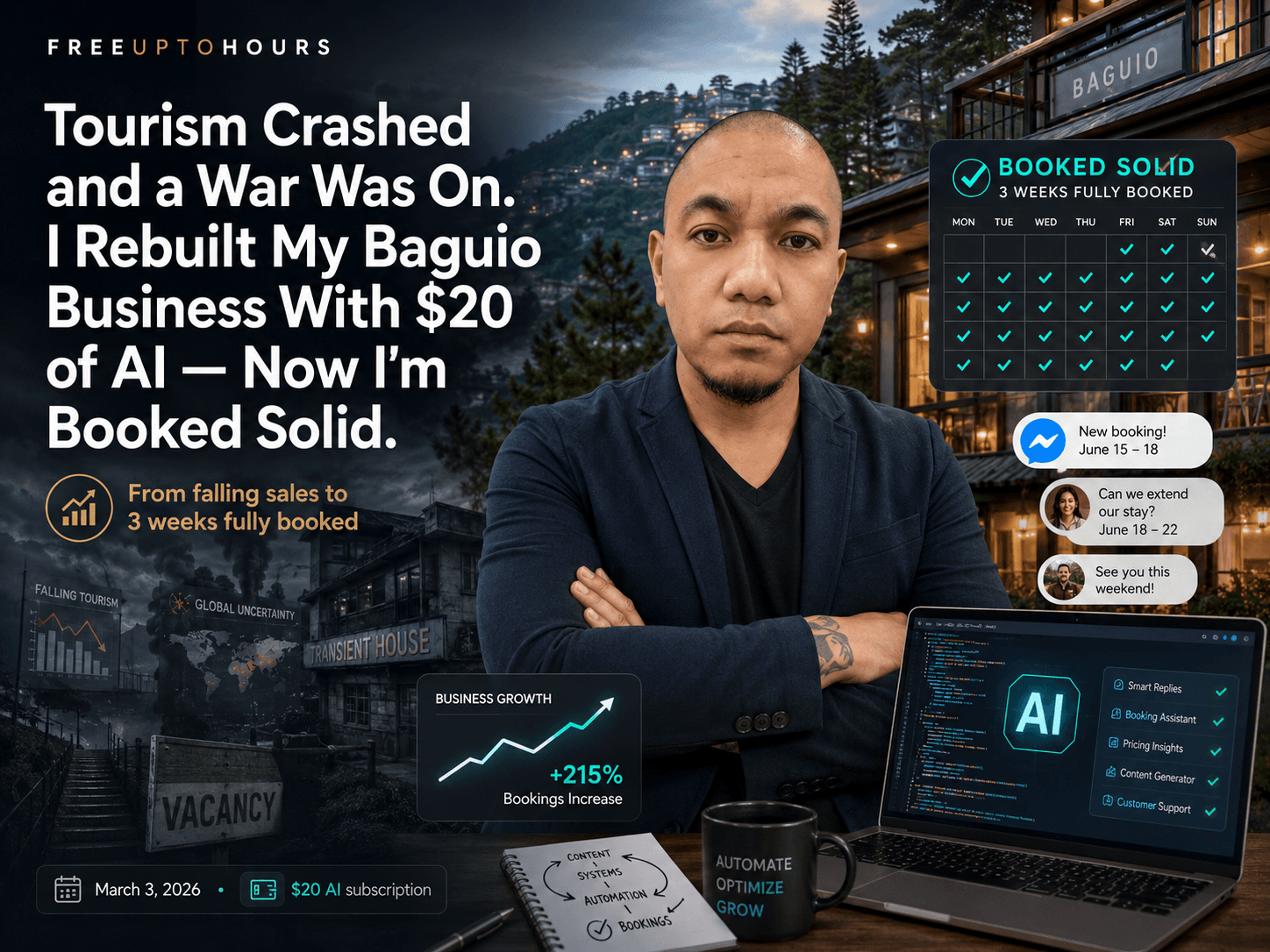
On March 3, 2026, I paid $20 for a Claude subscription. I was not experimenting. My Baguio business was bleeding.
Tourism in Baguio had dropped badly. Sales were falling month over month, the kind of slide that keeps an owner awake. And in the background, the same place every business owner was watching — a war in the Middle East, Iran and the United States, the kind of global uncertainty that makes people cancel trips and hold onto their money. I could not control the tourism numbers. I could not control the war. I could only control what I did next.
So I did something. I learned Claude Code and rebuilt my business from the inside.
Today, while that same war is still in the headlines and tourism still has not fully recovered, my property is fully booked — three weeks straight. That is not luck, and it is not a coincidence of the calendar. It is the direct result of a $20 subscription in the hands of someone who already understood both the technology and the business. This is the honest story of how that happened, and why I believe every business owner who waits until 2027 to do the same is making the most expensive decision of their life.
Why I Could Move Fast When It Mattered
Here is the part most people skip, and it is the whole point. The $20 subscription was not the magic. The magic was that when I sat down with it, I already knew what to build and why.
I spent 11 years as a WordPress developer with basic SEO. For more than a decade, that was my trade — themes, plugins, hosting, getting a small business onto Google. Then I spent 6 years running my own businesses, accommodation in Baguio, where inquiries come through Facebook Messenger at 11 PM in Taglish and the booking goes to whoever replies first. Those two phases gave me two completely different instincts: the developer who can build, and the operator who has felt the real pain of a lost booking and a slow night.
When agentic AI went mainstream in 2026, I did not have to learn from zero. My tech background made Claude Code easy to pick up — I could read what it produced, fix what broke, and direct it like a tool instead of hoping it worked. And my operator background meant I knew exactly what was worth building. That combination is why a $20 subscription turned into a fully booked business, and why the same $20 in the hands of someone without that foundation would have produced an impressive-looking demo and not a single extra booking.
What I Actually Built — A Sales Machine, Not a Website
This is the most important distinction in this entire post. I did not just build a website and call it done. A website that only looks nice is a brochure. I built a sales machine — a system whose only job is to turn attention into bookings, around the clock, at a cost I could survive on during a downturn. The website was one part of it. Here is the whole thing, piece by piece.
Why an AI Chatbot Is the Core of a Sales Machine
I built a chatbot that handles the bulk of my Messenger inquiries 24/7, in English, Tagalog, and Taglish, replying in seconds instead of hours. During a downturn, every single inquiry matters more, because there are fewer of them. Losing one to a slow reply is no longer an annoyance — it is rent you cannot pay. The chatbot made sure I lost almost none. This is the heart of the machine: speed-to-reply is the single biggest lever for a Philippine business that lives on Messenger, because the first fast, accurate answer wins the booking.
How I Ranked a Transient House #1 on Google (WordPress to Next.js + SEO Audits)
I rebuilt baguiotransient.net from WordPress to Next.js and ran proper SEO audits — and that is what got it ranking number one for the terms a Manila family actually types when planning a Baguio trip: near SM, near Session, near Burnham. These are not vanity keywords. They are the exact location-based searches that mean someone is ready to book right now. A fast, well-optimized site is what earns the ranking; a slow WordPress site buried in plugins almost never gets there. But a ranking only pays off if it converts, which is why the chatbot and the rest of the machine matter just as much. When tourism is down, you cannot afford to be invisible for the searches that still have real intent behind them.
How I Lowered My Facebook Ad Costs With the Meta Pixel
Here is one I did not expect: the AI itself told me to install the Meta Pixel properly. Once I did, my Facebook ad costs dropped sharply — because Meta could finally learn who actually books instead of who just clicks. In a downturn, ad efficiency is survival. Cutting the cost to acquire each booking is the difference between ads that drain your account and ads that feed it. If you are boosting posts without a properly installed Pixel, you are paying full price for guesses; with it, the platform optimizes toward people who behave like your real, paying guests.
More Efficient Calls and Warmer Inquiries
With the chatbot handling the repetitive questions and the system capturing every lead, the conversations that reached me by phone were warmer and closer to booking. Less time wasted on "magkano po," more bookings actually closed. Each of these is not a website feature — it is a sales function. Together, they are a machine that kept selling while the market around me was shrinking.
The Result — Fully Booked, in the Middle of a War
Three weeks fully booked, straight, while tourism is still soft and the war is still going. I want to be precise about why this is not a coincidence: the months when this turned around are the months I would normally expect to be hurting the most. The external conditions did not improve. My system did.
It is the power of Claude and ChatGPT combined, in the hands of an operator who knew what to point them at. That last clause is everything. The same tools, used by someone without real business experience, produce noise. Used by an AI operator who has actually run the business, they produce bookings.
The Trap — Why a "Vibe Coder" Could Not Have Done This
There is a new kind of builder appearing in 2026: the "vibe coder." Someone who builds software by directing AI in plain language, without ever learning the fundamentals. Vibe coding is genuinely powerful — I use AI to build faster than I ever could by hand. But it is also a trap, and you need to understand the trap before you trust your business to anyone selling it.
A vibe coder who skipped the developer years does not know when the AI is confidently wrong. They cannot read what it generated, cannot tell a secure pattern from a leak, cannot fix it when it breaks at 2 AM during a long weekend when bookings are flooding in. And a vibe coder who skipped the operator years does not know what is worth building in the first place — they build the demo that looks finished in a weekend, not the sales machine that quietly keeps you alive in a downturn.
I could rebuild my business in a crisis precisely because I was not vibe coding from zero. I had the scars — 11 years of knowing how software actually breaks, and 6 years of knowing what a real business actually needs. Trust is the real product now, and trust is earned by those scars. When you hire someone to automate your business, the question is never "can they build it." Almost anyone can build something now. The question is "can you trust it to run your business unattended, take inquiries, and never tell a guest the wrong rate" — and that answer comes from experience, not from the tool.
The 2027 Competition — Why Waiting Is the Expensive Choice
Here is my honest prediction. By 2027, the business that competes with yours will not be a bigger company with a bigger team. It will be a single AI operator — or a small business partnered with one — running on a cost structure you cannot match with manual labor. They will reply in three seconds at midnight while you sleep. They will run ads at a fraction of your cost because their Pixel is trained and their targeting is sharp. They will rank for the searches that convert while you are still boosting posts. One person, out-producing a team, at a fraction of the cost.
And the advantage compounds. Agentic AI only went mainstream in 2026, so the operators who moved early are barely a year ahead — which means the window to catch up is open right now, but it is closing every month. The tools will be available to everyone. The accumulated judgment of having run a real system through a real downturn will not be.
So what are the actual cons of not doing this now? You compete on a cost structure you will lose, because a competitor on AI economics can fill rooms at a price you cannot profitably match. You keep paying for slow — every late reply and wasted ad peso is revenue handed to whoever automated first. The gap widens while you wait, because the people ahead of you are not standing still. And you face the next crisis with the same old tools: the war did not warn me, the tourism crash did not warn me, and the owners who already have a sales machine will absorb the next shock while the rest feel it the way I felt this one.
What I Actually Recommend
I am not telling you to go learn to code. That is the wrong lesson. The lesson is that you need to either become, or partner with, an operator who understands both sales and technology and can be trusted to build you a sales machine — now, while the advantage is still cheap to build and the window is still open.
I am that operator, and I am not selling you a theory. I rebuilt my own collapsing business in the middle of a war and a tourism crash, with a $20 subscription and 17 years of hard-earned judgment, and today I am fully booked. I use these systems on my own properties every single day before I would ever recommend them to you. I am not selling you a demo I built last weekend. I am selling you the exact machine I trusted with my own income when I had everything to lose.
If your business runs on inquiries, bookings, and replies that need to happen faster than a human can manage — that is the sales machine I would build for you, on the same foundation that saved mine. Business owners are bleeding for this right now. I know, because I was one of them. The difference is I already built the cure.
SEO Services for Baguio City Small Business — What Actually Works
How the local ranking that fed this comeback actually works — and what wastes your money.
Property Management System Philippines: Run 15 Rooms for ₱2,000/Month
The lean system I use to run a 15-room property — bookings, leads, and follow-up — for a fraction of hotel-software pricing.
Custom Chatbot vs Intercom, Crisp, Tidio, Drift & Meta — Full Cost Comparison
The platform-by-platform math behind the chatbot in this sales machine — and why it costs cents, not thousands.
AI Chatbot Philippines: What They Cost and What They Actually Do
The honest overview of the chatbot layer for Filipino businesses — Messenger, Taglish, build versus buy.
Frequently asked questions
Can a $20 AI subscription really turn a business around?
What is a "sales machine" versus just a website?
How do you lower Facebook ad costs with the Meta Pixel?
How did you rank a transient house #1 on Google?
What is the cost of waiting until 2027 to adopt AI?
Want the same system for your business?
I'll set up AI automation for your business — just like I did for mine.