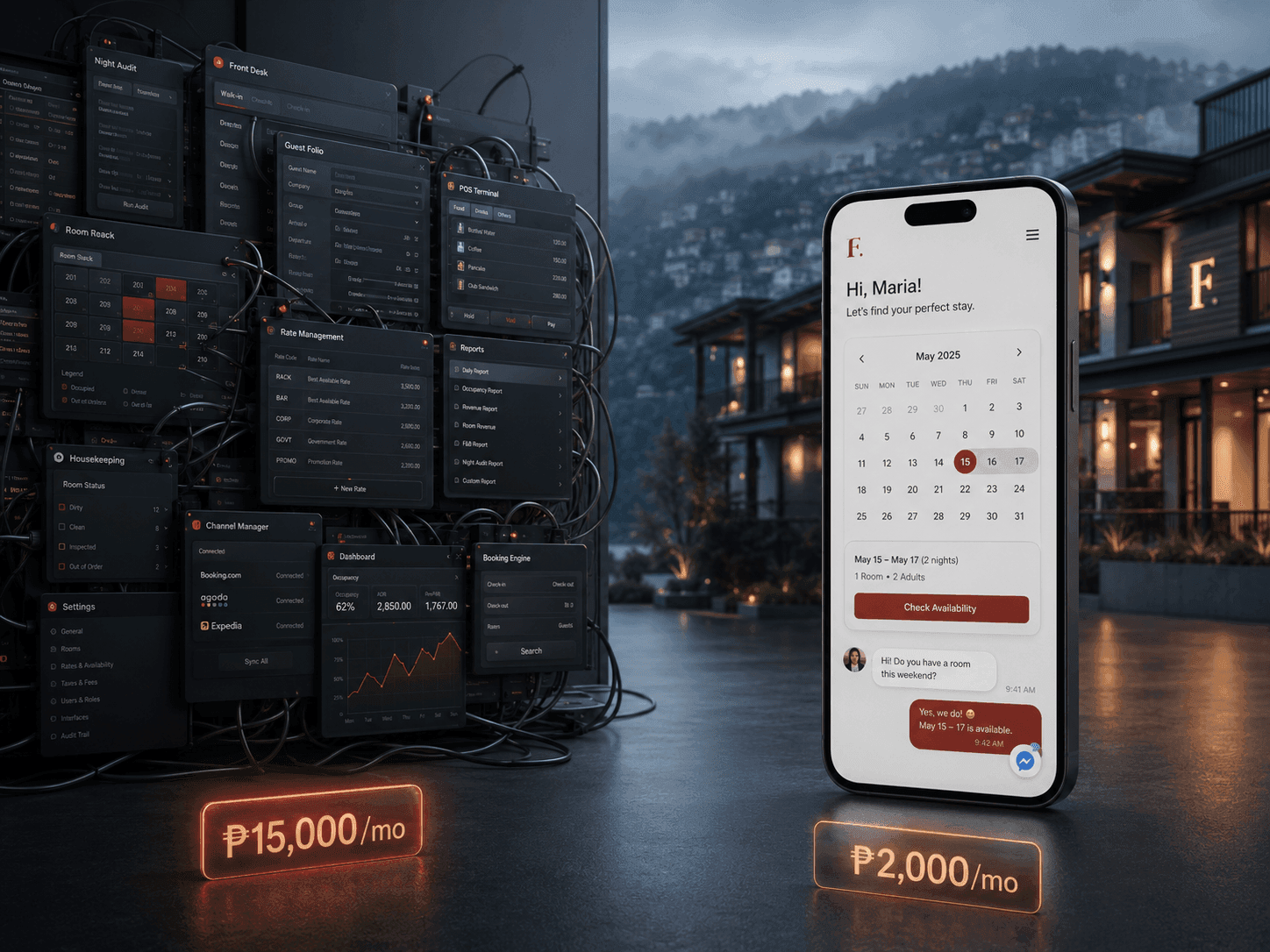
Property Management System Philippines: What I Use to Run 15 Rooms for ₱2,000 a Month (Not ₱15,000)
When I first searched "property management system Philippines," every result wanted to sell me hotel software priced in US dollars, per room, per month, with modules I would never open. Front-desk check-in screens. Housekeeping rotas. Night-audit reports. POS for a restaurant I do not have. I run a 15-room transient house in Baguio, not a 120-room hotel on Session Road — and almost none of it fit how the business actually works.
So I am going to tell you the thing the software vendors will not: most small property owners in the Philippines who search for a property management system do not need the property management system they are about to buy. They need the five things a PMS actually does — assembled for their real business, in the channel their guests actually use, at a price that matches a transient house and not a Marriott.
I manage my 15 rooms on a system that costs ₱800 to ₱2,100 a month. The equivalent imported hotel PMS, with the modules that matter switched on, typically runs ₱6,000 to ₱15,000+ a month once you add per-room fees and channel manager add-ons. This post is the honest breakdown of why that gap exists, who should still buy the expensive option, and who should build the cheap one.
What "Property Management System" Actually Means in the Philippine Market
A property management system, in the textbook sense, is software that runs the operational side of a lodging or rental business: reservations, availability, guest records, payments, and reporting, usually with a channel manager that syncs your rooms across Booking.com, Agoda, Expedia, and Airbnb so you never double-book.
That definition was written for hotels. But the people actually typing "property management system Philippines" into Google are mostly not hotels. From the searches I see and the owners who message me, they are transient house owners, condo-for-rent and condotel unit managers, apartelle and dormitory operators, small resort owners, and Airbnb or short-stay hosts managing 3 to 30 units. Different business, same search term — and that mismatch is exactly why so many of them end up paying for the wrong thing.
The honest question is not "which PMS is best in the Philippines." It is "what does my specific property actually need a system to do, and what is the cheapest reliable way to get exactly that." Answer that and the buying decision becomes obvious.
The 5 Jobs a Property Management System Actually Does
Strip away the dashboards and a PMS only does five real jobs. Knowing them lets you see exactly which ones you are paying for and never using.
- Availability and calendar — knowing which unit is free on which date, and never double-booking. This is the one job every property genuinely needs.
- Reservations and guest records — capturing the booking, the guest details, headcount, dates, and keeping a history so you can re-engage repeat guests.
- Channel management — syncing availability across the platforms guests book through, so a booking on one channel blocks the date everywhere.
- Payments and billing — tracking deposits, balances, and which bookings are paid, partially paid, or unpaid.
- Reporting — occupancy, revenue, source of bookings, so you can see what is actually working.
Here is the part that decides everything for a Philippine property: job number three. Imported PMS platforms assume your channels are Booking.com, Agoda, Expedia, and Airbnb. But for most transient houses, condo rentals, and small resorts in the Philippines, the channel that brings 70 to 90 percent of bookings is Facebook and Messenger — sometimes a direct call or a barkada referral. A ₱12,000-a-month channel manager that syncs five OTAs you barely use is solving a problem you do not have, while ignoring the inbox where your actual bookings come from.
The Three Real Options — And the Honest Cost of Each
There are only three ways to manage a property in the Philippines. I have used all three.
Option 1: Imported Hotel PMS (Cloudbeds, Hostaway, RMS, Hotelogix, eZee and similar)
These are genuinely good products. The reservation grids are mature, the OTA sync is reliable, and if you run a real hotel or a property that lives on Booking.com and Agoda, they earn their fee. The catch is that they are priced in US dollars, usually per room or per property per month, and the channel manager — the feature most of the cost sits behind — is built for OTA-heavy businesses. For a small Philippine property, you are typically looking at ₱6,000 to ₱15,000+ a month once the useful modules are on, paying mostly for a front desk you do not staff and OTA channels you barely use.
Option 2: The Manual Stack — Notebook, Facebook, and a Prayer
This is where most owners actually are: availability tracked in a notebook or your head, bookings confirmed in Messenger, payments checked by scrolling GCash, and a constant low-grade fear of double-booking a long weekend. The cash cost is ₱0. The real cost is 6 to 9 hours a day of manual work and the bookings you lose every time a guest messages at midnight and you reply at 8 AM — by which point they have already booked the property that answered in three seconds.
Option 3: The Lightweight Custom Build (What I Use)
The third option is to assemble exactly the five jobs you need from cheap, reliable parts: a live availability calendar, automatic booking capture, an AI assistant on the channel your guests actually use, and simple reporting. No per-room fee, no modules you ignore, no OTA channel manager you do not need. This is what I run, and it costs less than 3 days of one staff member's wages per month.
What I Actually Built to Manage 15 Rooms
Here is the real system, piece by piece. None of it is exotic. All of it is in production right now on my Baguio property.
- Availability and bookings: a Google Sheets booking calendar that the rest of the system writes to automatically. Every confirmed booking logs the guest name, contact, dates, room, headcount, amount, and payment status, and the calendar blocks the date instantly. Cost: ₱0.
- The channel (the important part): an AI chatbot connected to Facebook Messenger, trained on 200+ FAQs about my actual property — rates, inclusions, parking, directions, house rules. It answers in English, Tagalog, and Taglish in under 3 seconds, 24/7, and reads the live availability sheet to answer "available ba December 28 to 30?" with the real answer. Cost: roughly ₱500 to ₱1,500 a month.
- Lead capture and follow-up: every inquiry is logged as a row so no warm lead disappears, and an automatic follow-up nudges guests who went quiet before a peak weekend. Cost: included in the chatbot setup.
- The shopfront: a fast Next.js website that ranks on Google for "transient house Baguio" and feeds the Meta Pixel so Facebook ads get cheaper. Cost: one-time build, free hosting.
- Reporting: because every booking and inquiry lands in Sheets, occupancy and booking-source reporting is just a pivot table — no separate analytics module.
Total running cost: ₱800 to ₱2,100 a month. It handles roughly 90 percent of inquiries without me touching my phone, and it cut my daily operations from 6 to 9 hours down to about 30 minutes of reviewing escalations. That is the entire point of a property management system — and I am getting it for the price of a per-room line item on the imported platforms.
Imported Hotel PMS vs a Custom Build for a Philippine Property
| Factor | Imported hotel PMS | Lightweight custom build |
|---|---|---|
| Monthly cost | ₱6,000 – ₱15,000+ | ₱800 – ₱2,100 |
| Built around | Front desk + OTA channels | Your Messenger inbox + Google Sheets |
| Main booking channel fit | Booking.com / Agoda / Airbnb | Facebook Messenger (where PH bookings actually come from) |
| Tagalog / Taglish guest replies | Rare or none | Native, 24/7 |
| Double-booking protection | Yes | Yes (live Sheets calendar) |
| Modules you will never use | Many (housekeeping, POS, night audit) | None |
| Setup | Self-serve, but generic | Built to your exact property |
| Best for | Real hotels with heavy OTA volume | Transient houses, condo rentals, small resorts on Messenger |
This is not me saying imported PMS platforms are bad. It is me saying they are built for a different business than the one most people searching this term in the Philippines actually run.
Who Should Actually Buy a Real PMS (Be Honest With Yourself)
I am not going to pretend the custom build is right for everyone. There is a clear line.
Buy the imported PMS if: you run 30+ rooms, a real front desk with shifting staff, and the majority of your bookings genuinely come through Booking.com, Agoda, Expedia, or Airbnb. At that scale, with that channel mix, the OTA sync and the operational modules earn their cost, and a notebook will fail you. A hotel needs a hotel system.
Build or assemble the lightweight version if: you run 3 to 30 units, most of your bookings come from Facebook and Messenger, you do not staff a 24-hour front desk, and your biggest daily pain is answering the same inquiries by hand and tracking availability without double-booking. That is the profile of nearly every transient house, condo-rental manager, and small resort owner who messages me — and for them, the imported PMS is a Ferrari bought to drive five blocks.
How to Decide in 4 Questions
- Where do my bookings actually come from? If the honest answer is Facebook and Messenger, an OTA-centric PMS is solving the wrong problem.
- How many units am I managing? Under 30 and without a front desk, you almost certainly do not need full hotel software.
- What is my real daily bottleneck? If it is answering repeated inquiries and avoiding double-bookings — not OTA rate parity — a chatbot plus a live calendar fixes it for a fraction of the cost.
- What am I really paying for? Open the PMS feature list and circle what you would use weekly. If it is three features out of twenty, you are paying for the other seventeen.
Answer those honestly and the decision is usually clear. Most Philippine property owners land in the second camp — and discover that the system they actually needed costs a tenth of the one they were about to sign up for.
How to Automate a Transient House in the Philippines (The Complete Guide)
The full 5-piece system behind the property management setup in this post — what each part costs and the order to build it.
AI Chatbot for a Transient House in the Philippines
The Messenger chatbot that acts as the booking channel and availability engine in this stack.
Digital Marketing Automation Baguio: What to Automate First
Where a booking system fits in the bigger picture of website, SEO, leads, and automation order.
Frequently asked questions
What is the best property management system in the Philippines?
How much does a property management system cost in the Philippines?
Do I need a property management system for a transient house?
Why do imported hotel PMS platforms underperform in the Philippines?
Can I build my own property management system instead of buying one?
What features does a small property actually need from a PMS?
Need this for your business? I build exactly this kind of system for small business owners.
Custom AI Workflow →Want the same system for your business?
I'll set up AI automation for your business — just like I did for mine.