How to Automate a Transient House in the Philippines (The Complete Guide)
Six years. 180 Messenger inquiries a day. All of it, by hand.
Wake up. Open Messenger. Spend the next two hours typing the same ten answers before breakfast. Rates. Availability. Parking. Check-in time. Directions. Then someone calls. Then another message. Then it is noon and nothing else has moved in the business.
That was V.O.S. Valencia Baguio — my 15-room transient house in Baguio City. It was not a business. It was an unpaid second job with good reviews.
The moment I automated it, I got my mornings back. Then my evenings. Then I built this service for other owners doing the same thing. Here is exactly what I built, what each piece costs, and the order to set it up.
You are working 270 hours a month on tasks a machine can do
"Too busy" is easy to dismiss. These numbers are not.
| Task | Time per day | Time per month |
|---|---|---|
| Answering Messenger inquiries | 3–5 hours | 90–150 hours |
| Manual booking coordination | 1–2 hours | 30–60 hours |
| Updating availability calendar | 30 min | 15 hours |
| Writing Facebook posts / content | 1 hour | 30 hours |
| Chasing payment confirmations | 30 min | 15 hours |
| Total | 6–9 hours/day | 180–270 hours/month |
That is a full-time job spent keeping the place running — before you spend a single hour growing it, improving it, or building a second property. And the moment you step away from your phone, inquiries pile up, leads go cold, and the booking goes to whichever property replied first.
The 5-piece system that cut my workload from 9 hours to 30 minutes a day
I will break each piece down — what it does, what problem it solves, and exactly what it costs.
Step 1: Stop answering the same 10 questions yourself
Rates. Availability. Amenities. Check-in time. Parking. Directions. These questions do not need a human — they need a fast, accurate, always-on reply. Every time you type one of these answers, you are doing work a machine could do in 3 seconds.
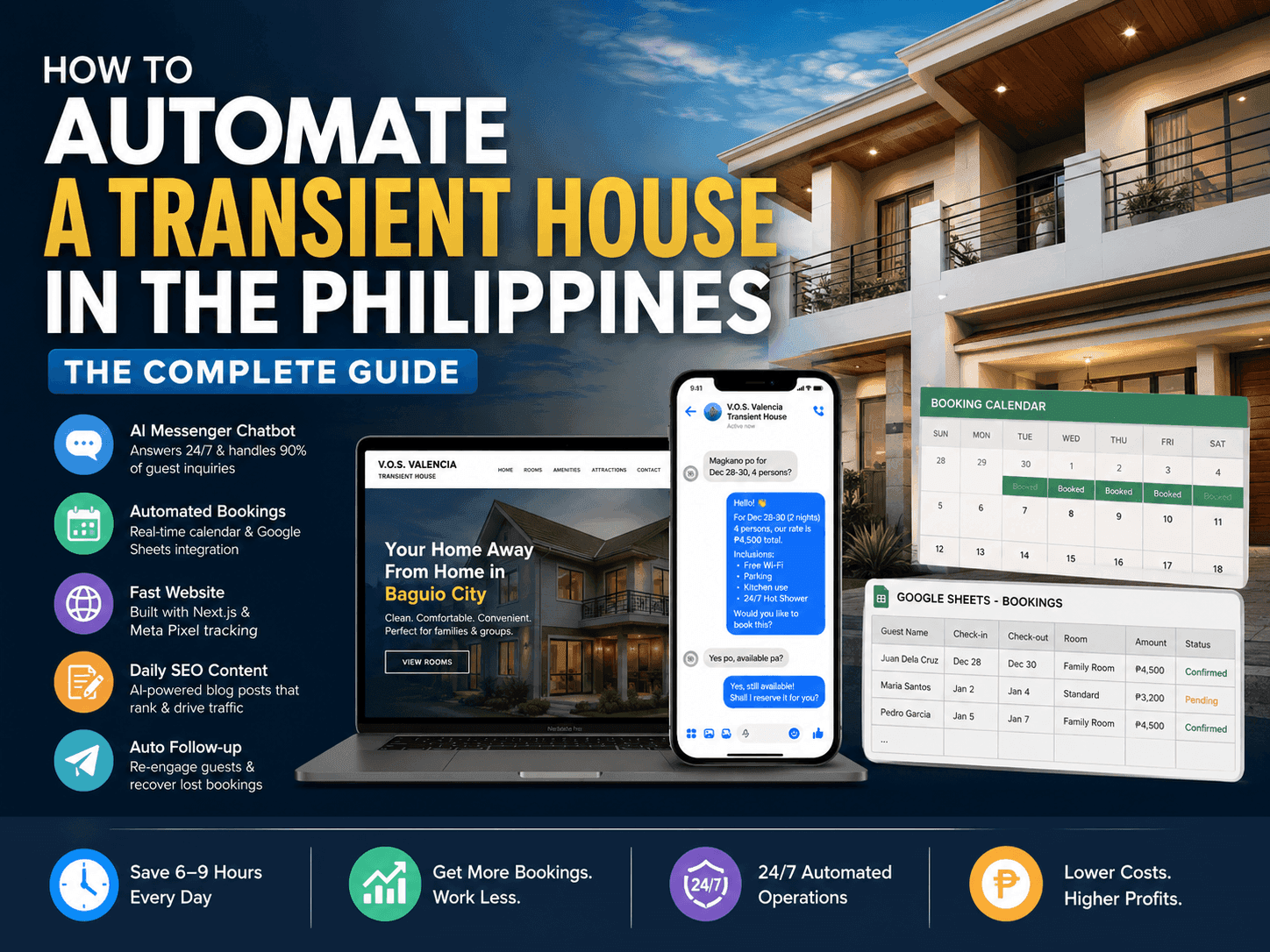
I built a custom AI chatbot connected to my Facebook Page via Messenger. It handles 200+ FAQs trained specifically on my property — room types, seasonal rates, inclusions, policies, location with map link, nearby attractions. When a guest asks "magkano po for 4 persons this December 28–30?" the chatbot replies with the exact rate, inclusions, and a booking prompt — in under 3 seconds, at 2 AM, every day of the year.
- 90% of all inquiries handled without you touching your phone
- Replies in 3 seconds — day, night, weekends, holidays
- Handles English, Tagalog, and Taglish naturally
- Escalates complaints and special requests to you as a notification
- Running cost: ₱500–1,500/month using DeepSeek V4 Flash
Step 2: Let every confirmed booking log itself
The chatbot handles the inquiry. The next problem is coordination — tracking which rooms are blocked on which dates, texting guests to confirm, writing bookings in a notebook, and praying you do not double-book on a long weekend.
I connected Google Sheets directly to the chatbot. The moment a guest confirms through Messenger, the system logs everything automatically: guest name, contact number, check-in and check-out dates, room type, guest count, total amount, and payment status. The calendar blocks instantly. No manual entry. No double-booking.
- Every confirmed booking logs to Google Sheets automatically
- Availability calendar updates in real time
- You get a notification for each new confirmed booking
- Guest history stays organized for re-engagement later
- Running cost: ₱0 — Google Sheets is free
Step 3: Get Google to send you free bookings every day
A Facebook Page gives you zero Google traffic. A slow WordPress site (7–8 seconds to load on Philippine mobile) gives you Google traffic but loses it before the page even opens. Both are costing you money you cannot see on any report.
A Next.js website built correctly loads in under 1 second, scores 95–100 on Google PageSpeed, and ranks for searches like "transient house Baguio" — sending you organic traffic every day without paying for ads. The Meta Pixel installed on the site also feeds real conversion data back to Facebook. My ad cost per booking dropped 35% within 90 days because Facebook finally knew who was actually booking — not just who was clicking.
- Loads in under 1 second on Philippine mobile connections
- Ranks on Google for "transient house [your city]" — free daily traffic
- Meta Pixel lowers your Facebook ad cost by 20–40%
- No WordPress plugins to update or break
- One-time build cost, free hosting on Vercel
Step 4: Publish 30 SEO posts a month without writing a single one
Every blog post on your website is a door Google can send someone through. "Best transient house in Baguio for families." "Pet-friendly transient house near Burnham Park." "Transient house Baguio with parking." Each one targets a search a guest makes when they are ready to book.
I set up an AI pipeline using Claude that drafts one SEO post per day from a keyword list I built around Baguio tourism and transient house searches. Each post takes me 10 minutes to review, then publishes automatically. After 90 days, my organic Google traffic was 3.2 times higher. These posts keep working for years — long after the day they were written.
- 30 SEO posts per month — AI drafts, you review in 10 minutes
- Targets local keywords guests use when searching to book
- Each post compounds — permanent traffic, not a one-day spike
- Auto-shares to your Facebook Page on publish
- Running cost: ₱300–600/month in API fees
Step 5: Recover the bookings you never knew you were losing
Some guests say "noted po" and disappear. Some are comparing properties. Some genuinely forgot. Without a system, these warm leads go cold permanently — because you do not have the time or bandwidth to manually chase every single one.
The auto follow-up sends a friendly check-in message 24 hours after an unconfirmed inquiry. If there is still no response at 48 hours, one final message goes out — timed before peak weekends or holiday bookings. Re-engagement rate: 15–25%. These are bookings that would have been lost forever.
The full system costs less than 3 days of staff wages
| Component | Tool | Monthly cost |
|---|---|---|
| AI Messenger chatbot | DeepSeek V4 Flash + Claude API | ₱500–1,500 |
| Booking calendar | Google Sheets (free) | ₱0 |
| Website hosting | Vercel free tier | ₱0 |
| Daily SEO blog posts | Claude API + caching | ₱300–600 |
| Follow-up sequences | Included in chatbot setup | ₱0 |
| Total | — | ₱800–2,100/month |
A part-time staff member handling Messenger costs ₱8,000–15,000/month, works 8 hours a day, takes days off, and cannot reply at 2 AM. The full automation stack runs 24 hours a day, 7 days a week, for ₱800–2,100 — less than 3 days of staff wages.
Start here — in this exact order
- AI Messenger chatbot first — stops the immediate time drain. This is the highest-leverage change you can make. Takes 1 week.
- Booking calendar integration — connects to the chatbot so confirmed bookings log automatically. Adds 2–3 days.
- Next.js website — the foundation for Google traffic and Meta Pixel data. Takes 1 week.
- Daily content pipeline — fills the site with SEO content once it exists. Takes 3–5 days to configure.
- Auto follow-up sequences — layer this on last, once the core system is stable.
Total from zero to fully automated: 2–3 weeks. After that, 30 minutes a day — reviewing escalations and approving content — instead of 6–9 hours doing everything by hand.
What your business looks like when the machine does the repetitive work
The obvious change is time. You get hours back every day. The less obvious change is that your business becomes scalable. Right now, if your booking volume doubles, your workload doubles. With automation, booking volume can double and your workload stays exactly the same. The system handles the volume. You handle the exceptions.
You also stop losing leads you never knew were slipping away. Before automation, I had no idea how many people messaged at midnight, got no reply, and booked a competitor by morning. After automation, every one of those inquiries is answered in seconds, captured in a sheet, and followed up automatically. They become confirmed bookings instead of lost revenue.
Property Management System Philippines: Run 15 Rooms for ₱2,000/Month
The property-management side of this system — calendar, bookings, and records — and why imported hotel software is the wrong tool for a Philippine transient house.
AI Chatbot Philippines: Costs, What They Do & How I Run One for ₱500/Month
The complete overview of AI chatbots for Filipino businesses — costs, the Messenger-first reality, and which industries they fit.
AI Chatbot Service — what I build for other business owners
The done-for-you chatbot at the core of this system — what is included, setup time, and how to start.
Frequently asked questions
Is this too complicated to set up myself?
What if the chatbot gives the wrong answer?
How much does it cost to automate a transient house in the Philippines?
Does the AI chatbot work in Tagalog and Taglish?
Do I need a website to automate my transient house?
How long does it take to set up the full automation?
Need this for your business? I build exactly this kind of system for small business owners.
AI Lead Automation →Want the same system for your business?
I'll set up AI automation for your business — just like I did for mine.