How to Handle 100+ Messenger Inquiries Automatically (From Someone Who Gets 1,000 a Day)
December. Christmas season. V.O.S. Valencia Baguio is fully booked — every room, every night.
And I still received 1,000 Messenger inquiries in a single day.
Fully booked means nothing on Messenger. Guests do not know you are full until you tell them. And when Panagbenga or Christmas hits Baguio, the messages come in like a flood — from the moment I wake up until 2 AM, then again at 5 AM before I even have breakfast. People asking rates, asking availability, asking if we are near Mines View, asking how to book, asking if we accept gcash.
On a slow month, I get around 100 inquiries a day. On a busy one, 600. At Christmas, 1,000.
For years, that was my job. Not running a business. Just answering the same questions, every hour, on repeat, forever.
This is how I stopped.
Everything I tried before building the real solution
I want to be honest about the failed attempts first, because most people reading this have probably tried the same things.
The first thing I tried was Meta's shortcut replies — the feature that lets you save canned responses and trigger them with a slash command. It helped a little. But I still had to manually read each message, figure out which shortcut applied, and send it. That is still me doing the work. It just made the typing slightly faster.
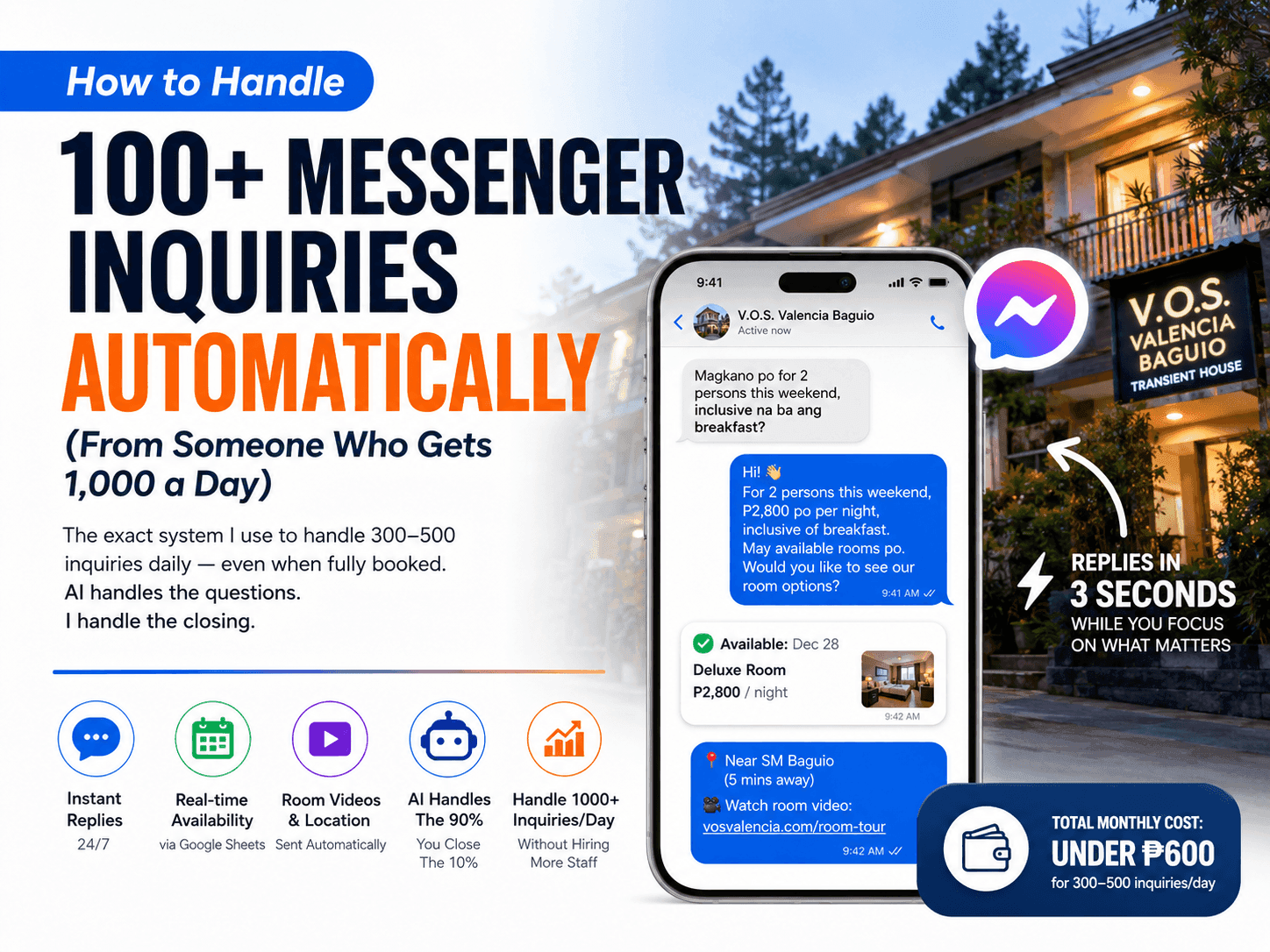
Then I tried Meta's built-in AI chat feature. This is where it really fell apart. The AI was too formal. Too purely Tagalog. My guests speak Taglish — that natural mix of Filipino and English that real conversations use. "Magkano po for 2 persons this weekend, inclusive na ba ang breakfast?" — Meta's AI answered like it was writing an official letter. Guests could immediately tell it was a bot, and not a good one.
Also: no shortcode capability. I could not make it automatically pull the current rate for a specific date. I could not make it send a video of the room. I could not connect it to my Google Sheets booking calendar. Every time someone asked "available ba kayo this December 28?", I still had to manually open my calendar and check.
And the comment section on Facebook ads — a completely separate problem. Every ad we ran generated dozens of comments asking the same rate and availability questions. I had to reply to each one individually. No tool handled that properly.
The honest truth: none of these attempts solved the problem. They were all band-aids on a wound that needed a completely different approach.
What the system looks like now — step by step
Today, when a guest sends a message to my Facebook Page, here is what happens — and how long each step takes:
- Guest sends any message — "magkano po?", "available December 28?", "malapit ba kayo sa SM Baguio?", anything
- My Node.js server receives the message instantly via Messenger webhook
- The message goes to DeepSeek V4 Flash — my AI model for FAQ handling — which reads the full message and generates a reply
- The AI checks my Google Sheets booking calendar in real time if the question is about availability — it does not guess, it actually checks the current data
- A reply goes back to the guest within 3 seconds — in Taglish, in my tone, with the correct rate, the correct availability, a map link if they asked about location, or a room video link if they asked to see the property
- If the guest is ready to book — "sige po mag-reserve na ko" — the AI flags the conversation and I get notified. I step in personally to close the deal.
That last step is important. I handle closing. The AI handles everything before it. And that boundary — informing versus closing — is the whole philosophy of the system.
The part nobody tells you: training it to sound like you
The chatbot was not good on day one. I want to be very clear about that.
Day one, it was functional. It answered questions. But it did not sound like me. It used words I would never use. It missed the casual, warm tone that my actual conversations have. Guests who had messaged me before and then got the bot would have noticed.
What I did — and still do — is treat it like a partnership. Every time I see a reply that does not sound right, I fix it. I open Claude Code, describe the problem, adjust the training data or the system prompt, and push the update. Sometimes this takes 10 minutes. Sometimes an hour. But every fix makes it better.
After about one week of consistent correction, the chatbot started sounding like me. After a month, guests were surprised to learn it was not me personally replying. That feedback — "sabi ko nga sa asawa ko ang bilis ng reply mo!" — is the metric I care about. Not accuracy scores. Real guest reactions.
The training is not a one-time event. It is ongoing. New questions come in. New situations arise. I train it on those. The chatbot and I have been working together for months now and it keeps getting better because I keep teaching it.
The biggest lesson: blank data kills chatbots. If a guest asks something the bot has never been trained on, it either gives a generic reply or fails completely. My solution — 200+ real questions from my actual Messenger history, in the exact Taglish phrasing guests use. Not generic FAQs. Real conversations.
Why the volume grew — and what would have happened without automation
Here is something I want to correct before anyone reads this wrong: the inquiry volume did not go up because of the chatbot. The chatbot did not generate demand.
The volume went up because of three things happening together: a fast Next.js website that ranks on Google, SEO content written with Claude as my expert content partner, and a properly configured Meta Pixel that made my Facebook ads dramatically smarter. Those three together turned 100 daily inquiries into 300–500.
The chatbot made it possible to handle that growth without breaking.
If I had received 500 inquiries a day with no automation — honestly, I would have needed to sleep 8 hours just to recover from the previous day. My entire life would have been that one job: chatting. Money would have been good. Quality of life would have been gone. That is not a business. That is a prison with good reviews.
The system I built gave me my time back. And I used that time to learn more automation, build more systems, and launch this service. The chatbot did not just handle inquiries. It changed what I could become as a business owner.
What it actually costs to handle 300–500 inquiries per day automatically
| Component | What it does | Monthly cost |
|---|---|---|
| DeepSeek V4 Flash API | Handles all FAQ replies — the volume model | ~$5 (₱280) |
| Claude API | Powers complex reasoning + daily SEO blogs | ~$5 (₱280) |
| Node.js server (my laptop) | Runs the webhook that connects everything | ₱0 |
| Google Sheets | Real-time booking calendar + lead capture | ₱0 |
| Domain | freeuptohours.com | ~₱15/month |
| Total | — | Under ₱600/month |
I chose DeepSeek V4 Flash specifically for the volume task. It is one of the cheapest effective AI models in the market right now — fast enough for real-time replies, accurate enough for FAQ handling, and cheap enough that even 1,000 inquiries in a day does not spike my bill. For the smarter reasoning tasks, Claude handles those separately.
Compare that to hiring a staff member for the same job: ₱15,000–25,000 per month, 8 working hours, offline every night, offline on weekends, sick leave, turnover. The automation runs 24 hours a day, 7 days a week, for less than most people spend on coffee in a month.
The one thing that separates a chatbot that works from one that kills your bookings
Speed.
Not intelligence. Not accuracy. Speed.
Here is the reality of how Filipino guests book a transient house: they message three or four properties at the same time. They are comparing you right now, in real time, while you are sleeping or eating or handling another conversation. The first property to reply with useful information gets the booking.
You might be better at closing deals than any chatbot. I believe that — human touch in the final conversation is still undefeated. But you cannot close a deal with a guest who booked somewhere else while they were waiting an hour for your reply.
A 3-second reply that answers the question correctly beats a perfect reply that arrives 60 minutes later. Every time. That is the math of how bookings are won and lost in the Philippines right now.
The chatbot does not replace you. It keeps the guest in the conversation long enough for you to close.
If you are at 100 inquiries a day and have never touched automation — start here
AI is coming whether you build with it or not. The difference is whether it works for your business or your competitor's.
But I want to give you practical advice, not just motivation.
- Set up Meta's free instant reply today. Five minutes. Settings → Messaging → Instant Reply. Write a message that includes your rates, your location link, and when they can expect a detailed reply. This is not a chatbot — it is a placeholder. But it captures the guest's attention while you build something better.
- Export 3 months of your Messenger conversations. Find the 30 questions that appear most often. Those are your training data. The chatbot cannot answer what it has never been taught.
- Do not start with a platform tool like ManyChat if you want real customization. Start with understanding what your guests actually ask. The tool comes second.
- When you are ready to build the real system — Node.js webhook, DeepSeek for volume replies, Google Sheets integration — message me. I built mine from scratch and I set up the same system for other business owners. One week to build. Runs itself after that.
At 100 inquiries a day, you are at the point where automation starts paying for itself immediately. Wait until 300 and you will spend those months exhausted. Start now, while the volume is manageable enough to train the system properly.
AI Chatbot Philippines: Costs, What They Do & How I Run One for ₱500/Month
The complete overview of AI chatbots for Filipino businesses — costs, the Messenger-first reality, and which industries they fit.
What Is an AI Chatbot for Transient House in the Philippines?
The full breakdown of how the chatbot works, what it costs, and how I trained it to sound like me.
How to Automate a Transient House in the Philippines (The Complete Guide)
Beyond the chatbot — the full 5-step system including website, booking calendar, SEO, and follow-up.
AI Chatbot Service — built for your business
What I set up for other business owners, what is included, and how to get started.
Frequently asked questions
How do you handle 100+ Messenger inquiries automatically in the Philippines?
What is the cheapest way to automate Facebook Messenger replies in the Philippines?
Why does Meta's free Messenger AI not work well for Philippine businesses?
How long does it take to train an AI chatbot to sound natural?
Should the AI chatbot handle closing the sale?
What is the maximum number of Messenger inquiries an AI chatbot can handle per day?
Want the same system for your business?
I'll set up AI automation for your business — just like I did for mine.