Which AI Model for Which Task? The Real Stack I Run My Business On for About $44 a Month
I run my businesses on five different AI models, and together they cost me about $44 a month. Not one premium model doing everything — five specialized ones, each pointed at the single job it does best.
Most people ask "what is the best AI model?" as if there is one winner. After running these tools every day — across software development, customer chat, content, images, and heavy audits — I can tell you the question is wrong. There is no single best model. There is the right model for the task, and the workflow you wrap around it. That second part is where almost everyone leaves both money and quality on the table.
My Full AI Stack at a Glance
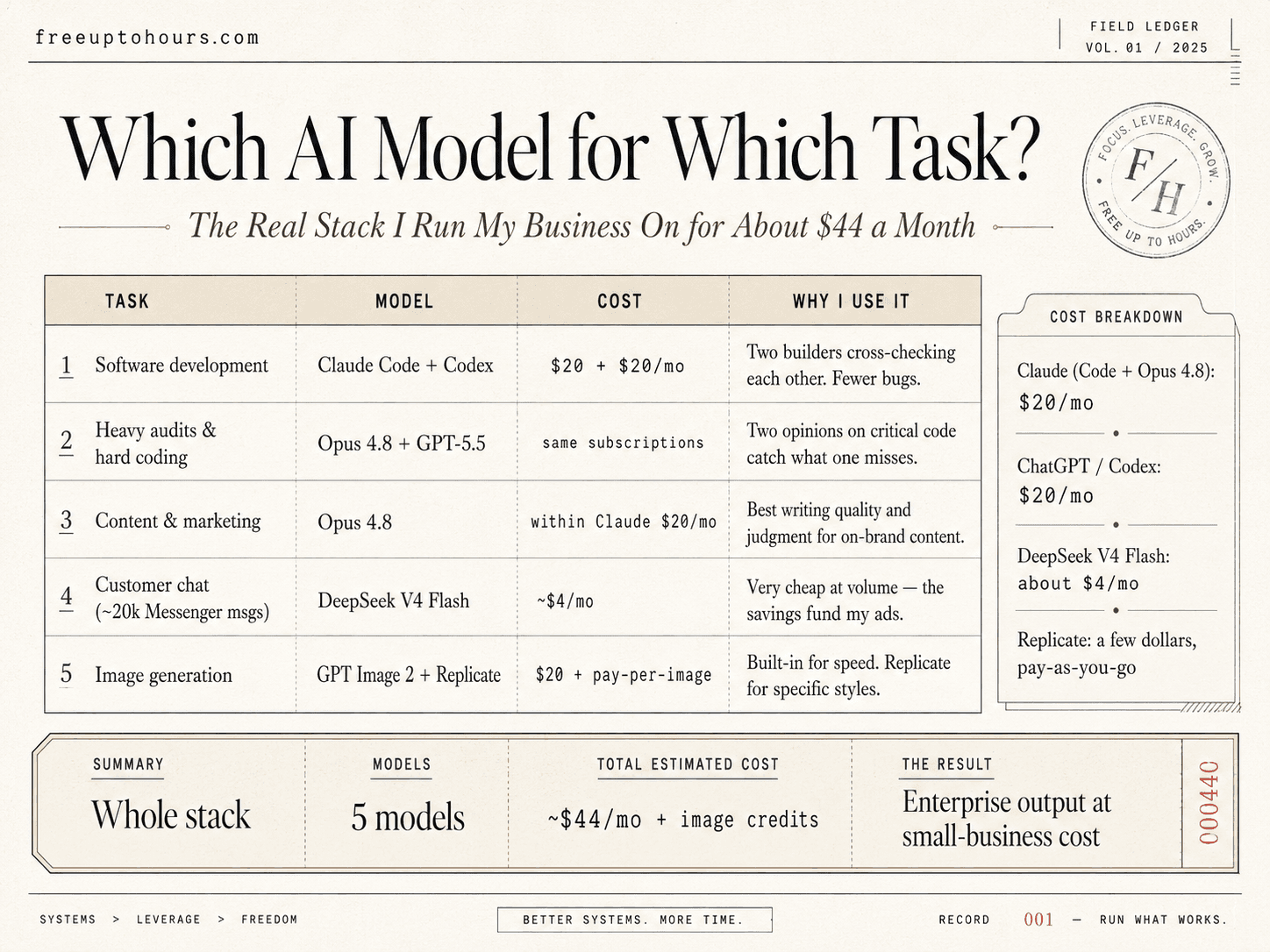
Here is the whole thing on one page — what each task gets, what it costs, and why I chose it. The detail behind each row follows below.
| Task | Model I use | Approx. cost | Why this one |
|---|---|---|---|
| Software development | Claude Code + Codex (together) | within $20 + $20/mo | Two builders cross-checking each other ships fewer bugs |
| Heavy audits & hard coding | Opus 4.8 + GPT-5.5 (together) | same subscriptions | Two opinions on critical code catch what one misses |
| Content & marketing | Opus 4.8 | within the $20 Claude plan | Best writing quality and judgment for on-brand content |
| Customer chat (~20k Messenger msgs) | DeepSeek V4 Flash | ~$4/mo | Dirt cheap at volume — the savings fund my ads |
| Image generation | GPT Image 2 + Replicate | within $20 + pay-per-image | Built-in for speed, Replicate for specific styles |
| Whole stack | 5 models | ~$44/mo + image credits | Enterprise output at small-business cost |
Development: Claude Code + Codex, at the Same Time
I do not pick one coding AI. I run Claude Code and Codex together, often on the same task — and I drive both with skills, not raw prompts. Skills are reusable instructions and workflows that turn a general model into a specialist for the job in front of it, and using them in both tools is the difference between an AI that guesses and one that follows my standards every time.
Why two at once? Because they have different strengths and different blind spots. When I am building a feature, one will often catch a mistake the other made, or suggest a cleaner approach. Running them side by side is like having two senior developers review the same change — for the price of two $20 subscriptions instead of two salaries. The model is the engine here; the skills and the two-tool workflow are what actually ship clean code.
Heavy Audits and Hard Coding: Opus 4.8 + GPT-5.5
For the high-stakes work — a security audit, a tricky bug, a critical refactor that cannot break in production — I run both Opus 4.8 and GPT-5.5 and compare their answers. Where they agree, I trust it. Where they disagree, that disagreement is the signal to slow down and look closer, because one of them has usually spotted something the other missed.
This is not overkill. The cost of a wrong answer on a payment flow or a guest-facing booking system is far higher than the cost of asking two models instead of one — and both already sit inside subscriptions I am paying for anyway. For anything that runs my business unattended, two opinions is cheap insurance.
Content and Marketing: Opus 4.8
For writing — blog posts, marketing copy, and the strategy behind them — I use Opus 4.8. This is the one place where the model quality genuinely matters most, because content carries the brand. Cheaper models produce text that is technically fine and completely forgettable; Opus 4.8 has the judgment to hold a real voice, an argument, and my actual experience together in one piece.
The case-study post about rebuilding my business with $20 of AI during a downturn was written this way — my experience, my numbers, my opinions, with Opus 4.8 doing the execution. The result reads like me because the strategy came from me. That is the whole point: a strong content model amplifies real experience, it does not replace it.
Customer Chat at Scale: DeepSeek V4 Flash for About $4
My Messenger chatbot handles roughly 20,000 inquiries a month. I do not use a premium model for that. I use DeepSeek V4 Flash, which costs about $4 for the entire month. Rates, availability, parking, directions, booking steps — these are repetitive questions that a cheap, fast model answers perfectly in English, Tagalog, and Taglish. Paying premium per message here would burn budget for zero extra benefit.
Here is the part most owners miss, and it is the real money lesson: when your customer-chat cost is this low, the savings do not just sit there — you redirect them into Facebook ads. Cheap, accurate replies at volume mean more inquiries handled, more bookings closed, and more budget freed up to buy even more inquiries. A cheap model on the high-volume task is not about being stingy. It is about turning saved pesos into a growth loop: lower cost per conversation funds more ads, which drive more sales.
Image Generation: GPT Image 2 + Replicate
For images I use both. GPT Image 2 (gpt-image-2) is my fast, built-in option for quick marketing graphics and social posts. When I need a specific style or a particular model that suits a brand, I reach for Replicate, which gives access to a whole collection of text-to-image models on a pay-per-image basis. Two tools, one job, matched to whether I need speed or a specific look — and neither one needs an expensive standalone subscription.
The Real Cost: About $44 a Month for All of It
Add it up and the whole stack is small:
- Claude (Code + Opus 4.8, for development, audits, and content): $20/month
- ChatGPT / Codex (for development, GPT-5.5 audits, and GPT Image 2): $20/month
- DeepSeek V4 Flash (for ~20,000 customer chat messages): about $4/month
- Replicate (for specific-style images): a few dollars, pay-as-you-go
That is roughly $44 a month, plus a little for image credits. For that, I get a two-person development team, a code auditor, a 24/7 multilingual customer service rep, a content writer, and an image studio. The equivalent in hired staff or enterprise SaaS would run into the tens of thousands of pesos a month. This is exactly how a small Filipino business produces output that looks like it came from a much bigger company.
The Real Lesson: Skills and Workflow Beat the Model
This is the part people miss. Anyone can subscribe to the same five models tomorrow. What they cannot copy is the workflow: knowing to run two coders at once, driving them with skills instead of one-off prompts, knowing which model to trust for which task, and deliberately matching the cheapest model to the highest-volume job so the savings fund growth.
The model is the engine. The skills and the workflow are the driver. A beginner with the best model on the market produces confident-looking garbage, because they do not know what to ask for or how to check it. An operator with a $4 model and a sharp system produces real bookings. I have lived both sides of that, and the gap is not the technology — it is the judgment of the person using it.
What This Means for a Filipino SME Owner
You do not need to learn all five of these tools, or run two coders at once, or tune a chatbot model. That is the wrong lesson. The right lesson is that an entire AI operation that would have cost a fortune a few years ago now runs for the price of two streaming subscriptions — if someone with the experience to build it correctly is the one holding the tools.
You either become that operator, or you partner with one. I run this exact stack on my own businesses every single day before I would ever recommend a piece of it to anyone else. I am not selling you a model. I am selling you the workflow and the judgment that makes the model worth paying for.
I Rebuilt My Baguio Business With $20 of AI — Now I Am Booked Solid
The case study behind this stack — what happens when an operator points cheap AI at the right jobs during a downturn.
Custom Chatbot vs Intercom, Crisp, Tidio, Drift & Meta — Full Cost Comparison
Why I run customer chat on a $4 DeepSeek model instead of paying SaaS thousands a year.
AI Chatbot Philippines: What They Cost and What They Actually Do
The Messenger-first chatbot the DeepSeek model in this stack actually powers.
The 6 Pillars of an AI Growth Architect: The Framework I Use to Grow Any Business
Where this stack fits in the bigger picture — Automation is one of the six pillars, and right-priced models are how it stays cheap.
Frequently asked questions
What is the best AI model in 2026?
How much does it cost to run AI for a small business?
Why use multiple AI models instead of just one?
What is the cheapest AI model for a customer chatbot?
Why run Claude Code and Codex at the same time?
Does the AI model matter more than how you use it?
Want the same system for your business?
I'll set up AI automation for your business — just like I did for mine.