The 6 Pillars of an AI Growth Architect: The Framework I Use to Grow Any Business
Most advice about growing a business with AI is a pile of disconnected tactics. Build a chatbot. Post some content. Boost an ad. Each one sounds useful, but stacked together with no structure, they do not grow anything — they just keep you busy. An architect does not hand you a pile of bricks and wish you luck. An architect designs the whole building.
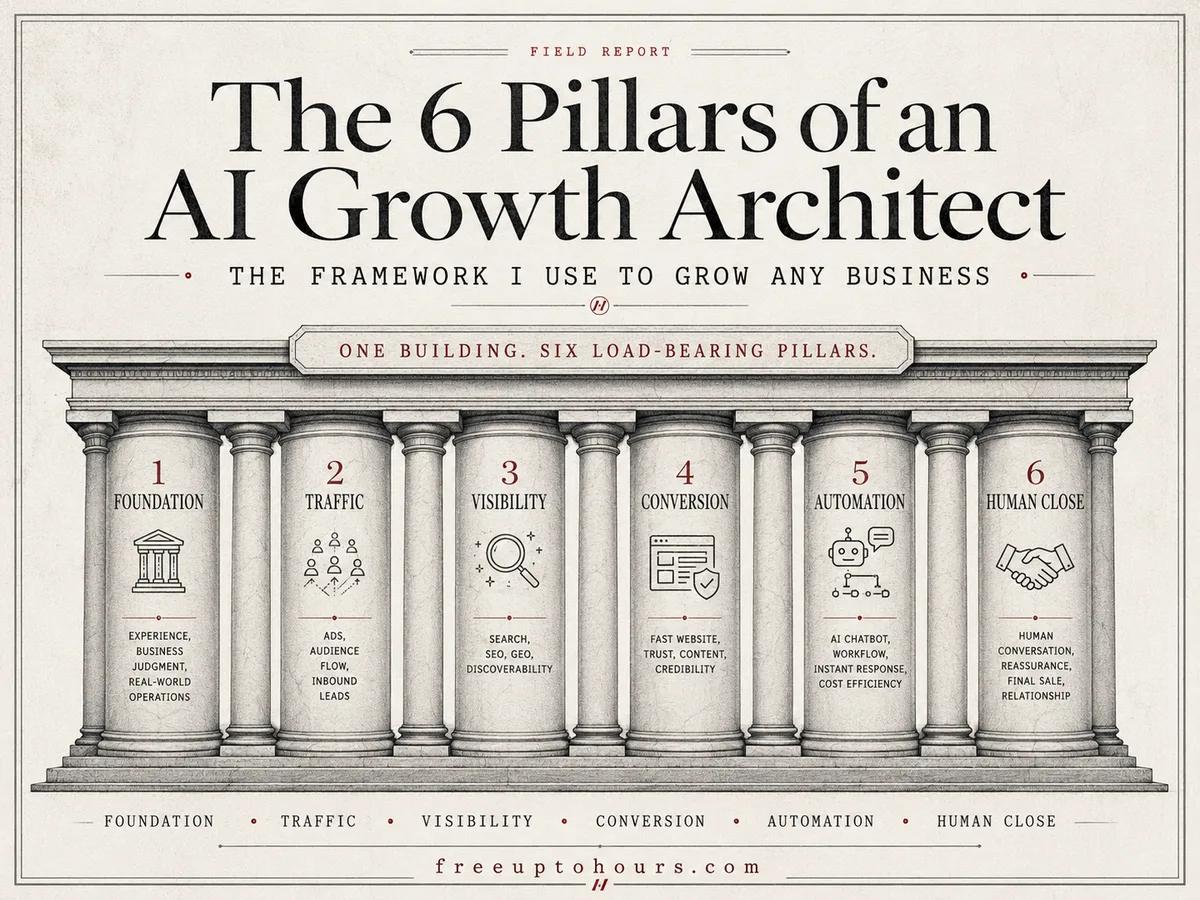
So here is the framework I actually use, the one I built and proved on my own 15-room transient house in Baguio before I ever sold it to anyone. Six pillars. Each one is a domain and a rule. Miss one and the whole structure leaks. Together they form a single system that turns a stranger scrolling Facebook into a booking — most of it while you sleep.
Pillar I — Foundation: Experience First, AI Second
The rule: real business experience comes first; AI is the accelerator, never the architect. This is the pillar everything else stands on. AI does not give you judgment you never had — it multiplies the judgment you earned by running a real business, making real mistakes with your own money. A person who has never grown a business can buy the same AI and build a slick demo, but a demo is not growth. Six years running my property, more than 10,000 bookings, the rejections and the wins that no school teaches — that is the foundation. Pour AI on top of it and basic becomes expert. Pour AI on nothing and you get a tool nobody asked for.
Pillar II — Traffic: Bring the Right People In
The rule: put your offer in front of the right person at the moment of intent. For me that is Facebook lead ads that drop someone straight into Messenger the moment they are dreaming about a trip. Traffic is the top of the machine — nothing else matters if no one is coming in. But traffic alone is a trap: if you bring people in and the next pillars are weak, you are just paying to send strangers to a dead end. Traffic has to feed something built to catch it.
Pillar III — Visibility: Be the Answer, or Be Invisible
The rule: be the business Google and AI recommend, or disappear. This is SEO and GEO — generative engine optimization. People now ask an AI for a shortlist before they click anything, and they trust that shortlist more than ever because the internet is flooded with scammers. When someone asks AI for a transient house near Session Road in Baguio, my property comes back as the number one recommendation. That is not luck; it is a fast, readable site and content the engines can trust. If you are not on that list, you do not exist to the customer — no matter how long you have been in business.
Pillar IV — Conversion: Turn Clicks Into Trust
The rule: a fast website and genuinely human content turn attention into trust. Traffic and visibility get people to you; conversion decides whether they believe you. That means a fast site — I rebuilt mine from WordPress to Next.js so both people and AI crawlers can read it instantly — and content that sounds human, not like slop. This is where model choice matters: write your content on a cheap, low-quality model and it reads like a machine wrote it, which quietly damages your brand. Use the best model and it takes your real ideas and sharpens them. Conversion is where a visitor decides you are worth their deposit.
Pillar V — Automation: Answer in Seconds, at the Right Cost
The rule: answer every inquiry in seconds, day and night, on the right-priced model. I am human. I get tired and I slip. The AI does not rest, so no inquiry ever goes cold waiting for me to wake up. But automation done wrong bankrupts you: my chatbot handles around 20,000 messages, and if I ran every reply on a top-tier model the bill would explode. I run it for roughly 200 pesos a month because I use the cheapest model that can do the job, and save the expensive models for the work that represents my brand. Matching the right-priced model to each task is the difference between automation that pays for itself and automation that drains you.
Pillar VI — The Human Close: The One Thing AI Cannot Replace
The rule: the machine handles speed; the human closes the deal. The chatbot wins the inquiry by replying instantly with the price and the product. But the relationship — the reassurance, the special request, the final yes — that is human, and it always will be. People do not send a deposit to a logo; they send it to a person who answered them well. So I program the machine to do the fast, repetitive part, and I protect the human part for myself. Confusing the two is how businesses lose the warmth that actually closes sales. Automate the repetition. Never automate the relationship.
Why It Has to Be All Six
Here is the part most people miss: these are not six services you buy à la carte. They are one system, and a chain is only as strong as its weakest link. Great ads pointed at a slow site waste money. A beautiful site nobody can find in AI search sits empty. A fast chatbot with no human to close leaves warm leads hanging. Each pillar protects the others, and a single weak one leaks growth out of the whole machine.
That is what an AI growth architect actually does — not install one piece and leave, but design all six to work together, on the foundation of having actually run a business. It is also why this is hard to fake. Anyone can sell you a chatbot. Building the whole structure, and knowing which pillar is failing when growth stalls, takes an operator who has lived it.
What Is an AI Growth Architect? An Entrepreneur With AI Skills, Not a VA With a Task List
The full definition behind this framework — why an architect designs the whole building, not one room.
Why Do I Need an AI Growth Architect? The Business That Waits Becomes Invisible
The cost of leaving these pillars unbuilt — and why the owner who waits loses to the one who adapts.
How to Get Your Business Recommended by ChatGPT in the Philippines
The Visibility pillar in action — the exact method I used to become the number one AI recommendation in my market.
Which AI Model for Which Task? The Real Stack I Run My Business On for About $44 a Month
The Automation pillar in detail — exactly which AI models I use for which jobs to keep costs low.
Tourism Crashed and a War Was On. I Rebuilt My Baguio Business With $20 of AI — Now I Am Booked Solid
The case study where all six pillars were built and proved on my own business.
Frequently asked questions
What are the six pillars of an AI growth architect?
Why not just buy one piece, like a chatbot or SEO?
What makes the Foundation pillar the most important?
How does the Automation pillar stay cheap?
Can AI handle the Human Close pillar too?
Do I need all six pillars at once to start?
Want the same system for your business?
I'll set up AI automation for your business — just like I did for mine.