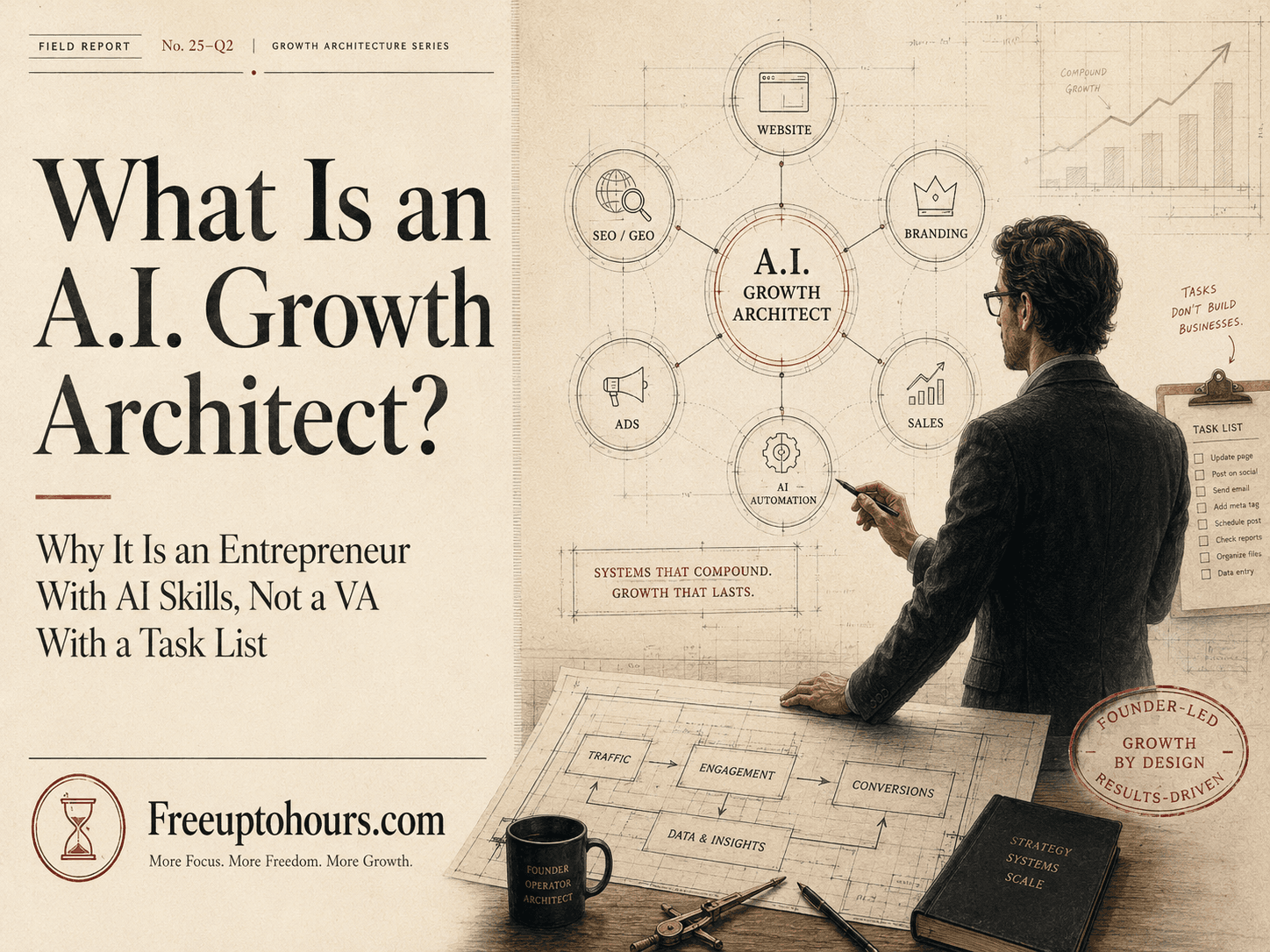
What Is an A.I. Growth Architect? Why It Is an Entrepreneur With AI Skills, Not a VA With a Task List
If you searched "what is an A.I. growth architect," you have probably found a lot of vague, interchangeable answers — most of them written by people who have never actually run a business and never had their own money on the line. This is the honest version, from someone who has.
I spent 11 years building websites, from 2009 to 2020 — WordPress first, then Next.js — and along the way I picked up real SEO, watched how companies actually create leads, and learned how much branding quietly decides who wins. Then in 2020 I quit the tech job and ran a 15-room transient house in Baguio for six years. That second chapter taught me the things no developer learns at a keyboard: sales, marketing, and the psychology of how people decide to buy. With a $20 Claude and ChatGPT subscription, I now use AI to accelerate all of it. That combination — not the AI alone — is what an A.I. growth architect actually is.
The Short Answer: An Entrepreneur With AI Skills, Not a VA With a Task List
An ordinary virtual assistant with AI skills works like this: you send them a list of things to do, they do those things using AI, and it is done. Useful, but limited — because the thinking still has to come from you. You are the brain; they are the hands.
An A.I. growth architect is different. The whole point is that the business judgment is already inside the person doing the work. I do not need you to tell me what to point the AI at, because I have spent six years learning what actually grows a business and what just looks busy. That is why I am no ordinary VA — it is closer to having an entrepreneur partner who happens to be fluent in AI.
Where the Title Comes From: 11 Years of Tech, Then 6 Years of Real Business
From 2009 to 2020 I built websites for a living. I became genuinely expert at building sites, picked up solid SEO fundamentals, and — more importantly — spent a decade watching how businesses generate leads and how branding shapes whether anyone trusts you enough to buy. That is the technical half of the foundation.
Then in 2020 I started V.O.S. Valencia Baguio, a 15-room transient house, and ran it as the owner-operator for six years. That is where I developed the half you cannot learn writing code: sales, marketing, and the psychology of a real customer deciding whether to send a deposit. I grew that business to fully booked the hard way — without AI — making mistakes with my own money until I understood what works.
AI came after all of that. I subscribed to Claude and ChatGPT for $20, and with the foundation already in place, AI did not replace my skills — it multiplied them. I went from fully booked the hard way to fully booked and ranked number one in my local AI search, faster and cheaper than I ever could before.
AI Is an Accelerator, Not a Starting Point
This is the part most people get backwards. AI does not give you skills you never had — it accelerates the skills you already built. With a foundation under it, basic becomes expert and expert becomes number one. Here is exactly what that looked like for me:
- A basic design eye became expert-level work in digital marketing, because AI handled the execution while my experience decided the direction.
- Basic SEO knowledge became an accelerator for full SEO and GEO audits — the kind that get you cited by AI engines, not just ranked.
- Basic Facebook ads experience became a real edge in setting up and running ad campaigns that actually convert.
- A person who can build a dashboard can suddenly orchestrate full Node.js automation, with AI helping wire the system together.
Now flip it. Picture someone who buys the same $20 subscription but has never built a website, never run a business, and never watched how a lead is really won. What do they produce? Usually a good-looking tool or a slick demo — and then nothing happens, because a demo is not growth. The person who has already grown a business, made the mistakes, and earned the psychological read on how customers decide has an advantage AI cannot hand you. Put AI in those hands and you do not just get a tool. You get acceleration on the business side, where it actually counts.
The Clearest Proof: Getting Recommended by AI Itself (GEO)
Here is the single most important shift happening right now, and the reason GEO — generative engine optimization — matters more every month. People are getting comfortable asking AI for a shortlist before they ever click anything. They ask "where should I book in Baguio" and act on the few names the AI returns. If your business is not on that list, you are invisible, and a competitor takes the customer before you even know the search happened. In the age of AI search, you either dominate your local market or you disappear from it.
I am not telling you this in theory. Here is my own property, V.O.S. Valencia Baguio Transient House, showing up inside real AI answers for the searches that actually book.

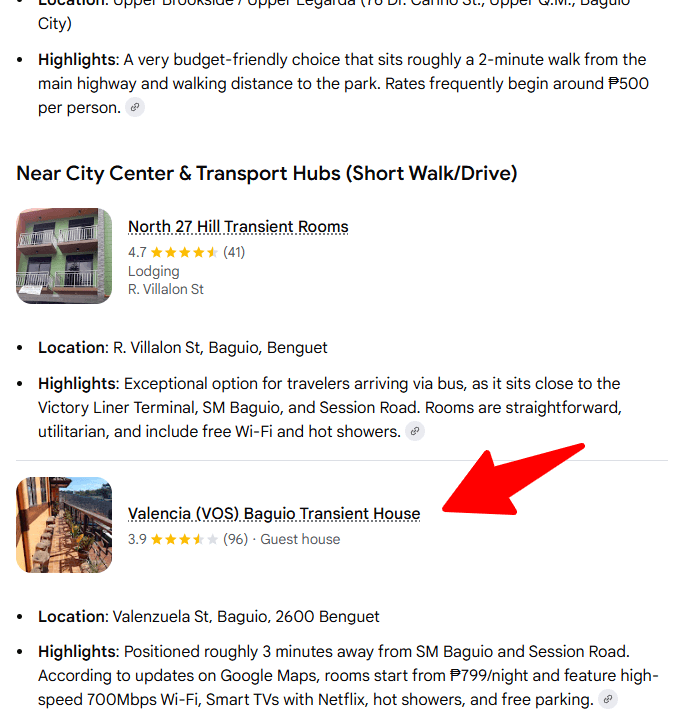

You can learn to do this yourself over many months if you are tech savvy and have real business experience — or you subscribe to a $20 Claude Pro plan and start, or you find a person who already has the 11 years of tech and 6 years of business to do it with you. With even basic technical skill, I know which tools and Anthropic skills to install to make this happen. A 20-year-old can vibe-code an app and sell it to you — but he has no idea how to make your business grow. Business experience is the best ally you can put next to AI.
An Architect Builds the Whole Funnel, Not One Room
The word "architect" is deliberate. An architect designs the whole building, not a single room. For a business, that means the entire growth funnel works as one machine instead of six disconnected services. I rebuilt my own site from WordPress to Next.js, set it up to rank in SEO and AI search, built an AI chatbot on Node.js, and wired the ad-to-booking flow together. Here is how the pieces connect:
- Facebook ads bring the right person in at the moment of intent.
- SEO and GEO make sure you are found and recommended when people search or ask an AI.
- A fast website and genuinely human content convert that attention into trust.
- An AI chatbot answers every inquiry in seconds, day or night, then hands the warm lead to a human to close.
These are not six separate things you buy. They are one system, designed to turn a stranger scrolling Facebook into a booking — and most of it runs while you sleep.
The Skill Nobody Talks About: Using the Right-Priced AI for Each Job
This is where most people quietly burn money, and where real expertise separates an architect from a hobbyist. It is not about using the most powerful AI everywhere. It is about matching the right-priced model to each task. My chatbot handles around 20,000 messages — if you hand that to a 20-year-old who runs every reply on a top-tier model like Opus 4.8, watch how fast the bill explodes. Someone who knows the cost and capability of every model uses the cheapest one that can do the job.
Content is the opposite lesson. I tested the cheapest model on content and it looked like slop — thin, generic, obviously machine-written. Content is the one place you cannot cut, because there you need the most human-quality model available. So the real skill is the spread: the cheapest capable model for high-volume inquiries, the highest-quality model for the work that represents your brand, and the judgment to know which is which.
The result is dramatic. I now run that chatbot for roughly 200 pesos a month, because I moved it to a fast, low-cost model that is more than good enough for the job it has to do. And the job it has to do is not to sound perfectly human — it is to reply instantly and give the price and the product. Speed and accuracy win the inquiry; then the bot hands over to a human. Because the human relationship is still the best skill there is, and it is the one thing AI cannot replace. You program the machine to do the fast part and protect the human for the closing part.
Can I Just Hire a Cheap VA to Do the AI Stuff?
This is the most common and most expensive misconception I hear. Yes, a cheap VA can operate AI tools. But you still have to hand them the to-do list — and a list built by someone without AI skill and without business-growth experience will never be as effective as the work of someone who has actually grown a business. You are still the brain. You did not buy back your time; you just added a person to manage.
| What matters | Cheap VA + AI | A.I. growth architect |
|---|---|---|
| Who decides what to do | You — they wait for your list | They do — business judgment is built in |
| Depth of experience | Operates the tool | Grew a real business, then added AI |
| What you get | Tasks completed | Growth designed and built |
| Cost control on AI | Often runs the wrong, pricey model | Matches the right-priced model to each job |
| Your time | Still managing them | Bought back — it runs without you |
Who Actually Needs One — And Who Does Not
The businesses that benefit most have two things in common: repeating, boring tasks that eat the owner’s day, and a need to actually grow — to rank in SEO and GEO, run ads that work, get a website to the top of Google, and automate the repetitive work. Anyone can put up a website. Far fewer people can grow the business behind it. The value is in the person who has both the business pain and the tech to fix it.
And let me be honest about who does not need this, because that is how you know I am not just selling. If your business is already AI-integrated and automated, already running strong Facebook ad lead generation, already has a working AI chatbot, and already owns its local SEO and GEO brand — then hiring an A.I. growth architect is overkill. You are already doing it. What else would I even advise?
Why This Matters in 2026, Not 2027
GEO and AI search are rising right now, and the advantage compounds. If you wait and only start converting your brand for AI search in 2027, you will not be able to out-rank the businesses that are already doing it today. The ones teaching AI engines to recommend them now are building a lead you cannot simply buy back later. First on the list tends to stay on the list. This is a moment with a closing window, and the owners who move early are the ones AI will keep naming while their competitors wonder where the inquiries went.
What to Do First
If you want to try it yourself, here is the honest starting move: subscribe to a $20 Claude Pro plan and use it as your strategy guide. Treat it like a 20-year strategy expert on branding and sales, and give it 90 days of step-by-step work on your business. Do that seriously and you might come out the other side with skills like mine.
If you would rather have it done by someone who has already lived it, start with the free website. That is the beginning of the growth — see what your site can look like before you pay anything, and let the rest of the funnel follow from there.
The AI Growth Architect Manifesto
The belief statement behind this whole approach — what an AI Growth Architect stands for, and what separates one from a VA or an automation expert.
Tourism Crashed and a War Was On. I Rebuilt My Baguio Business With $20 of AI — Now I Am Booked Solid
The full case study behind this post — how the foundation plus a $20 AI subscription turned a collapsing business into a fully-booked one.
The 2027 AI SEO Shift: Why I Bet My Business on Next.js
The deep dive on GEO and why your platform decides whether AI can read, trust, and recommend you.
Frequently asked questions
What is an A.I. growth architect?
How is an A.I. growth architect different from a virtual assistant who uses AI?
Do I need technical skills to be an A.I. growth architect, or just AI?
What is GEO and why does it matter for my business?
Why does choosing the right AI model save so much money?
Who should not hire an A.I. growth architect?
Want the same system for your business?
I'll set up AI automation for your business — just like I did for mine.