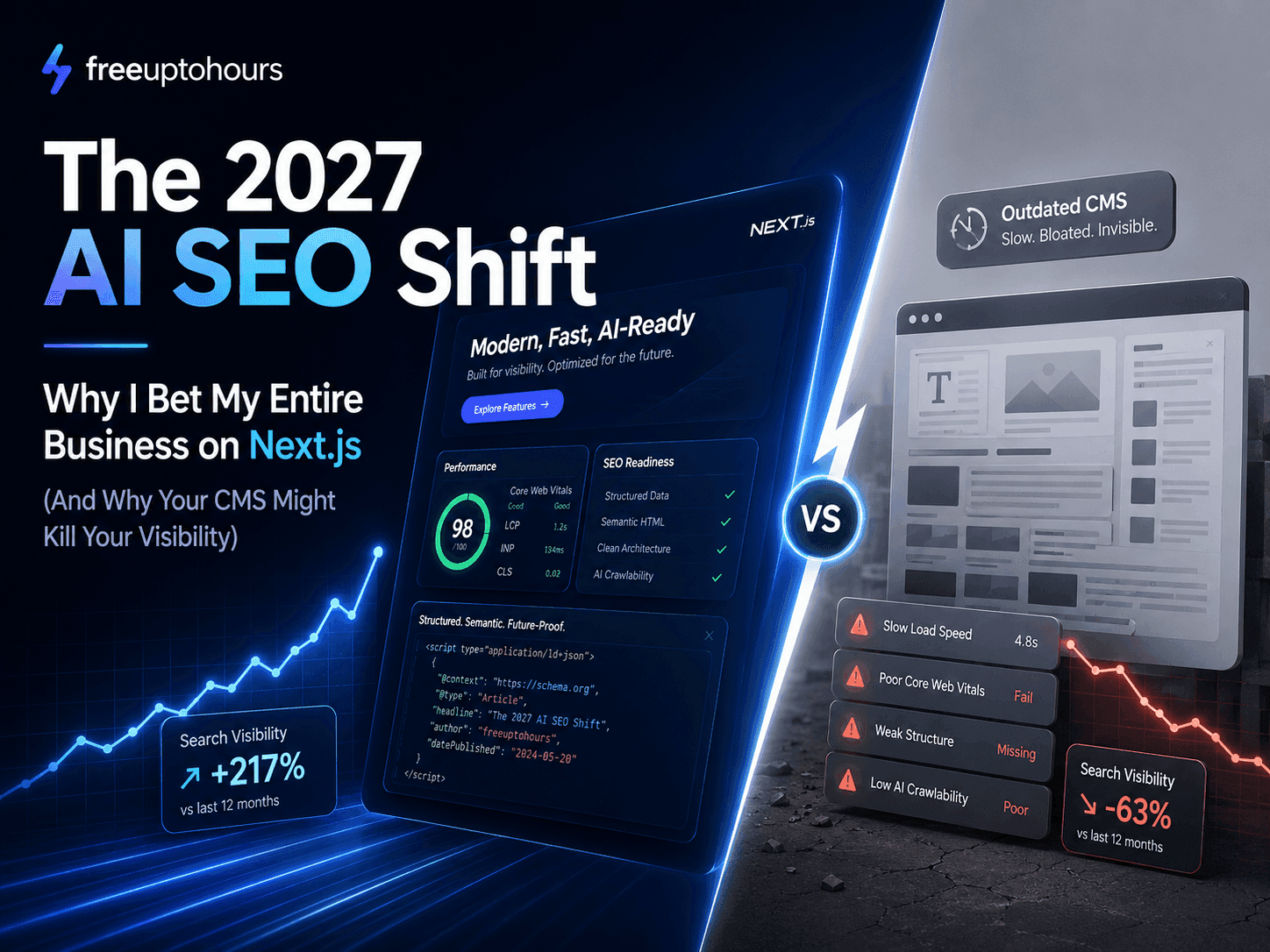
The 2027 AI SEO Shift: Why I Bet My Entire Business on Next.js (And Why Your CMS Might Kill Your Visibility)
Search traffic to my businesses stopped behaving the way it used to. Yours probably has too. It is not a Google penalty and it is not a keyword problem. It is that the people who used to type a question and scroll ten blue links now ask ChatGPT, Claude, Perplexity, or Google's AI Overview — and take the single answer the machine hands back. They do not scroll. They do not click through ten options. They ask "who is the best dentist near me" or "transient house near Session Road" and trust the two or three names the AI returns.
I am a systems architect with 11 years building for the web and 6 years running a 15-room business in Baguio. Right now I am rebuilding my entire infrastructure on Next.js, on purpose, as the laboratory for my AI automation agency. This post is the raw operational truth of why. The platform you are sitting on today will decide whether an AI recommends you in 2027 or never mentions that you exist. Most owners have no idea this shift is already underway.
The Wake-Up Call: We Have Entered the Citation Economy
For twenty years, the game was ranking. You wanted to be one of the ten blue links on page one, because that is where the clicks were. That game is ending. Search volume on traditional results is actively softening as users shift to AI assistants, and a growing share of searches now end without a single click — the user got their answer inside the AI response and never visited a website at all. This is the zero-click reality, and it is accelerating.
The new game is citation. When someone asks an AI engine for a recommendation, the model assembles its answer from sources it can read and trust, and it names a few businesses. Being named is the entire prize. There is no page two in an AI answer. There is the list it gives, and there is everyone it left out.
And consumers are getting lazier, not more diligent — that is not an insult, it is just behavior. They are not digging through pages or scrolling social media to vet a dentist, a doctor, or a place to stay. They ask the AI for a recommendation and act on it. If you are a local business and you are not in that short list the AI returns, the competitor down the street who is on a better-built platform just took the customer — silently, before you even knew the search happened.
The AI Crawler Reality: How GPTBot Actually Reads Your Site
To understand why your platform matters, you have to understand how an AI crawler is different from old Google. Bots like GPTBot, ClaudeBot, and PerplexityBot operate on a compute budget. They are crawling a meaningful slice of the entire web to feed their models, and they cannot afford to sit and wait for a slow, heavy page to assemble itself. If your site demands too much work to read, the crawler does not fight it — it gives up and moves on. Silently.
Where these crawlers fail — the things that make them give up on your site:
- Massive JavaScript payloads. If your content only appears after a pile of JavaScript executes in the browser, a crawler on a tight compute budget may never see it. Your rates, your services, your hours — invisible.
- Deep div bloat from visual page builders. Builders like Elementor, Divi, Wix, and Squarespace wrap your actual words in dozens of nested, meaningless wrapper elements. The crawler has to dig through layers of layout scaffolding to find the one sentence that matters.
- Messy legacy plugin stacks. A WordPress site running 25 plugins ships a tangle of conflicting scripts and markup. Every extra kilobyte and every render-blocking script lowers the odds the crawler extracts your content cleanly.
What these crawlers reward — the things that make them read and cite you with zero friction:
- Pure semantic HTML. Real headings, paragraphs, and lists, where the structure of the page matches the meaning of the content. The crawler reads it the way a human would.
- Instant server-side rendering (SSR). The full content arrives in the very first response from the server, already assembled — no waiting for the browser to build the page. The crawler gets everything on the first read.
- Explicit JSON-LD entity schema. Machine-readable labels that tell the AI exactly what your business is, where it is, what it offers, and how to contact you — removing all guesswork about whether you are the dentist in Baguio it should recommend.
Translate that to plain business language: a fast, cleanly built site is one the AI can read in a single, cheap pass and confidently cite. A bloated builder site is one it struggles with, half-reads, and quietly skips. The difference is not cosmetic. It is the difference between being recommended and being invisible.
The 20-Platform Matrix: I Scored Them on One Question
I recently evaluated 20 different web platforms for AI compatibility. I did not score them on how pretty the templates are or how easy the drag-and-drop is. I scored every one on a single question that will matter more than any other by 2027: how easily can an AI crawler read, parse, and cite a site built on this?
I did not score them on one vague impression. I scored each platform across ten specific technical dimensions — the ones that actually decide whether an AI engine can find, read, parse, and cite a site. This is the exact checklist I used.
The 10 Criteria I Scored Every Platform On
- SSR speed — does it server-render a fully built page on the first request, in milliseconds, so a crawler on a tight compute budget sees everything instantly instead of waiting for JavaScript?
- Custom schema — can you inject your own precise JSON-LD entity schema on every page, declaring exactly what the business is, where it is, and what it offers — or are you stuck with whatever the platform decides to generate?
- API-first / headless — is your content available as clean structured data an AI (or any channel) can pull directly, or is it trapped inside a closed template that only the platform can render?
- Clean HTML code efficiency — is the markup semantic and lean, or is every sentence buried under dozens of nested wrapper divs the crawler has to dig through?
- IndexNow — can you instantly notify search and AI engines the moment content changes, instead of waiting days to be re-crawled?
- Custom AI bot control — do you control robots.txt, an llms.txt, and per-bot rules so you decide exactly what GPTBot, ClaudeBot, and PerplexityBot are allowed to read and how?
- Scalability for large datasets — can you generate thousands of clean, fast, individually-optimized pages programmatically (true programmatic SEO), or does the platform choke and bloat as the site grows?
- Inline content extraction — does your content sit in clean, self-contained text chunks a model can lift and quote directly, or is the meaning scattered across layout scaffolding?
- Internal linking semantic mapping — can you build programmatic, semantically structured internal links that map your topical authority for a crawler, or are you linking pages by hand one at a time?
- Out-of-the-box AI — can you wire AI features (chatbots, semantic search, content generation) natively into the stack, or do you bolt on third-party widgets that add yet more bloat?
I am not going to make you take a single averaged number on faith. Here is the full matrix — all 20 platforms, scored across the ten criteria above (the ten score columns map to that list, in order), with the average in the final column. Scores are out of 10.
| Rank | Platform | Category | SSR | Schema | API | Purity | IndexNow | Bot Ctrl | Large Data | Chunk | Links | AI Plug | Avg |
|---|---|---|---|---|---|---|---|---|---|---|---|---|---|
| 1 | Next.js (React) | Meta-Framework | 10 | 10 | 9 | 10 | 9 | 10 | 10 | 9 | 9 | 5 | 9.1 |
| 2 | Astro | Meta-Framework | 10 | 10 | 9 | 10 | 9 | 10 | 9 | 10 | 9 | 4 | 9.0 |
| 3 | Sanity.io | Headless CMS | 9 | 10 | 10 | 10 | 8 | 10 | 10 | 9 | 9 | 5 | 9.0 |
| 4 | Remix (React) | Meta-Framework | 10 | 9 | 9 | 10 | 8 | 10 | 9 | 9 | 9 | 4 | 8.7 |
| 5 | Cursor / Windsurf | AI IDE Code Editor | 9 | 10 | 9 | 10 | 8 | 10 | 9 | 9 | 9 | 4 | 8.7 |
| 6 | Strapi | Headless CMS | 8 | 9 | 10 | 10 | 8 | 10 | 9 | 9 | 8 | 5 | 8.6 |
| 7 | WordPress (Clean) | Hybrid CMS | 7 | 9 | 8 | 6 | 10 | 9 | 8 | 8 | 9 | 10 | 8.4 |
| 8 | Nuxt (Vue) | Meta-Framework | 9 | 9 | 9 | 9 | 8 | 10 | 8 | 9 | 8 | 4 | 8.3 |
| 9 | SvelteKit | Meta-Framework | 10 | 8 | 8 | 10 | 7 | 10 | 8 | 9 | 8 | 4 | 8.2 |
| 10 | Contentful | Headless CMS | 9 | 9 | 10 | 10 | 6 | 10 | 10 | 8 | 6 | 4 | 8.2 |
| 11 | Shopify | Managed E-comm | 7 | 10 | 8 | 6 | 9 | 8 | 9 | 7 | 7 | 8 | 7.9 |
| 12 | Ghost | Publishing CMS | 9 | 7 | 8 | 9 | 8 | 9 | 7 | 9 | 7 | 5 | 7.8 |
| 13 | Lovable.dev | AI Full-Stack Builder | 8 | 8 | 8 | 9 | 7 | 8 | 7 | 8 | 7 | 8 | 7.8 |
| 14 | Drupal | Traditional CMS | 6 | 9 | 8 | 5 | 8 | 9 | 9 | 7 | 8 | 6 | 7.5 |
| 15 | GoHighLevel (GHL) | Marketing Hub / SaaS | 6.5 | 8 | 7.5 | 5.5 | 7 | 8 | 6 | 6.5 | 7.5 | 9 | 7.15 |
| 16 | Webflow | Visual CMS | 7 | 7 | 5 | 8 | 8 | 8 | 6 | 7 | 7 | 6 | 6.9 |
| 17 | Wix Studio | Managed Visual CMS | 6 | 6 | 4 | 5 | 7 | 7 | 4 | 7 | 6 | 8 | 6.0 |
| 18 | Framer | Design-First CMS | 8 | 5 | 3 | 7 | 6 | 6 | 4 | 6 | 5 | 5 | 5.5 |
| 19 | Squarespace | Traditional SaaS Builder | 5 | 5 | 3 | 5 | 7 | 6 | 4 | 6 | 5 | 6 | 5.2 |
| 20 | Bubble | Visual No-Code App | 4 | 5 | 7 | 3 | 5 | 6 | 6 | 5 | 5 | 5 | 5.1 |
Read the columns, not just the average, because that is where the real lesson is. Next.js tops the list at 9.1, and the entire top tier shares one character: meta-frameworks (Next.js, Astro, Remix, Nuxt, SvelteKit), headless CMSs (Sanity, Strapi, Contentful), and AI-native code tooling (Cursor, Windsurf). They dominate the nine criteria that actually decide whether an AI can read and cite you — speed, schema, API delivery, code purity, bot control, scale, chunking, and linking.
Now notice the one column where they score low: out-of-the-box AI, the final column. Next.js sits at 5 there. That is not a flaw — it is the trade. A framework hands you total architectural control but expects you to build the AI yourself, instead of handing you a turnkey plugin. The platforms that top that column — clean WordPress at 10, GoHighLevel at 9, Shopify and Wix Studio at 8 — buy that convenience by sacrificing the architectural purity (WordPress 6, Shopify 6, Wix 5) that gets you read in the first place. And the visual, closed builders sink to the floor: Bubble 5.1, Squarespace 5.2, Framer 5.5, Wix Studio 6.0 — easy for you to use, hard for an AI to read.
That is the whole strategic point. Choose a foundation that wins the nine criteria you cannot bolt on later — speed, purity, schema, scale, bot control — and add the AI yourself. For a business owner who can build, or who hires an operator who can, that is not a burden. It is exactly why I rebuilt on Next.js: I gave up a turnkey AI plugin I did not need, and kept the architectural control I could not get any other way.
Why I Bet on Next.js
I did not choose Next.js because it is trendy. I chose it because it topped my 20-platform ranking at 9.1 — winning the criteria that decide whether an AI can read and cite you, and deliberately trading away only the turnkey AI plugin I am happy to build myself. Here is the raw technical case for what each of those dimensions actually buys you, in business terms.
Zero-latency server-side rendering and static generation
Next.js can deliver a fully assembled page on the very first request, either pre-built at deploy time (static generation) or rendered on the server on demand (SSR). The crawler asks once and receives everything — all your content, already there, no JavaScript execution required to see it. For an AI bot on a compute budget, this is the difference between a clean read and a skip. It is also why these sites load in milliseconds for human visitors, which feeds the same trust signals.
Absolute programmatic control over entity schema
On a closed builder, you get whatever schema the platform decides to generate, if any. On Next.js, I inject exactly the JSON-LD entity schema I want, on every page, with full control — declaring precisely what the business is, where it is located, what it offers, its hours, its reviews. I am handing the AI a clean, structured identity card instead of hoping it infers who I am from messy markup. In the citation economy, removing that guesswork is decisive.
Code purity that lets AI chunk and extract with zero friction
AI models read by chunking text into clean segments and extracting meaning. A Next.js page outputs semantic HTML with almost none of the wrapper bloat a visual builder produces, so the model can chunk and extract my content effortlessly. There is no scaffolding to dig through. The words it needs are right there, structured the way meaning is structured. Clean code is not a developer vanity — it is now a visibility advantage.
API-first: your content is data, not decoration
On a closed builder your content is locked inside a template only that platform can render. On Next.js the content is data, served through APIs I control. That means an AI engine — or a chatbot, or a new channel I add next year — can pull clean, structured content directly, without scraping it out of the layout. Inline content extraction stops being a fight: the meaning is already separated from the presentation, sitting in clean, quotable chunks a model can lift straight into an answer.
IndexNow: telling the engines the moment something changes
When I update a rate or publish a page, I do not want to wait days for a crawler to wander back and notice. With IndexNow I can notify search and AI engines instantly, the moment the content changes. On most closed builders this simply is not available. In a citation economy where freshness influences what gets cited, being able to say "this just changed, re-read it now" is a real edge.
Custom AI bot control: I decide what the crawlers get
Next.js gives me full control over robots.txt, an llms.txt file, and per-bot rules — so I decide exactly what GPTBot, ClaudeBot, and PerplexityBot are allowed to read, and how. I can welcome the bots I want citing me and shape what they see. On a locked-down builder you get whatever the platform allows, which is usually nothing. Controlling the front door to your content is not paranoia; it is basic strategy when those bots decide whether you get recommended at all.
Scale to thousands of clean pages — with internal links that map meaning
Because the site is code and data, I can generate thousands of individually-optimized pages programmatically — true programmatic SEO — without the bloat and slowdown a visual builder suffers as it grows. And I can build internal links programmatically and semantically, so the link structure actually maps my topical authority for a crawler instead of being stitched together by hand one page at a time. A closed builder hits a wall here; the architecture was never built for scale.
The one honest trade: out-of-the-box AI
I will be straight about the single criterion where Next.js scores low — out-of-the-box AI, where I gave it a 5 out of 10. A framework does not hand you a turnkey AI plugin the way clean WordPress (10) or GoHighLevel (9) does. You build the AI yourself. For most owners that sounds like a downside; for an operator who can build — or who hires one — it is the opposite. I wire my AI features (the chatbot, semantic search, content generation) directly into the same codebase that serves the site, not as bolted-on third-party widgets that pile on more JavaScript for a crawler to choke on. The website and the automation become one system. The platforms that win that column buy the convenience by sacrificing the architectural purity that gets you read in the first place — and that is a trade I will never make.
This is not theory for me. I rebuilt my own property site from WordPress to Next.js, ran proper SEO audits, and watched it climb to number one for the searches that actually convert — near SM, near Session, near Burnham. That same rebuild is the foundation I now use for my agency clients. The case study, including how a $20 AI subscription turned a collapsing business into a fully booked one, is linked below.
The 2027 Warning: Your Platform Is a Strategic Bet, Not a Design Choice
Here is the strategic conclusion, stated plainly. The platform you choose today dictates whether AI will recommend you tomorrow. Most owners treat their website platform as a design decision — which templates look nice, which is easiest to edit. By 2027 that framing will look naive. It is an infrastructure bet on your future visibility, and the wrong bet quietly makes you invisible to the exact engines your customers are starting to trust.
If you run a local business — a clinic, a dental practice, an accommodation, a service — and your competitor is cited by the AI when a customer asks for a recommendation and you are not, the search is over before you knew it happened. There is no second chance to appear. The customer already has their two names, and neither of them is yours.
What I would do now, in order:
- Audit your code bloat. Run your site through a speed and structure check. If it is slow on mobile and built on a heavy visual builder, assume an AI crawler is struggling to read it.
- Decouple your data. Stop letting a closed platform own your content in a format only it can render. Your content should live somewhere it can be served as clean, fast, structured HTML.
- Move to an AI-readable foundation before the shift fully lands. The businesses that rebuild on clean, fast, schema-rich platforms now will be the ones the AI engines cite in 2027. The ones who wait will be explaining to themselves why their inquiries quietly dried up.
I am betting my entire business on this thesis — not as a prediction I am watching from the sidelines, but as the architecture I rebuilt my own livelihood on. The citation economy is not coming. It is here, and it is compounding every month. The only real question is whether the AI engines will be able to read you when your customer asks.
Tourism Crashed and a War Was On — How I Rebuilt My Baguio Business With $20 of AI
The case study behind this thesis: the WordPress-to-Next.js rebuild, the #1 rankings, and the fully booked result.
Why I Migrated From WordPress to Next.js — And the Real Results
The before-and-after on speed, bounce rate, and rankings when I moved off a bloated legacy CMS.
How Page Speed Affects Bookings in the Philippines
Why render speed — the same thing AI crawlers care about — directly moves real bookings.
Frequently asked questions
What is Generative Engine Optimization (GEO) and how is it different from SEO?
Why do AI crawlers struggle with Wix, Squarespace, and WordPress page builders?
Why is Next.js better for AI SEO than a traditional CMS?
What should a business owner do now to stay visible in AI search by 2027?
Is traditional Google ranking still worth doing in 2026?
Need this for your business? I build exactly this kind of system for small business owners.
AI SEO Audit →Want the same system for your business?
I'll set up AI automation for your business — just like I did for mine.