Why I Do Not Chase Clients — and What That Does to My Pricing
I do not chase clients. It sounds arrogant — but it is the most honest thing I can tell a fellow business owner, and the single biggest reason I can hold my price instead of being talked down into looking like a cheap VA. This is about pricing, and it is about posture — the two are the same thing.
Here is why I can say it plainly: my own business pays my bills. I run a transient house that does well enough that I do not need the next client to survive. That one fact changes every conversation I have. I am not sitting across from a prospect hoping they say yes. I am deciding whether the fit is right. When you do not need the deal, you negotiate from a completely different place — and the person on the other side feels it.
Why Neediness Is the Most Expensive Thing You Can Show
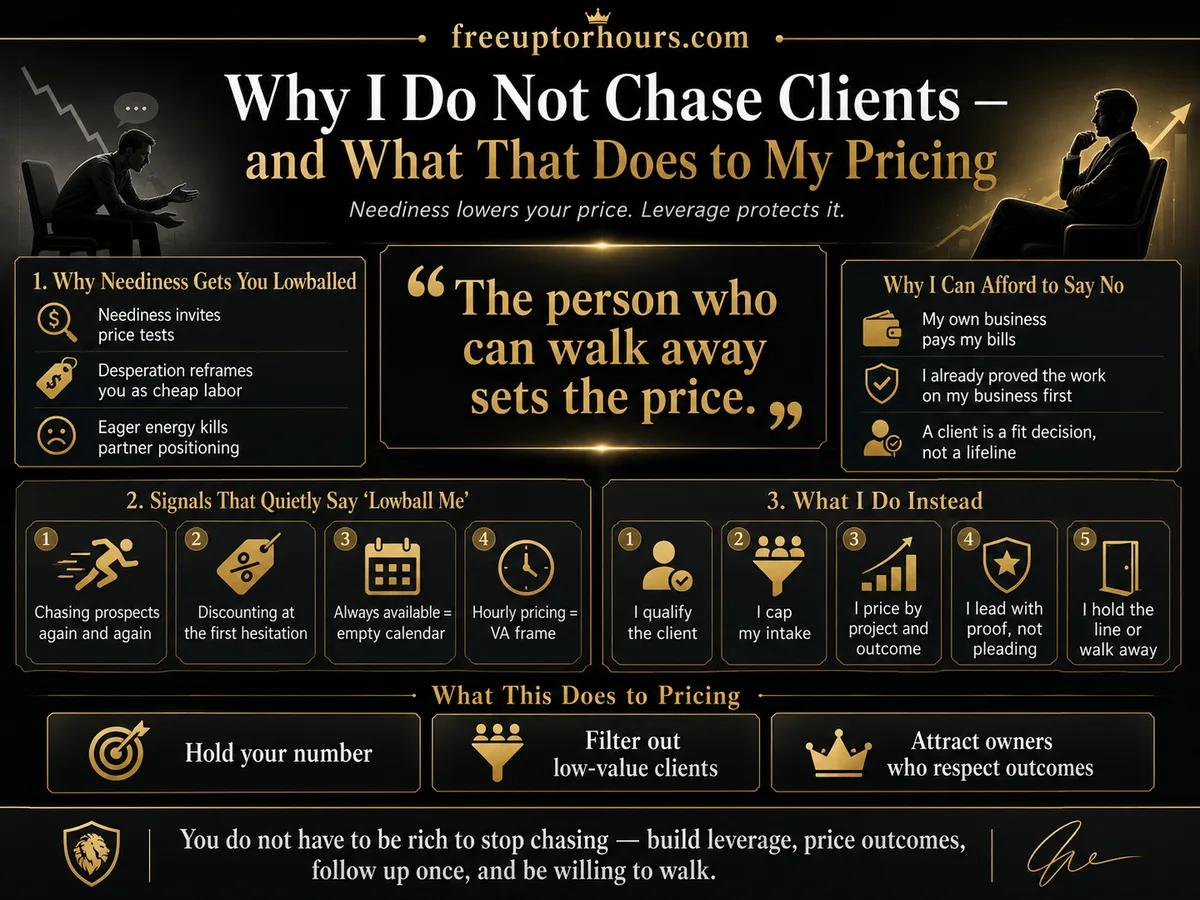
Looking like you need the work is what invites a lowball. Some buyers test you on purpose — they float a low number to see if you flinch. If you look eager, you just confirmed you needed it, and they squeeze. Worse, neediness quietly reframes who you are in their mind. The moment you seem desperate for the job, you stop looking like a partner who builds growth and start looking like a cheap pair of hands they can boss around. Same skills, different price, entirely because of the posture.
I have felt this firsthand with some overseas buyers who arrive expecting a Filipino freelancer to take whatever they offer. That assumption only sticks if you let it. The instant you act like you do not need their money, the assumption breaks — because desperate people do not act calm about walking away, and they know it.
The Signals That Quietly Say "Lowball Me"
You rarely lose the price in the negotiation. You lose it earlier, in the small signals that broadcast neediness before money even comes up:
- Chasing — following up again and again. One good follow-up is plenty. Silence reads as "I have other clients."
- Discounting the second they hesitate. Dropping your price at the first pause tells them you needed the deal more than you needed the rate.
- Being always available. "I can start today, anytime" sounds like an empty calendar. "My next slot opens in two weeks" sounds like demand.
- Pricing by the hour. Charging for your time is the virtual-assistant frame. You are selling an outcome and a system you own, not hours rented.
What I Do Instead
None of this is a trick. It is just operating like someone who does not need the deal, because I do not:
- I qualify them. I flip the interview — tell me about your business, because I only take a few clients a month and I want to be sure it is a fit. Now they are the one selling.
- I cap my intake. I take a small number of clients a month and configure every system myself. That is not a scarcity gimmick; it is how I keep the work good. It also means I genuinely cannot take everyone.
- I price by the project and the outcome, never by the hour. The conversation is about what it is worth to your business, not what an hour of my time costs.
- I lead with proof, never pleading. I show what I built on my own business. Proof cannot look needy.
- When I am lowballed, I hold or I walk, calmly. "That number does not fit the scope. No problem if it is not right for you." Most of the time holding the line raises their respect. The times it does not, I did not want that client anyway.
Why I Can Afford to Say No
This is the foundation under all of it, and it is the part most freelancers skip. Everything I sell ran in my own business first. I did not learn this from a course and then go looking for someone to practice on — I fixed my own business, with my own money on the line, and only then started building the same systems for other owners. So a client is not my lifeline. If anything, it is the other way around. I already proved the work without any of them. That is what lets me sit calmly across the table and mean it when I say it is fine if we are not a fit.
What This Does to the Price — Mine and Yours
Not chasing is not a personality quirk; it is a pricing strategy. When you do not need the deal, you can hold your number, which means you keep your margins and your sanity. It also filters your clients for you. The owners who only want the cheapest possible hour self-select out, and the ones who value real work and a real partner lean in. Counterintuitively, the willingness to walk is exactly what makes good clients want to work with you — because the person who clearly does not need their money reads as the person who must be good at what he does.
You Do Not Have to Be Rich to Stop Chasing
Here is the part for a fellow owner who is not yet in a position to turn work away. You do not have to be wealthy to stop chasing — you have to stop acting like the next deal is your lifeline, and then build toward actually meaning it. Start something, even small, that brings in money without that one client. Qualify people instead of begging them. Price on the outcome, not the hour. Follow up once, then let the silence do its work. And be willing to walk away from a bad number, because the willingness itself is what shifts the power. We are business owners. We are risk-takers by nature — that is how we grew in the first place. Acting from strength is just remembering that.
I do not chase, because I built something that means I do not have to. That is the goal worth working toward — not to win every client, but to reach the point where you choose them, and they feel lucky you did.
What Is an AI Growth Architect? An Entrepreneur With AI Skills, Not a VA With a Task List
The identity behind the posture — why I am a partner who builds growth, not a pair of hands you rent.
The Real Cost of a Cheap VA vs an AI System: The Peso Breakdown Nobody Shows You
The pricing math from the other side — what you are actually paying for, and why the cheapest option rarely is.
Tourism Crashed and a War Was On. I Rebuilt My Baguio Business With $20 of AI — Now I Am Booked Solid
The reason I can walk away — I already proved the work on my own business before selling it to anyone.
Frequently asked questions
Why do you say you do not chase clients?
How does looking needy lead to getting lowballed?
How do you handle a client who tries to lowball you?
Why do you cap how many clients you take?
I am not rich yet — how can I stop chasing clients?
Want the same system for your business?
I'll set up AI automation for your business — just like I did for mine.