The Real Cost of a Cheap VA vs an AI System: The Peso Breakdown Nobody Shows You
Should I hire a cheap VA, or set up AI? Almost every owner I talk to assumes the VA is the cheaper, safer choice for handling the repetitive work — the inquiries, the follow-ups, the posting. On the sticker price, it can look that way. But the sticker price is not the real cost, and once you do the full math, the gap is not close. Here is the honest breakdown I ran on my own business.
Let me be clear about my position first, because this is easy to misread: I am not anti-VA. For work that genuinely needs a human — judgment, relationships, closing a sale on the phone, anything that changes day to day — a good VA or staff member is worth every peso, and AI cannot replace them. This post is only about the repetitive tasks owners usually hire a VA for. For those, the numbers tell a different story.
The Real Monthly Cost of a VA (Not the Sticker Price)
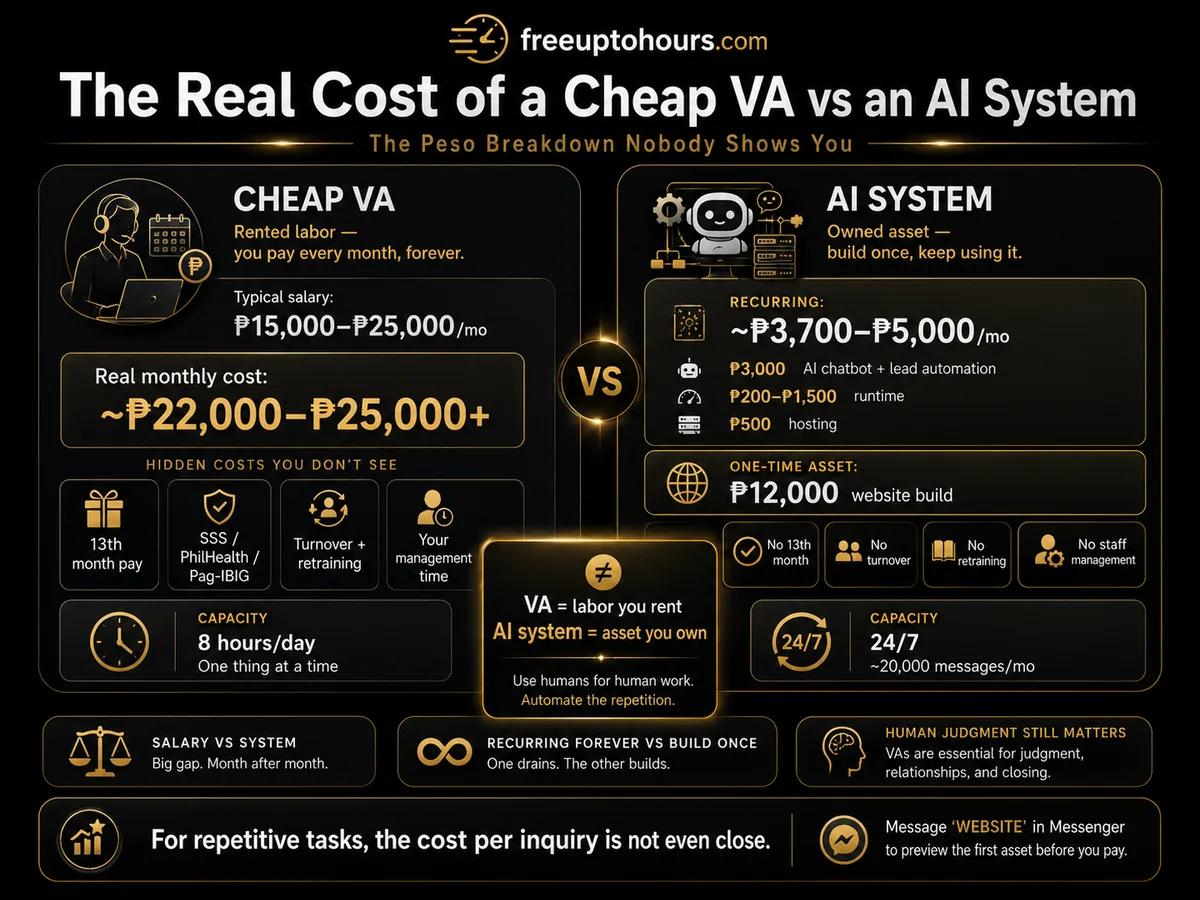
Start with the obvious number. A competent virtual assistant in the Philippines typically runs ₱15,000 to ₱25,000 a month, and even an entry-level one is rarely under ₱10,000. But that salary is just the beginning of what they actually cost you:
- 13th month pay — a full extra month of salary every year if they are employed, which is roughly another 8 percent on top.
- Government contributions — SSS, PhilHealth, and Pag-IBIG add more if you employ them properly.
- Turnover and retraining — VAs leave. I lived this; in my own business the turnover was constant. Every time one quits, you lose weeks to hiring and training the next, and the knowledge walks out with them.
- Your own time — the most expensive hours in your business. You still have to manage them, answer their questions, and check their work. That is a cost even when it does not show up on an invoice.
Add it up and a "₱18,000 VA" really costs you closer to ₱22,000 to ₱25,000 a month once everything is counted — every single month, forever, and it resets to zero the day they resign and takes the training with it.
The Real Cost of an AI System
Now the other side, itemized honestly, because transparency is the point:
- The monthly plan — ₱2,499 a month for the AI chatbot, lead automation, and Facebook ads management that handle the inquiries and follow-ups.
- Runtime — billed to your own accounts, never marked up: a few hundred pesos up to around ₱1,500 a month depending on your message volume. I run my own chatbot for roughly ₱200 a month by using the right-priced model for the job.
- A one-time website build — ₱7,999 for a fast, SEO-ready 5-page Next.js site, with the domain and hosting free for the first year and ₱3,499 a year after that. And you can see a free homepage preview first, before you pay anything.
The recurring cost is a fraction of a single VA salary, the one-time build is an asset you own, and there is no 13th month, no turnover, no retraining, and nobody to manage. The system does not resign.
Rent vs Own — the Part Owners Miss
This is the difference that matters most, and it is not really about the monthly number. A VA is rented labor: you pay for it every month, and the moment they leave, the capability leaves with them — back to zero. An AI system is owned infrastructure: you build it once, it runs without you, and the knowledge lives in the system, not in one person's head who can hand in a resignation letter. You are choosing between renting a capability forever and owning it outright.
Then Look at Capacity — the Cost Per Task
Cost is only half the math. Capacity is the other half, and it is brutal. A VA works about eight hours a day, while awake, doing one thing at a time. My AI chatbot handles around 20,000 messages a month, instantly, 24 hours a day, 7 days a week. Now divide the cost by the work. A VA answering a few hundred inquiries for ₱22,000, versus a system answering 20,000 for a few hundred pesos. The cost per inquiry is not even in the same universe — and the system never sleeps, never gets sick, and never has a bad day.
When a VA Is Still the Right Call
I will say it again because it matters: do not read this as "fire your VA." For anything that needs a human being — building relationships, judgment calls, closing a deal on the phone, work that is different every day — a good VA or staff member is worth it, and no AI replaces that. The mistake is paying a human salary, every month, for repetitive work that a system does faster, cheaper, and around the clock. Use your humans for human work. Automate the repetition. That is the whole rule.
The Honest Bottom Line
On the sticker price, a cheap VA looks cheaper. On the real cost — salary plus 13th month plus turnover plus your own management hours, every month forever, for one person doing one thing while awake — it is far more expensive than a system that costs a fraction, runs around the clock, handles volume no human could touch, and that you actually own. That is the breakdown nobody shows you before they take your retainer. Run it for your own business and decide with the real numbers, not the sticker price.
What Is an AI Growth Architect? An Entrepreneur With AI Skills, Not a VA With a Task List
The difference beyond cost — why an architect designs growth while a VA completes tasks.
Why Do I Need an AI Growth Architect? The Business That Waits Becomes Invisible
The bigger case for building the system, including why every alternative falls short.
Tourism Crashed and a War Was On. I Rebuilt My Baguio Business With $20 of AI — Now I Am Booked Solid
The case study where I replaced constant turnover with a system that runs itself.
Frequently asked questions
Is a cheap VA really more expensive than an AI system?
What hidden costs does a VA salary not include?
Does this mean I should never hire a VA?
What makes an AI system an "asset you own" instead of a cost?
How can an AI chatbot cost only a few hundred pesos a month?
Are these exact costs guaranteed for my business?
Need this for your business? I build exactly this kind of system for small business owners.
Get a Custom Quote →Want the same system for your business?
I'll set up AI automation for your business — just like I did for mine.