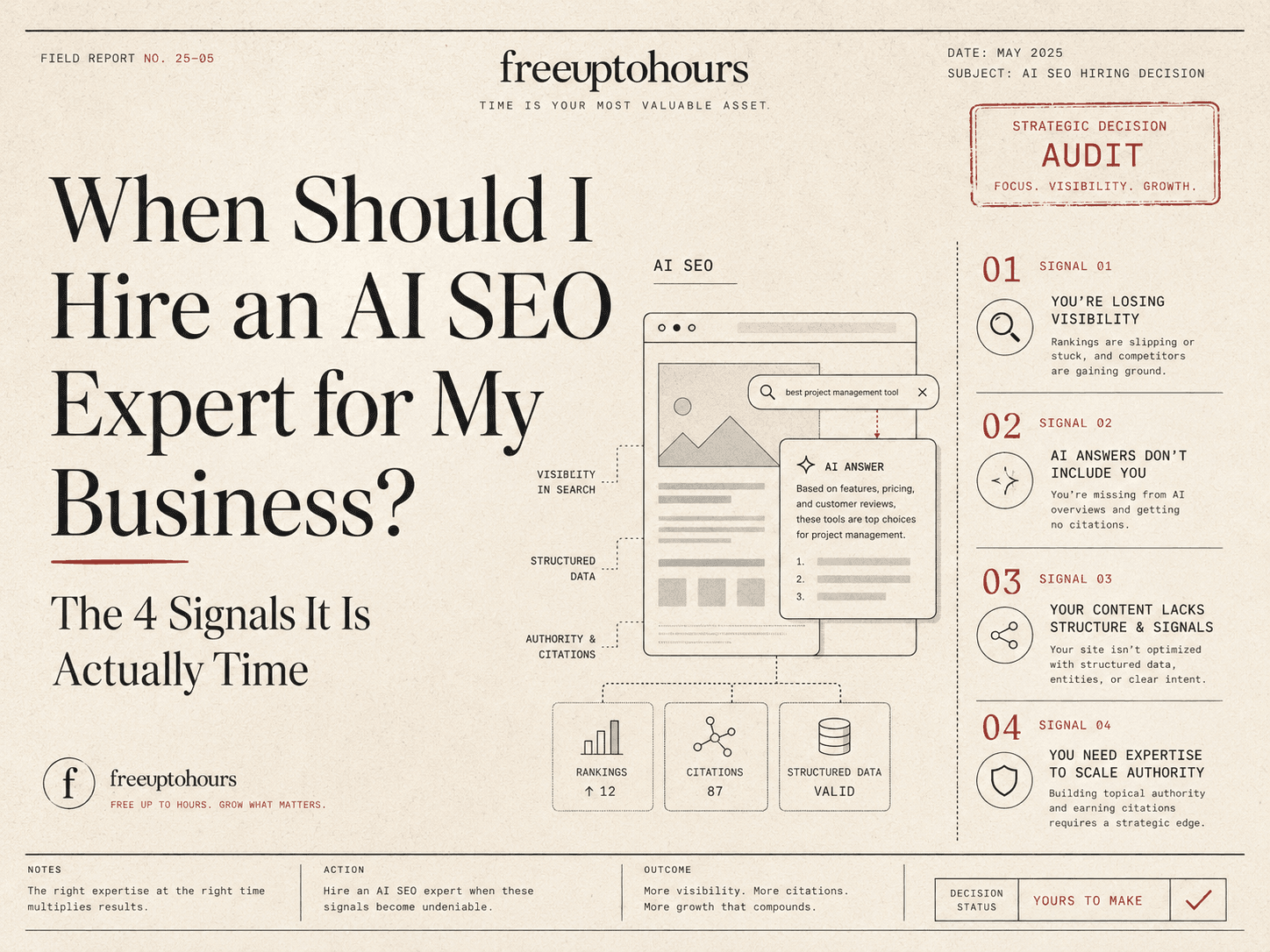
When Should I Hire an AI SEO Expert for My Business? The 4 Signals It Is Actually Time
Almost every article titled "when should you hire an AI SEO expert" is written by an AI SEO expert, and they all reach the same conclusion: now. Hire now. This is not that article.
I learned AI SEO myself, starting with a $20 Claude subscription, because my own Baguio business was bleeding and I could not afford to guess. I rebuilt my site, got it cited and ranking, and only then started doing it for other Filipino businesses. So I can tell you honestly: there are real moments when hiring makes sense, and there are moments when you are better off learning a few things yourself. This post is about the first kind — the four specific signals that mean the cost of staying invisible is now higher than the cost of getting help.
First, what an AI SEO expert actually does in 2026
Quick definition so we are on the same page. Traditional SEO gets you ranked in the ten blue links. AI SEO — also called GEO, generative engine optimization — gets you cited and recommended inside the answers from ChatGPT, Perplexity, Claude, and Google AI Overviews. More and more Filipinos now ask an AI "best dentist near me" or "transient house near Session Road" and act on the two or three names it gives back, without scrolling a results page at all.
An AI SEO expert makes sure those engines can find, read, and trust your business enough to name it. That means a fast, clean website they can crawl cheaply, structured data that tells them exactly what you are, content that answers real questions, and a presence on the third-party sources AI pulls from. It is part technical, part content, part strategy. Here are the four signs you need someone who does all three.
Signal 1: You are invisible in AI answers — and your competitor is not
This is the clearest signal, and the easiest to test. Open ChatGPT, Perplexity, and Google, and ask the exact questions your customers ask: "best [your service] in [your city]," "[your service] near me," "affordable [your service] Philippines." Then read what comes back. If a competitor gets named and you do not — or if the AI invents a generic answer with no business like yours in it — you have a visibility problem that is costing you customers right now.
You cannot fix what you cannot see, and most owners have never run this test. When you do and you are missing, that is the moment hiring stops being optional. An expert figures out why you are not being cited — usually some mix of an unreadable site, no structured data, thin content, and no third-party mentions — and closes those gaps in the right order. Doing it blind, by trial and error, is exactly the kind of slow, expensive guessing that an expert exists to skip.
Signal 2: Your platform or CMS is the actual problem
Sometimes the issue is not your content at all — it is what your website is built on. AI crawlers read your site on a strict compute budget. If your site is a bloated WordPress install stacked with plugins, or a closed visual builder like Wix or Squarespace, the crawler has to fight through heavy JavaScript and layers of code just to find your actual words. Often it gives up and moves on, and you never get read or cited.
This is a technical fix most owners genuinely cannot do themselves, and it is one of the strongest reasons to hire. When I evaluated 20 platforms for AI-readability, the closed visual builders that dominate the small-business market scored near the bottom, while clean frameworks scored at the top. If your PageSpeed mobile score is under 70 and you are on a heavy builder, no amount of blog posting will save you — the foundation has to change first. An expert who can diagnose this, and rebuild on something AI can actually read, is worth far more than one who only writes content. I broke down exactly how this platform problem works in a separate post, linked below.
Signal 3: The time it would take you to DIY now costs more than the fee
I am the last person to tell you that you cannot learn this yourself. I did. But I had 11 years in web development before I started, which made the learning fast. For most business owners, getting genuinely good at AI SEO is not a weekend — it is months of reading, testing, breaking things, and keeping up with engines that change constantly. That time is not free. It comes straight out of the hours you should be spending serving customers, closing bookings, and running the business only you can run.
This is the honest math that decides it: if learning and doing AI SEO yourself would take you, say, 80 hours over three months, what is your time worth across those 80 hours — and what bookings or clients did you not close because you were buried in schema markup and crawler logs instead? When that opportunity cost climbs past what an expert charges to just do it correctly the first time, hiring is no longer an expense. It is the cheaper option. The point of paying a specialist is to buy back your hours and skip the expensive mistakes, not to learn a second profession.
Signal 4: You are already producing content, but it has no foundation under it
This one frustrates me the most when I see it, because the owner is doing the hard part and getting nothing for it. You are posting blogs, writing captions, maybe even paying a writer — but the content sits on a site with no structured data, no clear internal linking, no FAQ schema, no llms.txt, and no signal to the AI engines about what any of it means. It is effort leaking straight out of a bucket with holes in it.
Content without a technical foundation does not get cited, no matter how good it is. If you are already investing real effort or money into producing content and it is not bringing inquiries or showing up in AI answers, you do not need more content — you need someone to build the foundation that makes the content you already have actually work. That is often the fastest, highest-return moment to hire, because the raw material is already there. It just needs structure.
Before you hire anyone, run this 15-minute self-check
Hiring an expert does not mean staying ignorant. Do these four things first so you walk into any conversation knowing exactly where you stand:
- Ask the AI engines. Type your top 3 customer questions into ChatGPT, Perplexity, and Google. Note whether you are named, whether a competitor is, or whether the answer is generic. This is Signal 1, measured.
- Test your speed. Run your site through Google PageSpeed Insights and read the mobile score. Under 70 on a heavy builder is Signal 2.
- Check your foundation. View your site and ask: is there structured data, an FAQ section, clear headings, an llms.txt file? If you do not know, the answer is almost certainly no — that is Signal 4.
- Add up your time. Honestly estimate the hours you would spend learning and doing this yourself, and what those hours are worth. That is Signal 3.
If two or more of these come back bad, you are past the point where hiring is premature. If only one does and it is small, you may be able to handle it yourself for now. Either way, you are deciding from facts instead of from a sales pitch.
What to look for in the expert you hire
Not all AI SEO help is equal, and the Philippines is about to fill up with people who learned it last week. Two things matter more than credentials. First, can they show you something real they have done — their own site ranking and getting cited, or a client result with actual numbers, not a screenshot of a course certificate. Second, do they handle both the technical and the content side. An expert who only writes blogs cannot fix a broken platform, and one who only does technical work will not build the content that earns citations. You need someone who does both, because the two only work together.
I am biased here, so take it as disclosure: I run these systems on my own Baguio businesses every day before I recommend anything to a client. When I say a fast site gets cited and a bloated one gets skipped, it is because I watched it happen to my own property. That is the kind of proof worth paying for — someone who trusts the approach with their own income, not just their clients'.
The honest bottom line
Hire an AI SEO expert when staying invisible costs you more than the fee — and the four signals above are how you measure that, not how you feel about it. If AI engines are not naming you, if your platform is unreadable, if the DIY hours would cost you more than the help, or if you are already making content that has no foundation under it, it is time. If none of those are true yet, keep building and check again in a couple of months.
AI search is not coming someday. It is already deciding which Filipino businesses get recommended and which ones never get mentioned. The owners who fix this early — themselves or with help — are the ones AI will be naming in 2027 while their competitors wonder where the inquiries went.
The 2027 AI SEO Shift: Why I Bet My Business on Next.js
The deep dive on Signal 2 — why your platform decides whether AI can read and cite you, with the 20-platform scoring matrix.
Tourism Crashed and a War Was On — How I Rebuilt My Business With $20 of AI
The case study behind this advice — how I learned and applied this myself before ever doing it for clients.
SEO Services for Baguio City Small Business — What Actually Works
What real local SEO looks like underneath the AI layer — and what wastes your money.
Frequently asked questions
When should a small business hire an AI SEO expert?
How do I know if my business is invisible in AI search?
Can I do AI SEO myself instead of hiring an expert?
What does an AI SEO expert actually do?
How much does AI SEO matter for a Philippine small business?
Need this for your business? I build exactly this kind of system for small business owners.
AI SEO Audit →Want the same system for your business?
I'll set up AI automation for your business — just like I did for mine.