Next.js and Node.js for Filipino SME Websites in 2026: An Honest Guide
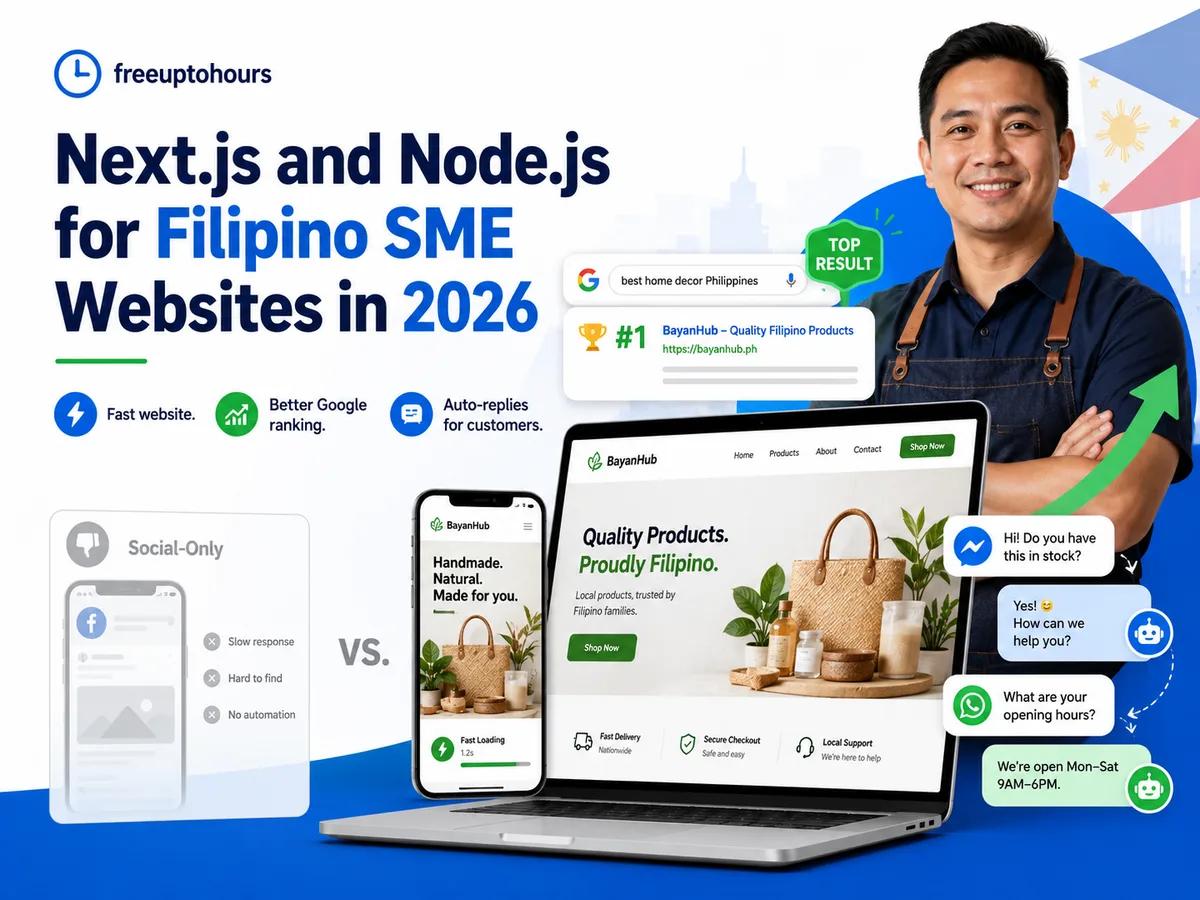
I know a business owner with 100,000 Facebook followers. I only have 30,000. But I rank number one on Google and number one on Google Business, while he only has his Facebook page. When I compare our bookings, I outmatch him. That is the whole point of this post in one example: in 2026, the website tech you choose decides whether you get found or stay invisible, no matter how many followers you have.
I am going to make the honest case for Next.js and Node.js for Filipino small and medium businesses this year. Not a one-sided pitch. I will tell you why it wins, where it does not make sense, and exactly how to start. I can do that because I am a Filipino business owner who runs his own fully booked business on this stack, and I was a WordPress developer for years before that.
Why the website tech matters more for a Filipino business
The Philippine market is its own animal. Most customers browse on their phones, often on mobile data they pay for by the load, sometimes on a slow connection. And Facebook and Messenger are usually the first touchpoint, not Google or email. That reality changes what a small business website actually needs.
A heavy, bloated WordPress or Wix site makes a customer on mobile data wait, and a customer who waits bounces before they ever see your prices. A fast site loads instantly and keeps them. So speed in the Philippines is not a luxury, it is survival. And it pays twice: the customer stays, and Google and AI reward the speed with better ranking. Slow quietly costs you bookings you never even knew you lost.
Next.js: built to rank and get indexed fast
Here is something I saw with my own eyes, having been a WordPress developer for years. When Google crawls my sites now, my Next.js pages get indexed easily and fast, much faster than my old WordPress sites ever did. I do not even need the full technical reason. Google simply loves indexing the Next.js site, and faster indexing means you start ranking sooner.
A Next.js site can score near 99 on Google PageSpeed, where a typical WordPress or Wix site is much heavier and slower. For a local business that lives or dies on being found, that combination, fast for the customer and fast to index for Google, is exactly what you want. It is built to rank, and ranking is the whole game for a local business.
Node.js: the brain for a Messenger-first market
The Philippines runs on Messenger and WhatsApp more than almost anywhere on earth. Most Filipino SMEs live in their inbox, not their email. This is where Node.js comes in, and why the stack fits this market so well.
Node.js is the brain. It runs on Messenger and WhatsApp, it connects to Google Sheets, and it can automate your email. It is also where you plug in the LLM, like DeepSeek, that powers the replies. So for a Filipino business whose customers love Messenger and WhatsApp, the website is not a dead brochure sitting in a corner of the internet. The Node.js layer actually replies to your comments and your inquiries automatically, right where your customers already are. A plain WordPress site cannot do that. It just sits there, disconnected from your inbox.
Why this stack is the AI-ranking upper hand
There is a reason I keep coming back to this stack in 2026: Next.js and Node.js are the most compatible with Claude Code, the most powerful AI right now. When I check it, nothing else comes close for this.
That compatibility matters because Claude Code can do the AI-technical SEO, GEO, and AEO work that gets you recommended by AI search, not just ranked on Google. So if you genuinely want a website that ranks and that AI recommends when a customer asks ChatGPT or Gemini for the best option in your area, you pick a stack the most powerful AI can actually build and optimize. That is the upper hand for the future, and it is available now.
It used to be enterprise tech. Not anymore.
A lot of Filipino owners assume Next.js is enterprise tech, only for big Manila companies, too complicated and expensive for a small shop. That used to be true. I was a Next.js developer back in 2019 and 2020, and honestly it was hard. WordPress was just drag-and-drop, while Next.js was real, expensive development work.
AI changed that completely. With Claude Code, Next.js is now easy to build, so whatever a small business needs, AI can do it. The tech that was once only for the big players is now friendly and affordable for a small resort, a restaurant, a rental, or a clinic. So it is not overkill for a small business. It is exactly right, because a small business needs every advantage it can get, and now it can have the same world-class tech the big companies have.
The honest trade-off, and when NOT to use Next.js
Let me be honest, because it would be a lie to say Next.js is best for everyone. If all you want is to edit and update your own content whenever you like, WordPress is enough. You can change things yourself without a developer. That convenience is real.
The catch is ranking. If you want to push your SEO, GEO, and AEO to the top, you need someone who can work the code, and Next.js lets you optimize 100% and fix anything that WordPress cannot. And there is one more honest line to draw: if you are running a pure online store or ecommerce, Shopify or WordPress is the better tool. Next.js is for the local business where ranking is what brings the customers. So pick Next.js if you are a local business that wants to be found. Pick something simpler if you just want to tinker with content or run a basic shop.
Why 2026 is the year to move
The keyword says 2026, and the timing is real. WordPress is still the king of websites, but it is dropping. Because of Claude Code, Codex, and the rest, static JavaScript sites like Next.js are becoming very popular, very fast.
At the same time, Google is rewarding speed and indexing modern websites faster, and customers are starting to ask AI for recommendations instead of scrolling. So the trend has already turned. If you want to be ahead, this is the year to convert. The Filipino SME that says "I will deal with my website next year" is handing a head start to the competitor who builds now and is already ranking by the time they wake up.
How to start, and what it costs
Starting is simple and low-risk. You message me on Facebook Messenger, say you want the free homepage, and send me the information I need. In 24 to 48 hours I build a real, working Next.js homepage for your own business and send you the mockup, free. You see it live on your phone, then you decide if you want to continue. No payment just to find out if it is good.
And it fits a small business wallet. The full build is ₱7,999 for a 5-page optimized site or ₱9,999 for 7 pages, with the domain and hosting free for the first year and ₱3,499 a year after that. That is not a Manila-agency price. Because the site is built clean and modern, it tends to get indexed quickly, so you can start climbing the rankings in weeks, not many months.
The honest final word
As a business owner in 2026, you need to be visible online: a website, Facebook, Google Business, Instagram, and TikTok. But you start with the website, because the website is the authority and the branding that everything else stands on. The social media works better after the website is in place, not instead of it.
The tech you choose for that website decides whether you get found or stay invisible. Next.js and Node.js are no longer enterprise tech you cannot afford. They are the affordable edge a Filipino small business needs to rank, to automate the inbox, and to be the one AI recommends. Choose it for the right reasons, and it pays for itself in customers.
I Rebuilt My Baguio Business With $20 of AI — Now I'm Booked Solid
The origin story behind this stack: how a WordPress developer rebuilt a real Filipino business on Next.js and $20 of AI into a fully booked operation.
WordPress vs Next.js in the Philippines: Speed and SEO in 2026
The head-to-head comparison behind this guide: exactly how Next.js beats WordPress on the speed and SEO that decide your ranking.
How Much Does a Website Cost in the Philippines?
The full pricing picture for a Filipino SME: what a real Next.js website costs to build and run, and what the cheap options quietly miss.
Frequently asked questions
Why should a Filipino SME use Next.js in 2026?
What does Node.js add for a Filipino business?
Is Next.js overkill for a small business?
When should I NOT use Next.js?
Can I update a Next.js site myself, or do I need a developer?
How do I start, and what does it cost?
Want the same system for your business?
I'll set up AI automation for your business — just like I did for mine.