How Much Does a Website Cost in the Philippines? An Honest Breakdown
When someone in the Philippines asks how much a website costs, the honest answer is anywhere from free to ₱200,000. Which helps nobody. So let me give you the real version, the one from someone who actually builds these and runs three of his own businesses on them.
Here is the short version before the details. The price is not really about the number of pages. It is about one thing: does the website actually get found and bring you sales? A cheap site that nobody sees is the most expensive thing you can buy, because it returns nothing. Let me show you the brackets, the hidden costs, and where owners get ripped off.
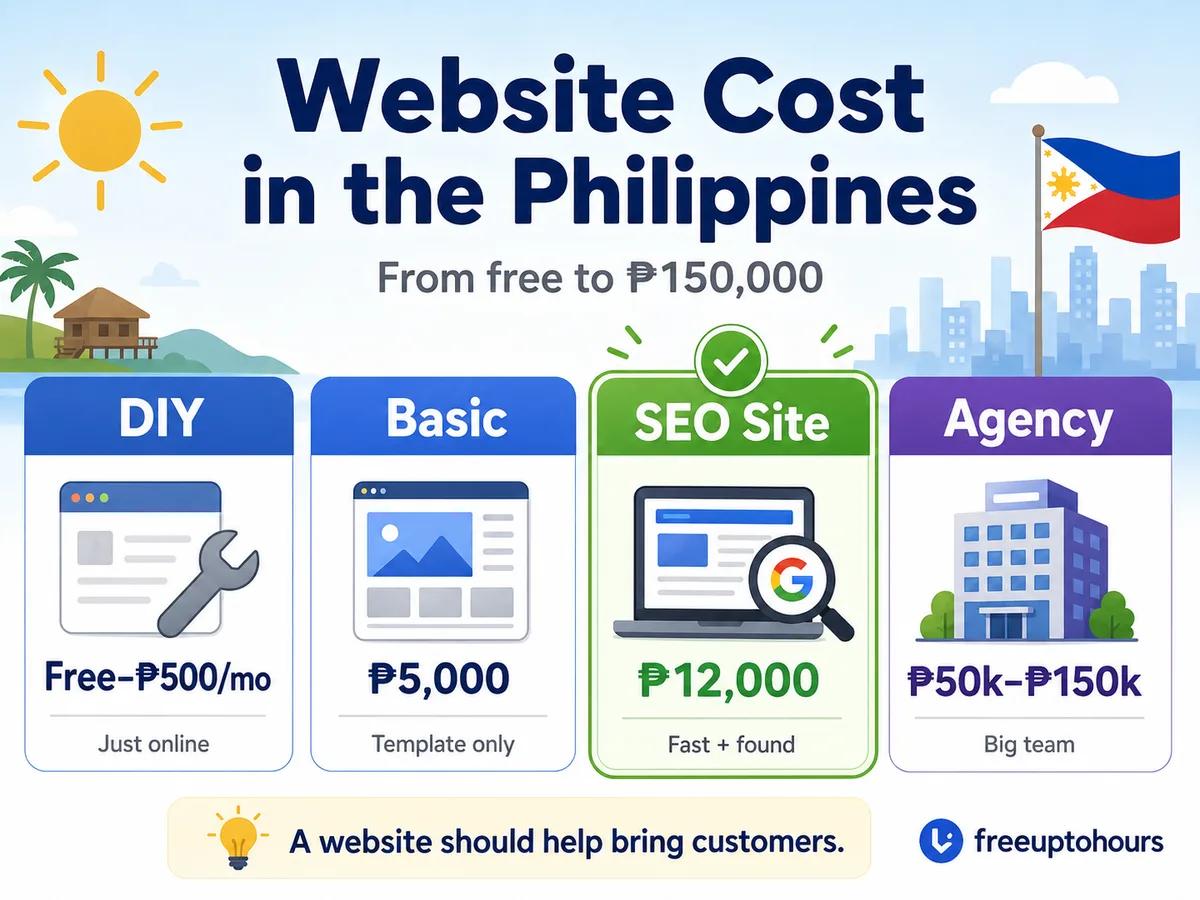
The real price brackets in the Philippines
Here is the landscape as I have actually seen it, and what each price really gets you.
| Option | Rough price | What you really get |
|---|---|---|
| DIY (Wix, free template, FB page) | Free to ₱500/mo | A page that exists but does not rank |
| Cheap freelancer | ₱5,000 | A template, no SEO, no schema, no ranking |
| Direct developer (Next.js) | ₱7,999–₱9,999 | 5 to 7 pages, full SEO, near 99 PageSpeed, ranks |
| Manila agency | ₱50,000 to ₱150,000 | Often the same site plus account managers and overhead |
The gap between a ₱5,000 site and a ₱7,999 site is not three thousand pesos of pages. The ₱5,000 site has no SEO and no schema, so it has no power to rank. It just does not show up on Google. The ₱7,999 Next.js site comes fully optimized: schema, AI and LLM readability, an SEO audit, and it is hooked into Google Search Console and Google Analytics from day one. It scores near 99 on Google PageSpeed for speed and performance. One of these gets found. The other one does not.
Why the ₱5,000 website is the most expensive one
The people selling ₱5,000 websites are usually beginners. They have no real knowledge of how to rank a page, so what you get is a template. It looks like a website, but it is not visible and it is not SEO friendly.
Think about what a business owner is actually paying for. You are not buying a template. You are buying impressions on Google, visibility, and authority. A site that nobody can find gives you no benefit at all. So a ₱5,000 site that brings zero bookings is not cheap. It is a pure loss, plus you will eventually pay someone else to rebuild it properly, which means you paid twice. What you actually need is a website that converts into sales. If it does not do that, the sticker price does not matter, because the return is zero.
The recurring costs nobody mentions
The build price is not the whole cost. A website has ongoing costs too, and this is where the honest math matters. Mine are simple and transparent:
- Year one: nothing. Domain and hosting with SSL are both included in the build price
- Year two onward: ₱3,499 a year, covering the domain and the hosting together
- Monthly fee: none
- Fixes: only charged if something actually needs fixing
That is it. Free for the first year, then ₱3,499 a year after that. No Wix-style trap where you pay forever or your site disappears, no surprise retainer, no freelancer who vanishes the moment something breaks. And I print the renewal price on the quote, because the agencies that hide it are counting on you forgetting by month thirteen.
How I can charge ₱7,999 when an agency charges ₱50,000
This is the question agencies do not want asked. The answer is simple: you pay the developer directly. There is no added sales team, no marketing department, no account managers, no middlemen taking a cut.
I am the website developer and the business operator at the same time, so I do it all. It is a flat rate because there is nobody else to pay. Just me, my AI tools, and 11 years of coding from 2009 onward, put together into the final product. The agency charging ₱50,000 is mostly billing you for the people around the website, not for a better website. Sometimes that overhead makes sense for a huge company with complex needs. For a small business that needs to rank and get leads, it is money spent on an invoice, not on results.
See it before you pay: the free homepage
Here is something almost nobody else offers, and it changes the whole conversation about cost. I build your homepage first, for free, before you pay a single peso.
You send me your current site or your Facebook page. I build a real, working homepage on my dev server in 24 to 48 hours, and you see it live on your phone. If you like it, we proceed to the inner pages, which is where the real SEO and CTR optimization happens, the part that makes the website actually work. At that point we take a deposit to continue. If you do not like it, I delete it, and there is no charge. The homepage is the proof. You see the real work before you spend anything. Compare that to the freelancer who wants half the money up front and then disappears.
What ₱7,999 actually gets you
The ₱7,999 build is a 5-page website with all your business information in place, and ₱9,999 gets you 7 pages with a blog section. The calls-to-action are already there, everything is optimized, and Google Search Console and Google Analytics are installed from the start. It is fast, it is SEO ready, and it can actually rank. That is the foundation.
But I want to be honest: the website is the beginning, not the whole journey. The ₱7,999 site gets you in the game. Becoming the number one, most-recommended brand in your area takes more than the site alone, and I will show you exactly what that involves next.
Proof: I run three of these myself
I do not just build these. I eat my own cooking. My brand, VOS Valencia, is the most recommended place near SM, near Session Road, and near Burnham, and it is a top search result. It is recommended by AI. That is not magic. I have the knowledge to put it on top, and I did it for my own business first.
The ₱7,999 website is the basic foundation that made it possible. To build real brand authority on top of it, you add daily content blogs on the website, Facebook content and reels, and an optimized Google Business profile. The site is what you can be found on. The ongoing content is what makes you the one AI recommends. Together, that is what keeps me fully booked without paying Agoda and Booking.com commissions.
The full staircase: website, content, ads, automation
A website is step one, not the whole climb. Here is the honest roadmap, so you know you do not have to spend everything at once.
Step one is the website: ₱7,999 for the 5-page optimized build or ₱9,999 for 7 pages, with the domain and hosting free for the first year and ₱3,499 a year after that. Step two, when you want real authority, is the content engine: daily blogs, programmatic SEO, Facebook content, avatar reels, and Google Business posts, which run ₱5,999 a month. Step three is Meta ads, to bring in leads now while the organic side grows, because in the early days you need leads fast to get sales. Over time the organic reach can outshine the paid ads. And the final step, once the sales are really flowing, is automation, to cut down the manual work. You climb the staircase as the business grows. You do not jump to the top on day one.
How to not get ripped off
The biggest trap is paying a cheap developer who has no business knowledge. They build you a ₱5,000 website, send you the link, and that is the end of it. It is a website, but it does nothing. No SEO, no leads, no sales. And then what? You just wait.
The real test of who you are talking to is simple: do they just hand you a file, or do they have a plan to grow your business? What I do is build the website, then sit down and map out how your business grows from here, step by step, until you are getting a lot of leads and calls. It takes time and it costs something monthly, but the outcome is a business that brings in leads like mine does. A developer who disappears after sending a link was never selling growth. He was selling a file.
Do you even need a website, or is Facebook enough?
A lot of Filipino businesses run on a Facebook page alone, so here is the honest answer. A Facebook page can genuinely get you leads and inquiries. That part is real, and it is fine for top of funnel.
But a Facebook page cannot give you brand authority, and it cannot get you recommended by AI search, which is where customers are heading now. If all you have is a Facebook page, AI cannot recommend you. To be the one it recommends, you need a website, with daily E-E-A-T content, programmatic SEO, and real landing pages, treated like a business and not a brochure. Use Facebook to get the leads and inquiries. Use the website to win the authority and convert the sales. You want both, but the website is the part that makes you findable and trusted.
The honest final word
So stop asking only what a website costs, and start asking what it earns. The cheapest site is the most expensive one, because it returns nothing. The ₱7,999 site is a foundation, not a magic button. What you are really buying is leads, authority, and sales, not a number of pages.
And remember the order. The website is not even the most important part. Getting the sales is. So we start with the free homepage, build the ₱7,999 website, then grow it with blogs on the website, Facebook, and Google Business. That is the foundation that brings the leads, the leads bring the sales, and once the sales are flowing, we add automation to cut the manual work.
I Rebuilt My Baguio Business With $20 of AI — Now I'm Booked Solid
The origin story behind these websites: how a $20 AI subscription and 11 years of coding rebuilt a real local business into a fully booked operation.
WordPress vs Next.js in the Philippines: Speed and SEO in 2026
Why the ₱7,999 site is built on Next.js: the speed and SEO difference that decides whether your website ranks or sits invisible.
How Page Speed Affects Bookings in the Philippines
Why that near-99 PageSpeed score matters in pesos: how a fast website turns into more bookings and a slow one quietly loses them.
Frequently asked questions
How much does a website cost in the Philippines?
Why is a ₱5,000 website a bad deal?
What are the ongoing costs of a website?
How can a developer charge ₱7,999 when agencies charge ₱50,000 or more?
Can I see the website before I pay?
Do I need a website if I already have a Facebook page?
Need this for your business? I build exactly this kind of system for small business owners.
Get a Custom Quote →Want the same system for your business?
I'll set up AI automation for your business — just like I did for mine.