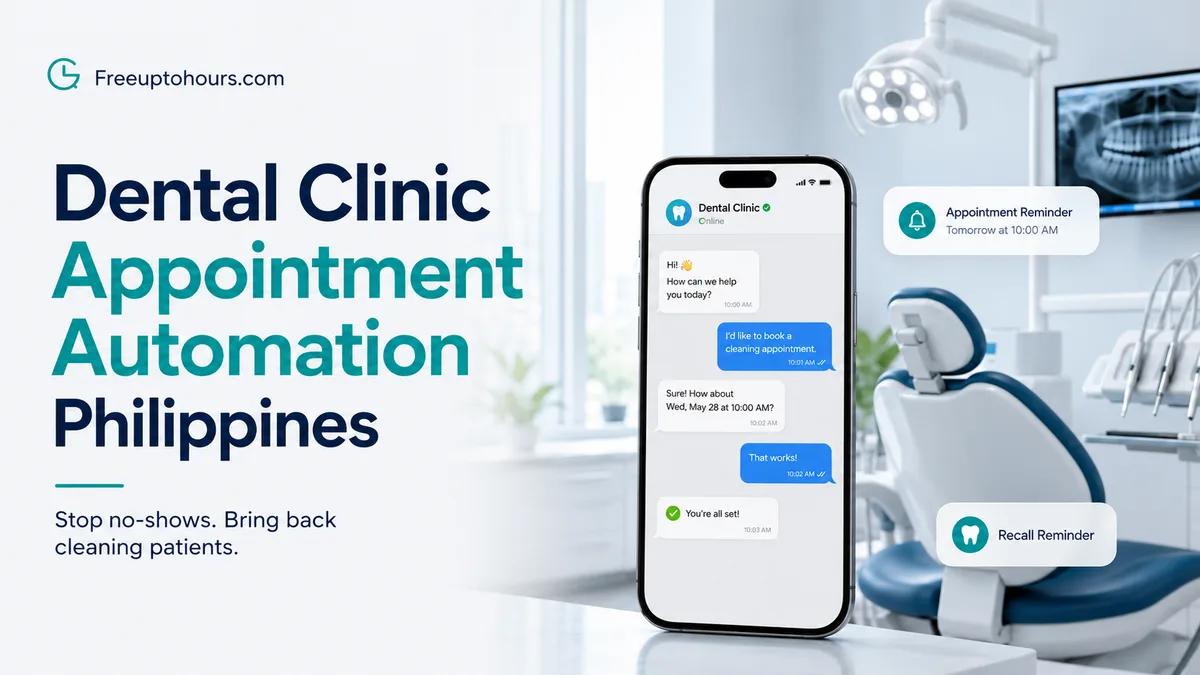
Dental Clinic Appointment Automation Philippines: Stop No-Shows, Bring Back Cleaning Patients, and Win the Slot Before the Slow Clinic Replies
A dental clinic is not a transient house, and that is the first thing that makes appointment automation harder for a clinic than for the accommodation businesses I usually talk about. One clinic often has more than one dentist, and each dentist has their own services and their own rates — from a basic cleaning to a full cleaning to braces and beyond. So the automation cannot just quote one price. It has to know which dentist does what, and for how much.
The funnel itself is familiar: the Facebook page and the website hold all the dental information, and from there patients land in Messenger or WhatsApp to ask the rates, check appointment availability, and book. That is exactly where a busy clinic breaks down — because the receptionist is juggling the phone, the walk-ins, and the inbox while the dentist is literally working inside a patient's mouth and cannot reply. This post is how I fix that, from someone who has run the same kind of agent on his own 20,000-message business.
No-Shows: The Empty Chair the Receptionist Forgets to Defend
A no-show is the silent killer for a dental clinic. An empty chair is lost money the dentist can never get back, and it hurts most when appointments are booked days or weeks in advance — plenty of time for a patient to forget. Here is the behavioral reality the automation is built around: people live inside Facebook and WhatsApp. So the reminder has to reach them exactly where they already are.
After a patient books, the agent reminds them — you are scheduled on this day. If they do not respond or confirm, that slot can be released instead of sitting empty as a no-show. Automatic reminders built into the agent system are the no-show defense the human front desk is simply too busy to run consistently. And if a clinic wants to go further, there is the option I use in my own transient business: a small downpayment to lock in commitment. A dentist may or may not want that, but the choice is there — reminders reduce no-shows, and a deposit gives the patient skin in the game.
What the Patient Actually Experiences
Before any of the chat happens, the consultant work comes first: get the leads flowing with Meta ads and a website that AI search recommends, so patients are actually arriving. Then the funnel drops into Messenger or WhatsApp, and here is what happens inside:
- Standard services — cleaning, braces — get the standard pricing instantly, even at 9 PM when the clinic is closed.
- Complicated cases get escalated to the dentist, because only the expert should quote a complex problem. The AI knows its limit.
- An appointment system connected to a Google Sheet holds the clinic hours, every dentist's schedule, the location, and the phone number.
- After the patient books, the agent collects whatever information the clinic needs.
- Walk-ins are handled too — the agent simply sends the location and the details for getting there.
So it is not "a bot that answers questions." It is leads in, instant standard quotes, expert escalation for the complex cases, a booking written into a live multi-dentist schedule, and patient information captured — all without the receptionist or the dentist touching the first message.
"What If It Quotes Wrong or Double-Books?"
This is the dentist's biggest fear, so here is my honest, proven answer. The system runs on Opus 4.8 and a Google Sheet, and that combination does a lot of the magic. My own 15-room transient house has handled 20,000 booking messages through an AI agent with zero double-bookings — it is simply accurate, and the Sheet can be customized to prevent double-booking by design. I trust it for a dental clinic because I already trusted it with 20,000 of my own bookings.
Pricing stays safe by staying humble. The AI only sends the standard rate — the minimum — and anything beyond that, the real quote for a complex case, goes to the dentist. The AI never pretends to be the clinical expert. That boundary is exactly what makes it trustworthy: it is fast and accurate on the routine, and it hands off the moment a real diagnosis or a complex quote is involved.
The 6-Month Recall: The Recurring Revenue Clinics Leave on the Table
Dental patients are not one-time. A cleaning patient should come back every six months; braces patients return monthly for adjustments. This is the recurring revenue most clinics quietly lose, because nobody has time to chase it. The Google Sheet holds each patient's cleaning period, and the chatbot sends the recall reminder at the right time — it is time for your cleaning po.
I will be honest from the patient's side, because I am the perfect example: I have a cleaning due and sometimes I do not go for a whole year, simply because nobody reminds me. That is not a me-problem. That is every patient. The patient forgets, and the busy dentist and front desk forget too. The system does not. And that reminder is not just service — it is pure profit, because every recall you bring back is revenue the clinic would otherwise have lost to forgetfulness. A cleaning patient who returns every six months for years is worth far more than a single visit.
What It Costs — and How Fast It Pays Back
I will be concrete instead of vague. There is no setup fee, and the first seven days are free. After that it is ₱2,499 a month, which covers the API cost, the server maintenance, the Facebook ads management, and ongoing changes. Clinics with several dentists and a long service list take more building, but that is my problem, not a line on your invoice.
The math works out fast in dental terms. ₱2,499 a month is less than a part-time receptionist who works eight hours and cannot reply at 9 PM. One recovered no-show, or one returned cleaning patient brought back by a recall reminder, can already cover the whole month — and a braces patient who books because the agent replied first is worth many months of the fee. The system does not cost the clinic money. The empty chairs and the forgotten recalls are what cost money.
What Clinics Are Getting Wrong Right Now
Here is my blunt opinion. A booked appointment with no fast reply is a wasted customer — fast reply is fast booking. The clinic that answers in seconds wins the patient the slow clinic loses. And the second mistake is having no recall system at all, which is recurring revenue walking out the door because patients forget and the front desk is too busy to remember.
But the deeper mistake is missing the whole visibility standard. Fast AI replies, a recall and reminder system, a Google Business profile, and a website that AI search recommends — that is the new baseline. And here is the part that should worry the best dentist in town: if you do not have this, a less-expert clinic that did implement it will out-visibility you. Being the most skilled dentist means nothing if patients cannot find you, cannot get a fast reply, and never get reminded to come back. Visibility beats expertise at the moment a patient is choosing who to message first — and some dental clinics are already implementing all of this.
"Hindi Ako Techy, I Am Busy With Patients All Day"
This is the fear that stops most dentists, and the answer is simpler than they expect. The only two things you need to know are tools you already use every day: your Messenger and your Google Sheet. That is it. You check your Messenger, you glance at the Sheet, and you are done.
Everything technical — the website, the Google Business profile, the Meta ads, the Facebook page, and the AI agent itself — is handled by me and the experts. There is no new software to master and no dashboard to learn. You stay in the chair doing dentistry while the system runs around you. You do the two things you already do, and the rest is off your plate entirely.
What the Clinic Looks Like 6 to 12 Months Later
Picture the clinic that said yes and did the work. Three things are different: new leads are coming in, returning customers are coming back automatically, and there is far less time lost to inquiries and follow-ups. That last shift is the one that matters most — the clinic's time and energy move away from chasing messages and reminders and back toward the real dental services, the actual work in the chair that makes the money.
That is how a stuck clinic becomes a growing one. The system handles the front-of-house grind — answering, booking, reminding, recalling — so the clinic's best people are finally freed to do their best work. Less follow-up, more dentistry, more growth.
Grab It Now — or a Competitor Dentist Will
Here is my closing message to the dentist drowning in Messenger between patients, losing chairs to no-shows, watching patients forget to come back. Every business needs an AI agent automation expert now, and if you do not grab it, a competitor dentist will. The fears are real and worth naming: the fear of not being the number one or two clinic recommended by AI in your location, the fear of having no ads and therefore no visibility, the fear of no returning clients, and the fear of staying stuck in the manual ways while the work piles up.
And the thing that makes it urgent: some dental clinics are already doing this. Only one clinic per location gets the top spot in the AI's answer, and your competitor down the street is deciding right now whether it will be them. The first step is small — the foundation that gets you found and replies fast — and it starts the momentum. Grab it, or watch the clinic that adapted first take the patients who were looking for a dentist exactly like you.
I Rebuilt My Baguio Business With $20 of AI — Now I Am Booked Solid
The case study behind this system — what an operator does with AI when the business is on the line.
AI Agent Bot Receptionist for a Resort in the Philippines
The same Google Sheet brain and booking logic, applied to a multi-service resort front desk.
How I Build an AI Receptionist on WhatsApp With Node.js, LangGraph, and Google Sheets
The technical build — how the live schedule reading and no-double-booking actually work under the hood.
Frequently asked questions
What is dental clinic appointment automation?
How does appointment automation reduce no-shows for a dental clinic?
Will an AI quote the wrong dental price or double-book a dentist?
How does automation bring back repeat dental patients?
How much does dental appointment automation cost in the Philippines?
Does the dentist need to be technical to use it?
Want the same system for your business?
I'll set up AI automation for your business — just like I did for mine.