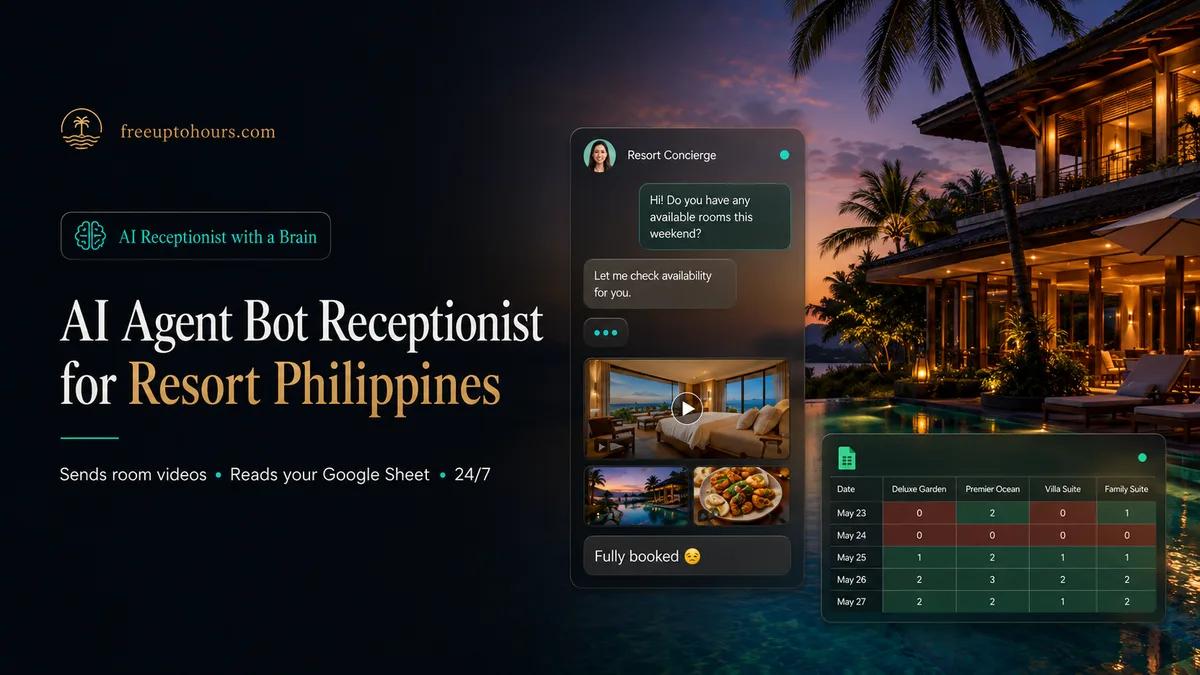
AI Agent Bot Receptionist for Resort Philippines: Sends Room Videos, Reads Your Google Sheet, Never Gets Tired of "Fully Booked"
A resort is not a transient house, and that is the first thing most people get wrong. A transient house is mostly rooms. A resort is rooms plus a restaurant, function halls and events, day-tour rates, group and bulk reservations, walk-ins, and entrance and pool fees — every one of them generating its own inquiries, all flooding the same inbox at the same time.
So when a resort owner tells me they need an AI receptionist, we do not install a generic bot. We load it with everything: location and Google Maps directions with a video of the way there, room reservations and restaurant reservations, room photos and videos sent on request, food photos and videos, function hall rates and current event happenings, bulk reservations, walk-in guidance, and all the fees. Then we wrap the growth layer around it — a website with daily E-E-A-T blogs so the resort builds brand authority, gets recommended by AI, and shows up on local listings, plus Meta ads driving leads for both room and restaurant bookings. It is all customized to that resort's own needs.
Why Sending Room and Food Videos Inside the Chat Closes the Sale
Here is what is unique to a resort: it sells an experience, not a bed. And the single biggest difference between an inquiry and a deposit is whether the guest can see what they are buying. So the receptionist does not send a link or say "please visit our page." It sends the actual room walkthrough, the pool video, the food photos, the function hall pictures — right inside Messenger or WhatsApp, the second the guest asks.
There are two jobs happening, and it is important not to confuse them. Daily blogs feed GEO and SEO — that is what brings people in. But sending the real videos and images inside the chat is what converts and closes the sale. Text informs; video and images sell. People buy what they can see, and a resort that shows the pool while the guest is still excited captures the booking that a text-only reply would lose.
The 5-Minute Law — and Why a Resort Breaks It Without AI
There is a universal rule in any service business: the moment a guest messages you, their attention is on you. Reply five minutes late and you still have them. Reply thirty minutes late and they are already searching for another resort. Speed is not a nice-to-have. It is the whole game, because attention is fleeting and the resort that answers first wins the booking.
A resort multiplies that pressure, because it is not just rooms — it is restaurant, function halls, events, and day tours, all flooding the same inbox at once. No human front desk can hold a five-minute response time across all of those during peak season. An AI receptionist holds it across every channel and every category, day and night. That is the difference between capturing a booking and donating it to the resort next door.
The Real Cost of a Tired Front Desk in Peak Season
Let me be honest about something I have seen and lived. In peak season, some front-desk staff just close their phone. I have been the guest on the other end of that — and even when the resort was genuinely full, being ignored felt like disrespect. Here is the part that costs the most: a guest who gets ghosted does not come back to your resort again. That is not one lost booking. That is a lost customer for life, plus the bad word of mouth that follows.
A human gets tired of saying "fully booked" for the hundredth time. An AI receptionist never does. It replies "we are fully booked for those dates, but thank you po" with the exact same respect at message number one and message number one thousand, even at two in the morning. In a resort, respect is retention. The receptionist does not only handle the volume — it protects every relationship a tired human would have accidentally burned.
"What If It Gives the Wrong Rate or Double-Books?"
This is every resort owner's real fear, so here is my straight answer. It is 2026. AI models are now advanced enough to be more accurate than a human who is tired. A front-desk person at hour fourteen of a long weekend makes mistakes; the model does not fatigue. And it reads everything from your Google Sheet — pricing, availability, function hall slots, any data you keep — with precision, and answers from those real numbers instead of guessing. Keep the Sheet accurate, and the bot is accurate. And in 2027, the models only get smarter. The "what if it is wrong" fear is really a fear of yesterday's chatbots; today's read your live data and outperform an exhausted human on accuracy.
How It Plugs Into How a Resort Already Runs
Most resort owners track bookings in a notebook, a whiteboard, or a messy Excel file, and they expect AI to mean some expensive new system. It does not. In 2026, Google Sheets is powerful enough to be your whole back office: shared with all your employees in real time, doing your accounting, your bookings, acting like your own database — nothing to buy.
The AI reads that same Sheet precisely and sends accurate answers from it. So the setup is not exotic or scary. Your front desk updates the Sheet the way they already do, the whole team sees it live, the AI receptionist answers guests straight from that single source of truth, and confirmed bookings get written back into it. The owner stays in full control of one familiar file — update a rate or block a date in the Sheet, and the bot knows instantly, no code involved.
What the Receptionist Quietly Does to Grow Revenue
Answering is only half of it. The receptionist works after the conversation too, and this is the money most resorts leave on the table. When a guest says thank you, it automatically sends a Google review request — so your reviews and online presence keep growing without you ever messaging anyone. It follows up on every lead so none of them go cold. It reads and writes data to the Google Sheet, capturing every contact for re-marketing. And it sends large video files across Facebook, Messenger, and WhatsApp — wherever the guest actually is.
So while it is answering today's inquiries, it is also compounding your reviews, recovering your warm leads, and feeding your database for tomorrow. Whatever the resort needs, it can be built to do. That is the difference between a bot that costs you nothing but answers, and a receptionist that quietly grows the business every single day.
The Cost: A Better Closer That Works More Hours for Less
I will not pretend it is free — building it properly costs money. But the comparison is the whole point. Do you keep spending more on another front-desk employee, or do you invest once in a better sales closer that works more hours and converts more sales? The running cost of the AI itself is small — a custom chatbot handling tens of thousands of messages a month runs roughly ₱500 to ₱1,500 — far below a single salary for the same 24/7 coverage.
And you are not replacing your people. The AI feeds all the normal information — rates, availability, photos, videos, directions, the repetitive ninety percent — instantly and tirelessly, which frees your humans to do what humans do best: close the deal, handle the VIP, take care of the guest standing in front of them. For a resort, where one recovered group booking or function hall event can be worth tens of thousands of pesos, a single saved peak weekend pays the whole thing back.
Receptionist With a Brain vs. a Generic FAQ Bot
This is the distinction that justifies the word "receptionist." A generic chatbot company gives you an FAQ machine — it answers the canned questions, but availability, complex reasoning, and group bookings still get dumped on a human, so you still need to staff up. An AI receptionist has a brain: it is fed everything from your website and your business, it reads all your Google Sheet data, and it reasons through real availability and complex requests. The only human you need is one good sales closer.
Built by an operator who actually runs accommodation businesses, that brain is tuned for how Filipino guests really behave — replies in English, Tagalog, and Taglish, understands GCash and bank deposits, handles the barkada and family group bookings, and builds the trust that comes before a deposit. A generic overseas tool gets that texture wrong. An operator who has answered these exact messages for years does not.
The Resort That Adapts First Becomes the One AI Recommends
Here is my closing, from one accommodation operator to a resort owner. The most successful businesses are not the biggest — they are the ones who adapt earliest. In the GEO era, the resort that adapts with AI builds more authority and becomes the one AI recommends when a guest asks for the best resort near them.
And the honest warning: if you decline, another resort will not. Your competitor down the road is deciding the same thing right now, and only one of you gets to be the recommendation. The first step is small — a website and the foundation that feeds both Google and AI search — and it starts the momentum. Adapt early, or watch the early adapter take your guests.
I Rebuilt My Baguio Business With $20 of AI — Now I Am Booked Solid
The case study behind this system — what an operator does with AI when the business is on the line.
How I Build an AI Receptionist on WhatsApp With Node.js, LangGraph, and Google Sheets
The technical build behind the receptionist — how the Google Sheet brain and real-time availability actually work.
AI Chatbot Philippines: What They Cost and What They Actually Do
The cost and capability overview of the Messenger-first chatbot this receptionist is built on.
Frequently asked questions
What is an AI receptionist for a resort?
How is an AI receptionist different from a generic chatbot?
Can an AI receptionist send room and food videos to guests?
Will an AI receptionist give wrong rates or double-book?
How much does an AI receptionist cost for a resort in the Philippines?
Does the AI receptionist replace my front-desk staff?
Want the same system for your business?
I'll set up AI automation for your business — just like I did for mine.