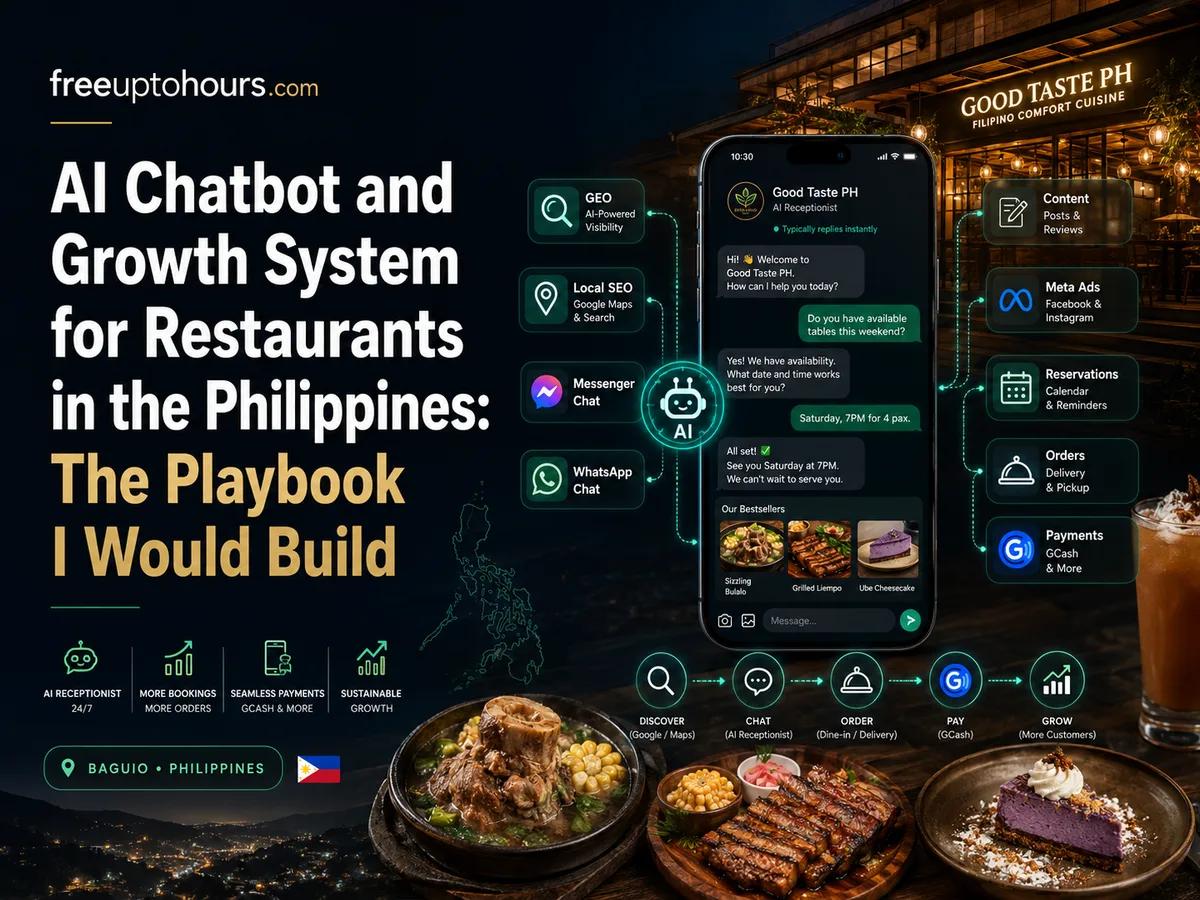
AI Chatbot and Growth System for Restaurants in the Philippines: The Playbook I Would Build
Most restaurants in the Philippines have the same blind spot: they rely on vloggers for exposure and own nothing themselves. No real website content, no local SEO, no GEO. So when a hungry person asks AI or Google for the "best restaurant in Baguio" or "where to eat near Session Road," the restaurant is invisible — unless a vlogger happened to feature it recently. That is renting your visibility instead of owning it, and it is the first thing I would fix.
Let me be straight with you up front, because honesty is the whole point of how I work: I have not run this system for a restaurant client yet. What I have done is run every single piece of it — the AI receptionist, the GEO, the Messenger funnel, the daily content — on my own 15-room business in Baguio for years. I am a business owner, so I have the instinct for growing a local business, and these systems transfer. So this is the exact playbook I would build for a restaurant, and I would refine it with the first restaurant owner who comes in. If it did not work on my own business first, I would not be writing it.
The Real Problem: You Are Renting Exposure From Vloggers
A vlogger feature feels great, and the views come fast. But they are forgotten just as fast — people scroll past a TikTok and the restaurant is gone from their mind a minute later. Worse, you do not own any of it. When the vlogger moves on to the next place, your exposure goes with them, and you are invisible again. You never built anything that lasts. The restaurants that win long-term are not the ones with the most viral clips. They are the ones that own their visibility, so they show up the moment a customer is actually deciding where to eat.
The Fix: Be the Answer AI Recommends, Not the Clip People Forget
Here is the funnel I would build. People increasingly ask AI for a shortlist — "top restaurant in Baguio," "best ramen near me" — then search the location, click the website, and the website hooks them into Messenger for the rest. That means the restaurant has to be on the AI recommendation list in the first place, which is GEO, generative engine optimization. And here is the part most owners miss: AI can only recommend what is documented online. A restaurant can have the best food and the best experience in the city, but if it is not written down — no content, no photos, no location data — AI search has nothing to surface, so it never recommends you. Documenting honestly is not marketing fluff. It is the raw data the AI uses to put your name forward.
The 24/7 AI Receptionist: Your Menu, Answered Instantly
Once a customer is chatting with the restaurant on Messenger or WhatsApp, an AI receptionist answers around the clock — and it presents the menu the way a good server would, not by dumping the whole list. It sends a short video food list, then shows just the two best-sellers first. If the customer wants more, it sends five popular dishes. Want more still, another five. The reason is the same psychology that runs my room bookings: show someone the entire menu at once and they freeze with analysis paralysis, then leave for a simpler option. Show two, then five, then five, and they actually decide and order. The bot answers the real questions too — what is good, do you deliver to my area, what are your hours — instantly, day or night.
Order, Pay, and Get the Food: the GCash Flow
Once they have chosen, the receptionist routes them by what they want, and takes the payment through the chat:
- Dine-in: it sends the Google Maps location and, if needed, takes a reservation.
- Delivery: it sends a short fill-up form for name and address, takes the GCash or PayMaya payment, and your own motor delivers.
- Reservation: it locks the slot with a small GCash deposit tied to a specific date and time, so a booked table is a real one, not a maybe.
And then the human takes over at the exact right moment — when the payment lands. Once the money is in, a person tells the motor to deliver or the cook to start. The AI takes the order and the payment; the human runs the kitchen and the relationship. It is still a human-touch operation where it counts, with the machine handling everything repetitive up to that point.
Facebook Ads to Fill the Area With Hungry Leads
GEO and content bring the people who are searching. Facebook and Meta ads bring the people who are not searching yet but are hungry and nearby. A well-targeted local ad drops people straight into Messenger, where the receptionist takes over with the video menu and the order. For a restaurant, that is a powerful combination — ads create demand in the area, and the bot converts it into orders without anyone manually answering every message.
Daily Content That Earns the Recommendation
This is the fuel for everything above, and it is the step most restaurants skip. Every day you publish real food stories — the dishes, photos of actual customers enjoying them, the experience, the location. That is what builds E-E-A-T (experience, expertise, authoritativeness, trust) in Google and AI engines, and it is the documented data those engines need to trust and recommend you. The restaurant that quietly documents its food every day will out-rank the one that is merely good but invisible. You cannot be recommended for an experience you never put online.
Who This Is For — and the Honest Part
This is for startup restaurants that want to launch with a real system instead of hoping for a viral video, and for established restaurants still doing everything the traditional way that want to expand and grow more sales. It is not a fit for a place that already owns its local SEO, already runs a working chatbot, and is already booked solid — that owner does not need me.
And the honest part again, because it matters: I have not run this for a restaurant yet. My proof is a 15-room transient house in Baguio that I rebuilt with these exact systems and keep fully booked. I am a business owner with a real instinct for growing a local business, and the pieces — the AI receptionist, the GEO, the Messenger funnel, the daily content — are the same ones I run every day. I would build this for your restaurant on that proven foundation and refine it together. You would be the first, and I would treat it that way.
How to Get Your Business Recommended by ChatGPT in the Philippines
The GEO method behind getting a restaurant onto the AI recommendation list instead of relying on vloggers.
How I Build an AI Receptionist on WhatsApp With Node.js, LangGraph, and Google Sheets
The receptionist build and the show-only-a-few-options psychology, applied here to a menu.
What an AI Chatbot Costs in the Philippines, and How to Run One Cheap
The honest overview of AI chatbot cost and capability for any Philippine business, restaurant or otherwise.
Tourism Crashed and a War Was On. I Rebuilt My Baguio Business With $20 of AI — Now I Am Booked Solid
The proof that I run every piece of this playbook on my own business before proposing it to anyone.
Frequently asked questions
Why should a restaurant in the Philippines use an AI chatbot?
Why is relying on food vloggers a weakness for a restaurant?
How does a restaurant get recommended by AI like ChatGPT?
Can the chatbot take payment and orders for a restaurant?
Why show only a few dishes instead of the whole menu?
Have you done this for a restaurant before?
Need this for your business? I build exactly this kind of system for small business owners.
AI Chatbot for Messenger →Want the same system for your business?
I'll set up AI automation for your business — just like I did for mine.