I Fired My Broken Scripts and Built a Self-Healing Localhost AI Business: How Gemini 4 Argon and October 2026's Frontier Models Run My Operations While I Sleep
If you run a small business in the Philippines, you already know the "2:00 AM trap."
You are sound asleep when your phone buzzes on the nightstand. It’s a prospective customer on Facebook Messenger: "Boss, available pa ba room for 8 pax bukas? Magkano kung early check-in?"
If you ignore it and go back to sleep, they message three other pages and book with whoever replies first. If you wake up, open your spreadsheet, calculate the early check-in fee, and type out a reply, you secure the booking—at the cost of your sleep, your sanity, and your next morning's focus.
Running a 15-room transient house in Baguio taught me that small business owners don't burn out from doing the actual work. We burn out from the repetitive micro-tasks surrounding the work.
That realization led me to build FreeUpToHours. I wanted to turn myself into a one-man army where my localhost computer ran the entire front-desk, lead follow-up, and daily content engine on its own.
But the truth? My first hundred attempts were a disaster. Here is the unfiltered story of how my early automation crashed and burned, how the arrival of Gemini 4 Argon and the October 2026 wave of frontier models fixed what used to be impossible, and how I now use gamified simulations to run a zero-downtime local business.
The Graveyard of Broken Scripts: Why Early Automation Failed
When I first wired up custom scripts on my local machine to handle customer inquiries and calendar bookings, I thought I was a genius—for about four hours. Then real customers started talking to it.
Human beings do not talk like software forms. They switch between Taglish and Ilocano mid-sentence, send blurry screenshots of GCash receipts, change their headcount three times in four minutes, and ask edge-case questions like "Kasya ba ang Montero sa parking niyo kung may roof rack?"
My early systems broke in three painful ways:
- The Brittle Logic Crash: A simple Python script expecting a clean date format (YYYY-MM-DD) would throw a fatal exception when a guest typed "Sa long weekend po ng Undas." The local webhook crashed silently, leaving 20 subsequent customers on "Seen."
- Context Amnesia: Early models had tiny memory windows. By the time a guest finished asking about WiFi speed, water heaters, and pet policies, the bot had completely forgotten which room they wanted to book in the first message.
- Blind Text-Only Pipelines: Whenever a client sent a photo—a bank transfer receipt for a transient room, or a leaking pipe photo for a plumbing client—the automation hit a brick wall.
The Turning Point: How Gemini 4 Argon Changed the Architecture
Everything shifted in October 2026. The newest generation of AI didn't just get marginally better at writing essays—it gained long-horizon agency, massive unified memory, and self-correcting reasoning.
At the center of my current stack is Google DeepMind’s Gemini 4 Argon. Instead of treating AI like a glorified autocomplete, Argon acts as the senior systems architect of my business:
1. Unified 1-Million-Token Operational Memory
With a massive 1M-token context budget, Gemini 4 Argon doesn't just read the last three messages in a chat thread. I can feed it an entire year of historical guest conversations, seasonal pricing rules, maintenance schedules, and standard operating procedures at once. When a past guest messages after eight months, the system remembers their exact room preference and greets them like a regular.
2. Autonomous Debugging and Self-Healing Workflows
In the old days, an API timeout or a malformed Google Sheets row killed the pipeline. Today, pairing Gemini 4 Argon with Claude Opus 5.5 allows my localhost watchdog to catch errors in real time. When a script fails, the agent reads the traceback log, rewrites the faulty payload parser in an isolated sandbox, verifies the fix, and resumes the queue without waking me up.
3. Multi-Model Specialization (The October 2026 Stack)
Instead of forcing one model to do everything, my localhost orchestrator routes tasks to specialized October 2026 models based on what they do best:

| Business Task | The Old Manual / Broken Way | My October 2026 Autonomous Stack |
|---|---|---|
| Complex Logic & Content Engine | Generic templates that sound robotic and repetitive | Gemini 4 Argon & Claude Opus 5.5 synthesizing deep local context and self-healing code |
| GCash Receipt & Photo Checks | Waking up to manually inspect payment screenshots | NVIDIA Nemotron 3.5 Bolt 74B running vision verification locally on a 24GB GPU |
| Instant 24/7 Messenger Triage | Customers waiting hours for basic rate inquiries | DeepSeek-V4.1-Flash & Qwen 3.6 27B delivering sub-second Taglish replies for pennies |
| Late-Night Voice Calls | Missed calls from travelers driving up to Baguio | Grok Voice 3.0 answering phone calls in real time and locking calendar holds via tool calls |
| Busy-Season Forecasting | Guessing when to raise rates or add cleaning staff | Mistral Timestral predicting occupancy surges weeks before peak holidays |
How I "Play Games" with AI Models to Bulletproof Client Systems
People often ask me: "How do you know the chatbot won't hallucinate a discount or double-book a room?"
The secret is that I never test a new workflow on live customers first. On my localhost machine, I built adversarial game simulations—turning business automation into a high-speed strategy game between competing AI agents.
Before any system goes live at FreeUpToHours, it has to survive three simulated game loops:
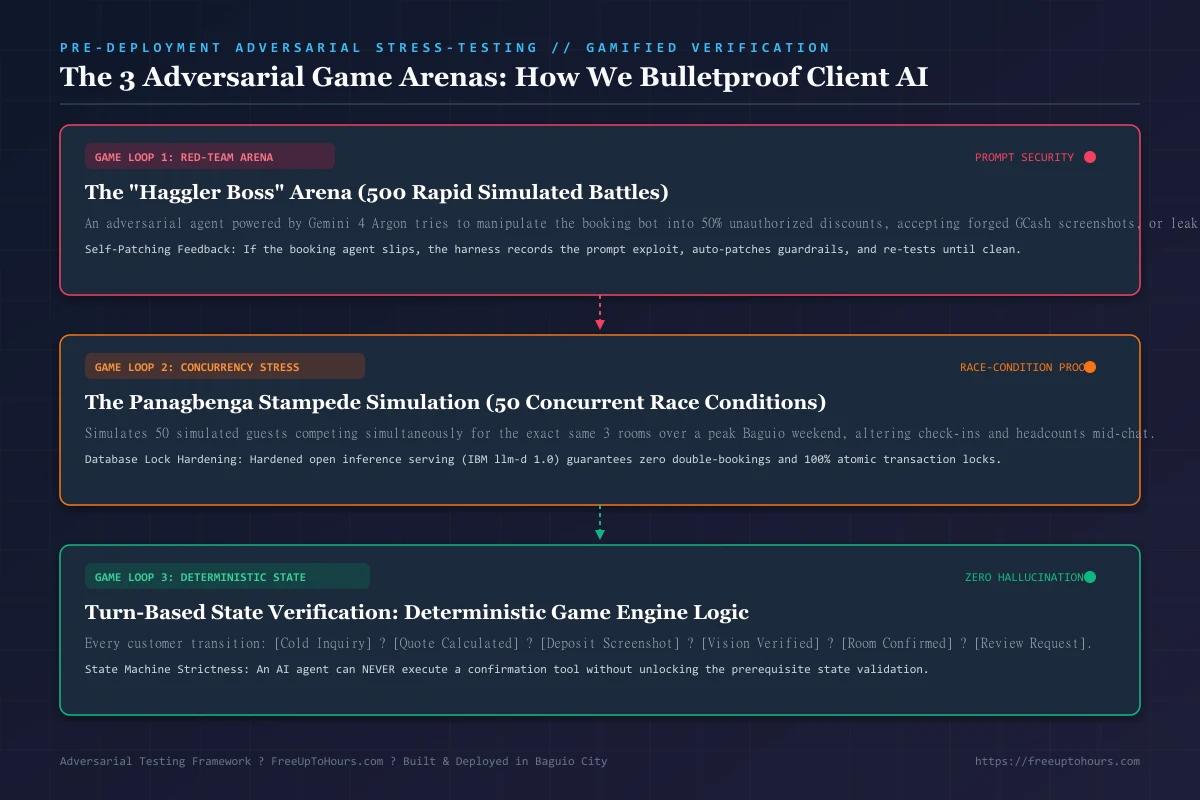
The "Haggler Boss" Arena
I spin up an adversarial agent powered by Gemini 4 Argon and give it one goal: trick my booking bot into giving an unauthorized 50% discount, accepting a fake receipt, or revealing private system prompts. They battle across 500 simulated conversations in minutes. Every time the booking bot slips, the system patches its own guardrails.
The Panagbenga Stampede Simulation
I simulate 50 concurrent customers trying to book the exact same 3 family rooms over the exact same February weekend while changing their check-in times mid-chat. Using hardened open inference serving like IBM's llm-d 1.0, I verify that database locks hold 100% of the time with zero race conditions.
Turn-Based State Verification
Every customer journey—from Cold Inquiry to Warm Lead Follow-Up to Deposit Verified to Post-Checkout Review Request—is coded like a deterministic game state machine. An agent cannot jump to "Room Confirmed" without unlocking the "Payment Verified" state first.
What This Means for Your Business Today
Whether you run a transient house, a dental clinic, a veterinary practice, a plumbing service, or a local print shop, the lesson from my journey is simple: you no longer need a 10-person admin team or a ₱50,000/month agency retainer to run a world-class operation.
The errors, the crashed terminals, and the sleepless nights of debugging are already behind us. The models available right now can read your receipts, answer your Messenger and phone lines 24/7 in natural Taglish, follow up with cold leads after 30 minutes, and log every peso cleanly into your Google Sheets.
Every system I offer at FreeUpToHours ran in my own business first, survived thousands of simulated stress-tests on my localhost, and exists for one purpose: to give you your life and your hours back.
Beyond the Giants: How October 2026's Wave of Open-Weight AI Models Changes SMB Automation
Compact open weights like Qwen 3.6 27B, sub-cent Flash models, and Mistral Timestral in operations.
What I'm Actually Doing With AI in October 2026
Why AI moved into the plumbing: autonomous triage harnesses, two-tier model architectures, and real receipts.
Why I Only Employ 2 Cleaners and Run My Entire Business on an $86/Month AI Team
The exact breakdown of Gemini Argon, Claude Opus 5.5, GPT-6.1 Sol, and Grokbot in production.
Frequently asked questions
What is a "self-healing" AI business architecture?
Why is Gemini 4 Argon central to this localhost setup?
How does local receipt vision protect customer privacy?
How do adversarial game simulations prevent AI hallucinations?
How does the system prevent double-bookings during peak holidays?
Can this autonomous stack work for other businesses outside transient houses?
Want the same system for your business?
I'll set up AI automation for your business — just like I did for mine.