Beyond the Giants: How October 2026's Wave of Open-Weight and Specialized AI Models Changes Small Business Automation
If you only follow mainstream tech headlines, you might think the AI race begins and ends with flagship cloud giants like Claude Opus 5.5 and Gemini 4 Argon. Both are phenomenal reasoning engines that power the heavy lifting in my daily workflow.
But over the past week of October 2026, a quieter, equally disruptive shift happened across the AI landscape—one that directly impacts solo operators and small business owners running lean operations on localhost.
From compact open-weight models you can run on your own hardware to specialized foundation models built exclusively for forecasting demand, the newest October 2026 releases prove that small business automation is becoming faster, cheaper, and vastly more specialized. Here is a breakdown of the latest breakthroughs from this week and how I am connecting them to real-world operations at FreeUpToHours.
1. The Open-Weight Localhost Boom: Qwen 3.6 27B, Meta Muse Spark Open, and DeepSeek-V4.1-Flash
Within a single week, three major open-source and high-efficiency models dropped:
- Qwen 3.6 27B (Released October 21, 2026): Alibaba's newest 27-billion-parameter model tracked on LLM Gateway packs frontier-grade instruction following into a footprint compact enough to run on local consumer GPUs or low-cost dedicated servers.
- DeepSeek-V4.1-Flash (Released October 17, 2026): Featured on the October 2026 AI Release Tracker, this model prioritizes sub-second latency and ultra-low inference cost while preserving multi-turn conversational accuracy.
- Meta Muse Spark Open & Muse Wonder (Released Mid-October 2026): Alongside the 1M-token Muse Wonder family, Meta launched Muse Spark Open, giving independent builders an open-weight model they can fine-tune and inspect locally without vendor lock-in.
What This Means for Your Local Business
When I started automating my 15-room transient house in Baguio, every single guest message on Facebook Messenger had to ping an expensive external API. If a marketing post went viral and 500 inquiries flooded in overnight, API token bills spiked.
With compact, high-speed models like Qwen 3.6 27B and DeepSeek-V4.1-Flash, I can route 80% of routine FAQ and availability checks through a local inference engine or an ultra-cheap flash endpoint, reserving heavy hitters like Gemini 4 Argon or Claude Opus 5.5 only for complex multi-room custom quotes or self-healing database fixes.
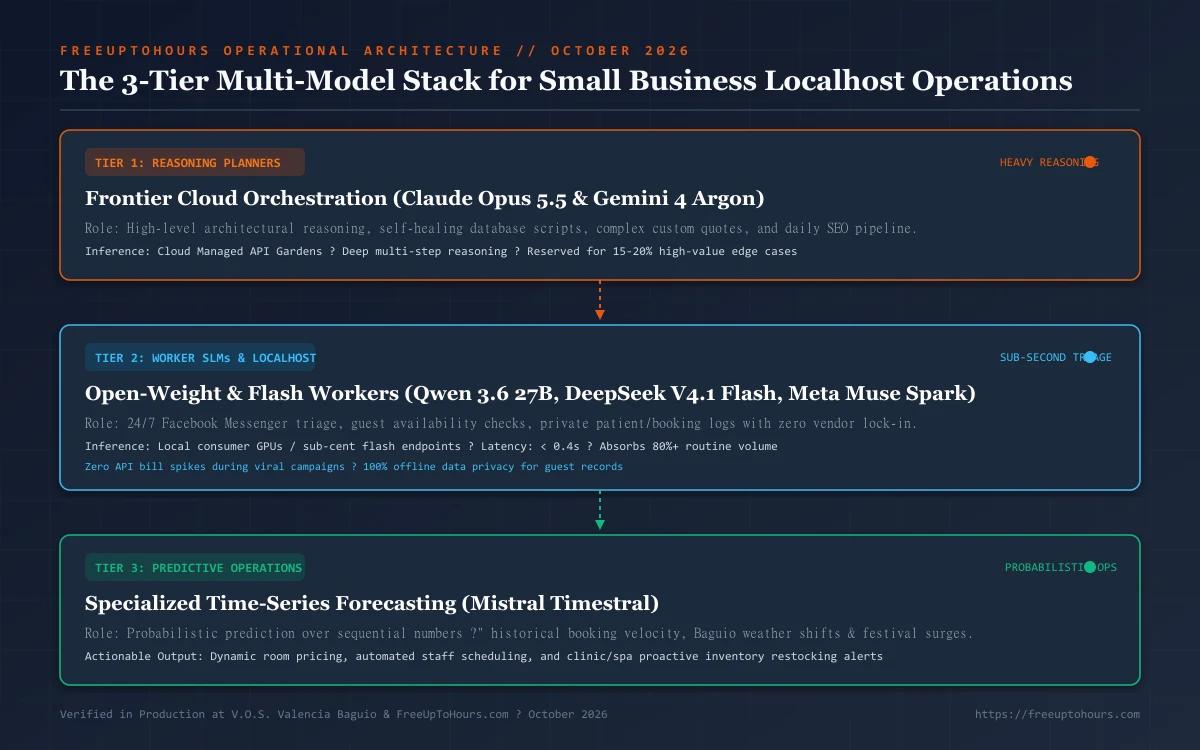
2. Forecasting the Future: Mistral's "Timestral" Time-Series Model
On October 15, 2026, Mistral unveiled Timestral, a dedicated foundation model built specifically for time-series forecasting and probabilistic prediction.
While language models predict the next word, a time-series model predicts the next pattern in sequential numbers:
- Seasonal Occupancy & Dynamic Pricing: In Baguio, room demand fluctuates wildly around long weekends, weather shifts, and festivals. Instead of guessing when to adjust room rates or minimum night stays, a time-series model analyzes historical booking velocity to predict full-occupancy dates weeks in advance.
- Staff Scheduling & Inventory Alerts: At FreeUpToHours, two of the most requested automations for clinics, spas, and repair shops are staff shift scheduling and supply restocking. Pairing a conversational agent with predictive time-series logic means your system alerts you to order supplies before a seasonal rush hits.
3. Cross-Cloud Orchestration & Two-Stage Planning
Two more announcements from the past 48 hours highlight where agentic workflows are heading:
- Multi-Model Cloud Gardens (October 21, 2026): The announcement that OpenAI models and Codex workflows are joining Google Cloud signals the end of single-vendor silos.
- Two-Stage Planning Architectures (October 22, 2026): Yesterday's launch of Canva Craft demonstrated how separating planning from execution eliminates sloppy AI outputs in visual and marketing assets.
How FreeUpToHours Puts Every New Model to the Test
A new model release is meaningless if it breaks when a real customer messages your page at midnight. Before any new model makes it into a client workflow at FreeUpToHours, it goes through my local stress-test pipeline:
| October 2026 AI Breakthrough | Operational Role in the Stack | Real-World SME Benefit |
|---|---|---|
| Gemini 4 Argon & Claude Opus 5.5 | Master orchestrators & complex reasoning | Self-healing database scripts, complex billing escalations, and daily SEO blog generation |
| Qwen 3.6 27B & Muse Spark Open | Localhost / private-server worker agents | Zero-lock-in data privacy and offline resilience for sensitive guest and patient records |
| DeepSeek-V4.1-Flash | High-speed Messenger triage | Instant sub-second replies to 24/7 customer inquiries in English and Tagalog |
| Mistral Timestral | Predictive operations & scheduling | Automated busy-season alerts, staff shift forecasting, and proactive inventory reminders |
You Don't Need to Track 200+ AI Models—Your System Should
In October 2026 alone, more than 20 major models shipped across 16 different labs. As a business owner running a transient house, dental clinic, plumbing service, or print shop, you shouldn't have to spend your evenings reading benchmark papers or rewriting prompts.
That is why I built my one-man automation lab in the first place. I test the models on my localhost, run them through simulated guest game-loops to expose edge cases, and package the winners into reliable, hands-off workflows.
What I'm Actually Doing With AI in October 2026
Why AI did not fade away—it moved into the plumbing. Two-tier architectures and real receipts.
The 20-Person Company Is Obsolete: Why Legacy Businesses Are Stuck on Chatbots
Why 17 out of 20 seats in legacy firms are just software debt, and how DeepSeek V4.1 Flash changes operations.
In 2010, They Were My Bosses on a WordPress Team. In 2026, All My Employees Are AI Agents
From cubicle life in a traditional agency to running 15 hotel rooms and software builds as a solo operator.
Why I Only Employ 2 Cleaners and Run My Entire Business on an $86/Month AI Team
The exact breakdown of Gemini Argon, Claude Opus 5.5, GPT-6.1 Sol, and Grokbot in production.
AI Is Moving Into Your House: Why I Am Investing in a Local AI Computer in 2027
Why local AI computers with owned weights beat endless cloud subscriptions for privacy and security.
Frequently asked questions
What is an open-weight AI model and why does it matter for small businesses?
How does DeepSeek-V4.1-Flash lower customer service costs?
What makes Mistral Timestral different from regular LLMs like ChatGPT?
Do I need an expensive server or GPU rig to benefit from open-weight models?
How does FreeUpToHours integrate these models into a real business?
Want the same system for your business?
I'll set up AI automation for your business — just like I did for mine.