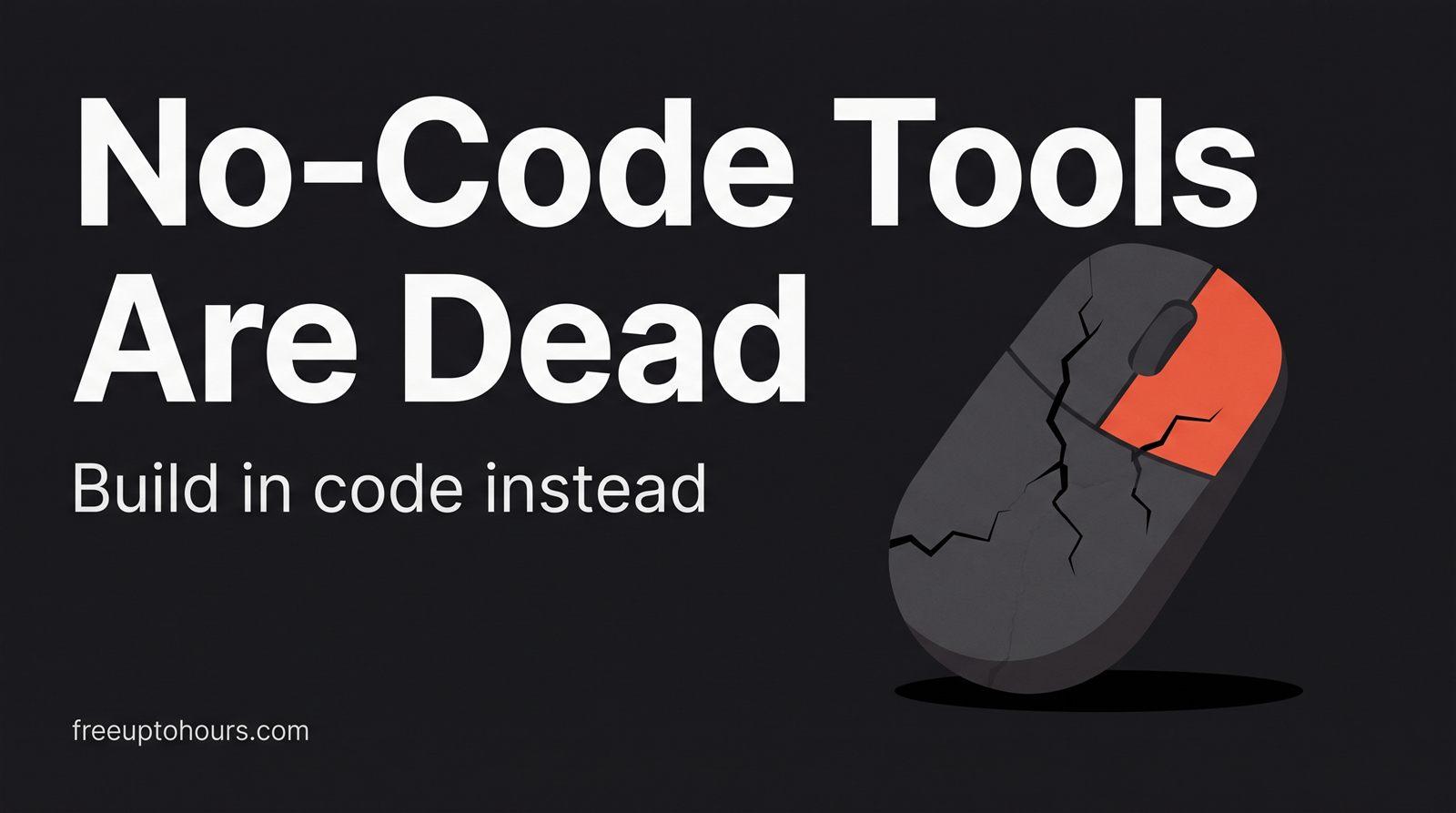
No-Code Tools Are Dead for Me: Why I Build Everything in Code With AI Harnesses
I stopped using website builders and no-code automation tools — and my business runs better without them.
In February 2026, my WordPress site was infected with viruses and I had to act. I rebuilt it in Next.js using Claude Code, and the viruses were gone. My SEO shot up 2,103 percent. From that moment I built my whole business in code — websites, apps, and automation — with Claude Code, Codex, and my own DeepSeek harness on Node.js, JavaScript, and Python. Today I run no n8n, no Make, no Zapier, no website builder. Here is the honest why, from a business owner who ran his own money through the switch.
The February Wake-Up: Viruses, Then Code
For years my transient house site lived on WordPress. Then in February 2026, viruses infected it. I did not have the patience to fight plugin-based infections plugin by plugin — I had already watched the WordPress plugin economy turn my site into a maintenance headache, and the infection was the last straw.
So I rebuilt the business site from scratch. Claude Code did the heavy lifting; the site runs on Next.js today. The viruses were gone with the old platform, and the ranking response was fast: Google Analytics shows my traffic up 2,103 percent. That one number changed how I think about building everything else.
The story is not "WordPress is evil." WordPress carried my business for years, and it still suits people who never want to touch code. The story is that a builder hands you a machine you cannot fully own — plugins you do not control, updates that break things, a platform that decides what you can do. Code hands you the whole machine. For an owner who wants his business to compound, that difference is everything.
The Contrarian Take: No-Code Is the Wrong Trade
Everyone is selling no-code as the small-business answer: website builders so you can launch in an afternoon, n8n and Make and Zapier so you can "automate without a developer." I used to believe it. Ten years of building taught me the truth: no-code trades tomorrow for today.
The builder gets you live fast, then caps you. The no-code automation tool connects your tools, then caps you on what a connection can do — a fixed set of triggers and steps, a monthly price that climbs with usage, a wall the moment your business needs something the template was never built to do. The wall always comes. It is the business model.
Code flips the trade. The first build is slower — an afternoon becomes a week. But there is no ceiling after it: when my chatbot needed a custom follow-up layer, I built it. When my content pipeline needed the humanizer pass, I added it. When a better model shipped, I swapped it in the same afternoon because nothing in my stack is married to a vendor's roadmap. That is the whole argument: no-code is a rental with walls, and code is ownership without them.
The Stack I Actually Run
Here is what "everything in code" means day to day, because the how matters more than the position. One model per job, chosen on cost and capability — the same discipline I have written about before.
| Job | What runs it | Why code, not no-code |
|---|---|---|
| Websites and apps | Claude Code + Next.js | Clean builds, zero plugins, PageSpeed 95+, full ownership — a builder caps you at its templates |
| Coding agent harness | Claude Code, Codex, DeepSeek Harness | My own customizable runtime — add marketing skills, a blog pipeline, a QA loop; no feature gate |
| Business automation (chatbot, follow-ups, reminders) | Node.js + DeepSeek V4 Flash API | The whole system runs 24/7; prompt caching keeps the API bill low at my 15k-30k message volume |
| Content and SEO | Qwen 3.8 Flash + GLM 5.3 Flash | Full control of the pipeline — editor and humanizer passes, no template walls |
The automation that runs my local business — Messenger inbox, comments, follow-ups — is built entirely in code. It runs 24/7 on the open-source Flash models, and at my volume the whole thing costs tens of dollars a month. The same workload through a no-code node would be a subscription with per-operation pricing and a ceiling I would hit exactly when the business grew.
What No-Code Actually Costs You
The headline price of no-code is the subscription. The real price is the cap on what your automation can become.
| Approach | Monthly cost | The real ceiling |
|---|---|---|
| No-code automation (n8n, Make, Zapier) | Subscription + per-operation pricing that climbs with usage | Only what the templates and connectors can do — a wall when your business outgrows the tool |
| No-code website builder | Monthly fee + premium plugins + hosting | Template limits, plugin bloat, and a platform that owns your site's ceiling |
| Code-first on AI harnesses (my stack) | Tens of dollars in API + tooling at small-business volume | No ceiling — add a feature, swap a model, own the whole machine |
I can optimize the costs directly against the API — DeepSeek, GLM, and the Flash tiers — because the code sits between my business and the model. My cache rate runs around 98 percent, which is the difference between an automation that costs tens of dollars and one that quietly bleeds hundreds.
Why This Is the Start of Something Bigger
The same week I write this, the two strongest frontier models are ChatGPT Astra and Claude Fable 5.1. What I see in them is not just better chat. The quality bar for AI-generated games has crossed a line — and I believe we are at the start of a wave where AI builds games, apps, and whole businesses, not just assists at them. Some people call that the start of AGI. I am careful with that word, so I will say it plainly: I believe this is the start, and I am sharing the belief as my perspective, not a prediction I can prove.
That is exactly why I refuse to build my business on no-code. Every template I adopt is a bet that the tool's ceiling is high enough for a world that is changing this fast. Code is the opposite bet: the ceiling is mine. When the models leap again, my stack leaps with them in the same afternoon — because nothing in it is locked to a vendor's roadmap.
Who Should Not Do This
Code-first is not for everyone, and I will say it plainly. If you do not want to learn technical things, if you have no time to maintain a codebase, if you want a site up this weekend and never think about it again — a builder or a no-code tool is the honest answer, and there is nothing wrong with that. The tool should match the owner.
But if you are an owner who wants to compound — who wants the machine to grow with you, who is willing to spend one week learning what a builder would have taken one afternoon — the code path returns that week a hundred times over. It returned it to me: the site that loads clean, the inbox that answers at 2 AM, the automation that does not have a ceiling. Kaya mo 'to.
WordPress vs Next.js Philippines — Which Is Faster? The Real Numbers
The technical comparison: PageSpeed scores, Core Web Vitals, and when each platform makes sense
The $40 Subscription Is Dead: Why I Switched My Whole AI Stack to Open-Source Models
The chapter before this one — closed source to open source, and the cost math that started this direction
Which AI Model for Which Task? The Real Stack I Run My Business On
The full model-to-job map behind the workloads in this post — GLM 5.3 Flash, DeepSeek V4 Flash, Qwen 3.8 Flash
Frequently asked questions
Are no-code tools like n8n, Make, and Zapier dead?
Why did you leave WordPress, and what happened after?
Do I need to be a developer to build with Claude Code or a harness?
Is code-first automation more expensive than no-code?
Why do you say ChatGPT Astra and Claude Fable 5.1 are the start of AGI?
How do I start if I want to go code-first?
Want the same system for your business?
I'll set up AI automation for your business — just like I did for mine.