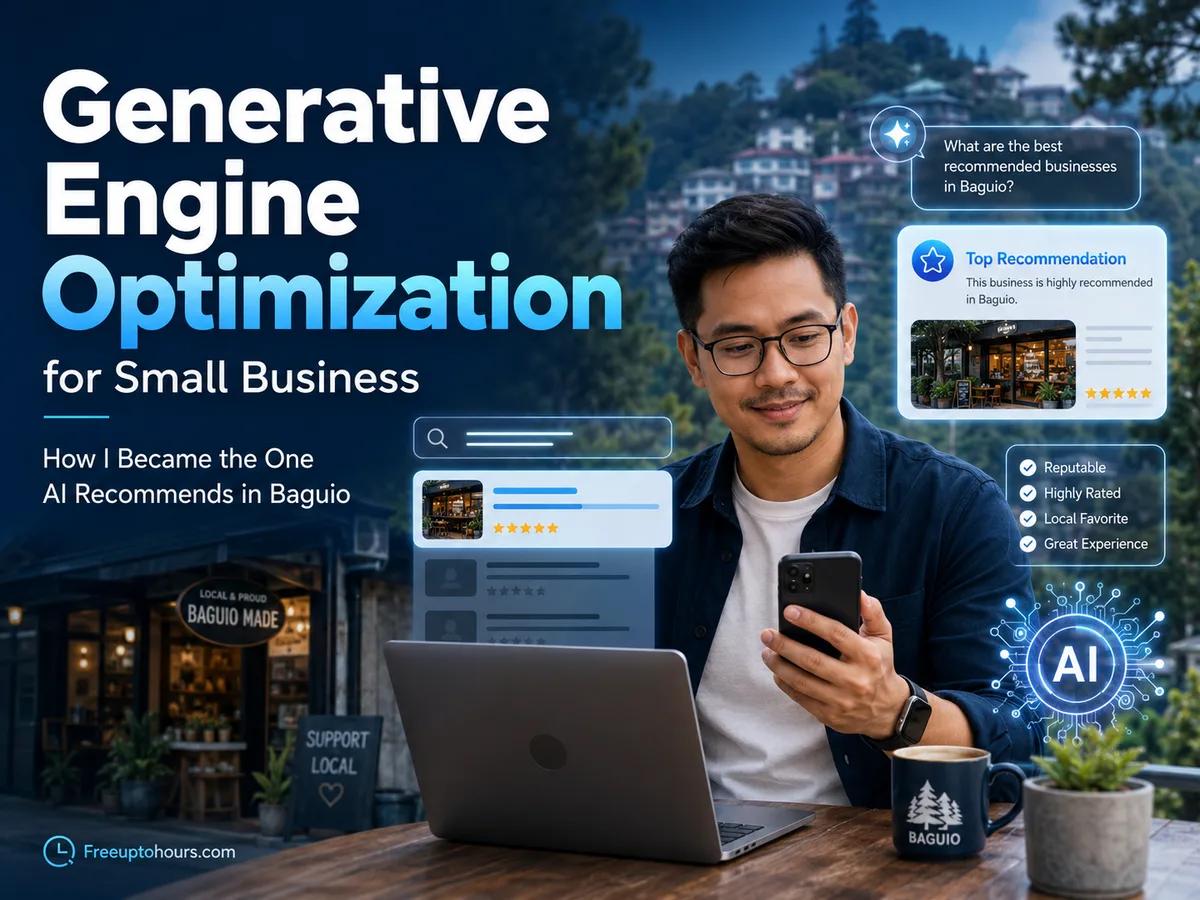
Generative Engine Optimization for Small Business: How I Became the One AI Recommends in Baguio
Here is exactly how I buy things now, and I am willing to bet you do the same. I see an ad on Facebook. It looks good. But before I pay for that product or that service, I open AI and ask it: is this legit? Is this actually recommended? Only when AI confirms it do I trust the business enough to hand over my money.
Read that again, because it is the whole game. AI is not the place I discover businesses — the Facebook ad did that. AI is the place I decide whether to trust them. It sits right between the ad and the payment, and it has veto power over the sale. If you are a small business and AI does not name you when a customer runs that check, the deal is dead before you ever knew it existed.
That is what generative engine optimization (GEO) actually is for a small business. Forget the textbook definition for a second. GEO is making sure that when a real person asks ChatGPT, Gemini, or Perplexity "where should I eat, where should I stay, who should I hire" — your business is the answer it gives. I am going to show you how I did it for my own businesses in Baguio, what worked, what is a waste of money, and why your window to do this is closing faster than you think.
They can fake followers. They cannot fake AI-recommended.
Let me give you the proof from my own businesses before I give you the theory. I run three transient properties in Baguio. Today, I believe mine is the most-recommended transient near SM Session Road and Burnham Park when you ask AI. That is why I am almost always fully booked, and why people trust me.
Now compare that to a competitor with 300,000 followers on Facebook — the kind of page that got big by boosting posts. On the surface they look bigger than me. But here is the thing I keep coming back to: they can fake followers. You can buy them, boost them, inflate them. What they cannot fake is being the business AI recommends.
This is why GEO matters more for a small business than another round of boosted ads. AI does not count your likes. It weighs signals you cannot buy your way into — and that levels the field between a one-person operation like mine and a page with a hundred times my following.
What I actually did to become the one AI recommends
Everyone wants the "how." Here is the honest combination — not one trick, but a stack of real signals working together:
- Honest E-E-A-T blog posts published on my own website, daily.
- Consistent Facebook content tied to the same real stories.
- Genuine positive reviews on my Google Business Profile.
- Letting Claude run my AI-SEO optimization and do my SEO audits.
And here is the part that actually made it work: I am the only transient business in Baguio doing all of this together. Everyone else is still posting room photos and boosting the same tired post. I built an actual supply of information that AI can read, verify, and quote. When AI looks for the real, knowledgeable local expert, there is content from me to find — and almost nothing comparable from anyone else in my category. That is not luck. That is being first.
Why honest content is the ranking signal — real is real
When people hear "post daily blogs," they panic and do one of two things: freeze, or pump out ten soulless AI-generated posts. Both are wrong. Let me tell you what actually gets AI to trust you.
You just need to write honest blogs. How does your business actually feel — the wins and even the rough parts? Positive or negative, it does not matter. Real is real. That is the reason AI recommends me: I created real, genuine, positive content about my own business, from inside it. AI is getting very good at telling the difference between marketing copy written to impress an algorithm and a real owner telling the truth about their work. Most owners are too scared to be honest online. I turned honesty into my distribution.
And do not let anyone tell you it eats your whole life. Every business owner has time to go shopping, right? Then you have time for this — because you are not writing alone. You do not need AI to generate a perfect blog in one shot. You tell your own stories, in your own words, and AI builds the rest: the grammar, the structure, the polish. The story is yours and genuine; the typing is the machine's.
What small businesses get wrong (stop doing this today)
I watch other businesses and the "AI gurus" online do GEO the wrong way constantly. The pattern is always the same: they post ten AI-generated posts with no feelings in them. The content is so generic that even the owner does not know what is in their own blog.
Think about how damning that is. If you have not even read your own blog, why on earth would AI trust it enough to stake a recommendation on you? The other traps are the same family of mistake — obsessing over keywords, chasing whatever easy AI-slop shortcut is trending this week. It is motion without meaning.
AI rewards the opposite of volume. Fewer posts with real heart beat a flood of empty ones. Put yourself into the content. Add real-life detail only you could know. Quality of experience, not quantity of output — that is the whole formula, and almost nobody follows it.
The real engine: ads plus authority
Did it change my business? Dramatically. That is exactly why I pour my soul into daily content — because I have seen what it does.
Here is the honest nuance, though: I am still boosting ads. I did not stop. But the reality is that ads convert into easy sales once you have brand authority behind them. The ad gets the attention; the AI-verified authority closes it. Remember how I buy things — see the ad, ask AI to verify, then pay? Your customer does the exact same thing. The ad brings them to the door, AI confirms you are the real, recommended one, and the sale happens almost by itself.
Without that authority, the same ad just burns money — especially now, when there are so many fake Facebook pages that buyers have learned to run the AI check before trusting anyone. Ads alone rent attention. Ads plus AI-recommended authority is the engine. That is the difference.
The stack: what a small business actually needs to start
People love the story that I rebuilt my Baguio business on about twenty dollars of AI. It is true — but let me kill the lazy version of it. It is not that you pay twenty dollars and then, boom, you are good.
What that twenty dollars actually does is turn me into something like a superhuman — it installs every skill I need into Claude: writing, SEO, audits, strategy. With it, I can do almost anything a whole team would normally do. It is a skill multiplier, not a magic payment. It amplifies the work; it does not replace it.
So what does a small business genuinely need on day one? You need a brand online, right now. That means the foundation: a website you actually control, a Google Business Profile, a real Facebook page, and your other social platforms. Once you have that setup in place and you start feeding it honestly, that is where your business finally — slowly, steadily — begins to grow. The tool makes you capable. The foundation makes you findable. You need both.
Why you have to do this now, not next year
Google is already prioritizing generative answers over clicks. Sit with that. The old game was "rank number one, get the click." That game is dying. If you are not on the AI's shortlist, the customer never even sees you — there is no click left to win.
Which means if you are not recommended on the AI list, it is simply getting harder to make sales. And the scariest part for anyone reading this late: if you do not start now, know that some of your competitors are already quietly figuring it out. The window where being early is a genuine superpower is closing in real time. Do it now, or spend next year clawing your way onto a list someone else already owns.
Who this is for — and who it is not
This is for almost any small business with a physical, real-world service. Restaurants, salons, rentals, clinics — all of it. But it matters most for local businesses, the ones people turn to AI to find: where to eat, where to drink, where to sleep, the basic everyday things — and any local service someone needs nearby.
If your customers ask AI "what is the best ___ near me," and you sell that ___, this is not optional for you anymore. It is the new word-of-mouth, and right now there is still room at the front of the line.
I Rebuilt My Baguio Business With $20 of AI — Now I'm Booked Solid
The full origin story behind everything in this post — how a $20 AI subscription turned into a fully booked operation, and why the tool is a skill multiplier, not a magic payment.
How to Get Recommended by ChatGPT in the Philippines
The step-by-step companion to this post — the exact method for becoming the business AI names when your next customer asks it for the best option.
AI SEO in 2027: Why I Bet My Whole Business on Next.js
Where this is all heading — why Google prioritizing AI answers over clicks changes the entire game, and how I future-proofed my own site for it.
Frequently asked questions
What is generative engine optimization (GEO) for a small business?
How is GEO different from regular SEO?
Do I need a big budget or a marketing team to do GEO?
What kind of content actually gets a small business recommended by AI?
I already run Facebook ads. Why do I also need GEO?
Which small businesses should prioritize GEO?
Want the same system for your business?
I'll set up AI automation for your business — just like I did for mine.