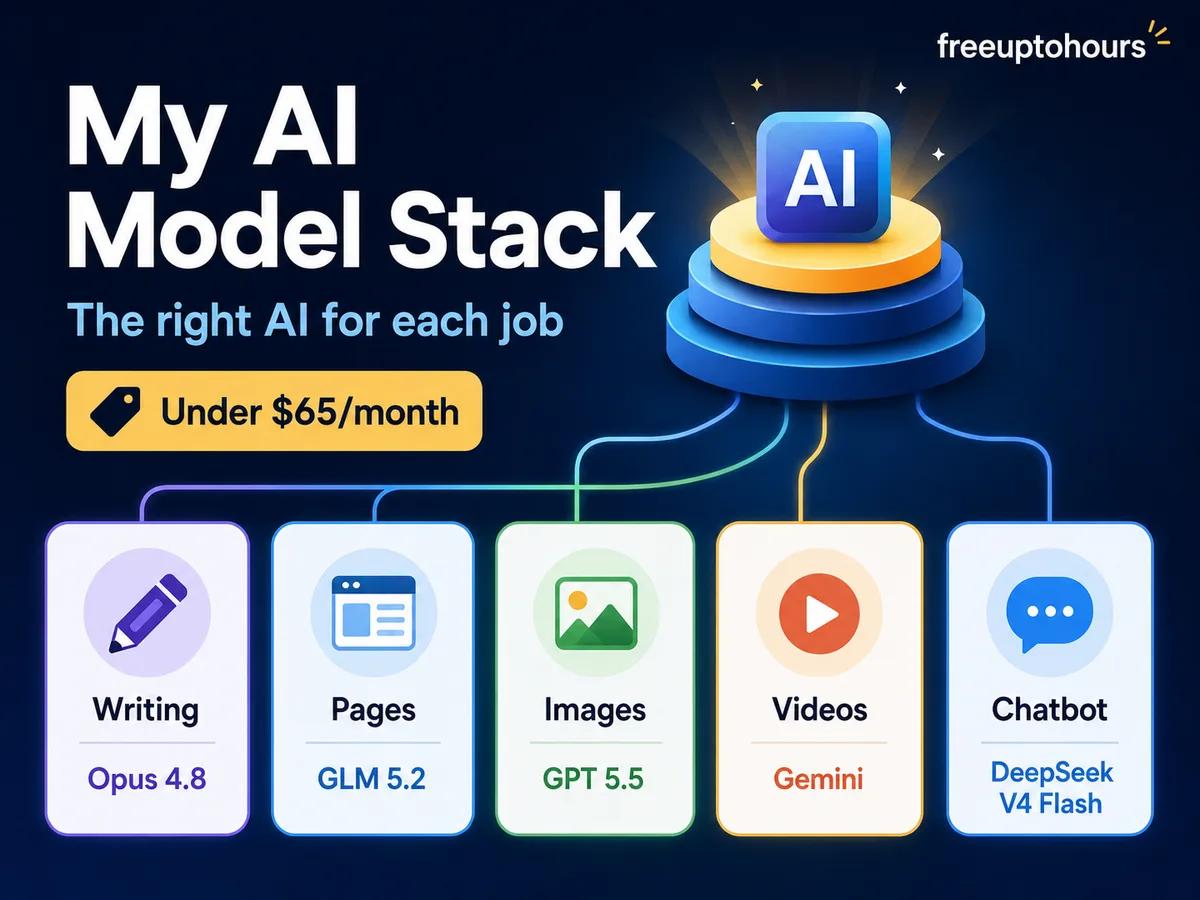
My AI Model Stack: The Right Model for Every Task, Under $65 a Month
Most people pick one AI and marry it. They buy a single subscription and try to force it to do everything: writing, images, video, code, customer replies. I used to think that way too. Now I run five different models, and each one only does the job it is genuinely the best at.
I am an AI growth architect, and this is the exact stack I use to run my own business every day. It writes my blogs, builds my landing pages, makes my images, produces the reels that go viral, and answers thousands of customer messages a month. The whole thing costs me under $65 a month. Let me walk you through it, model by model, with the real costs and the real reasons.
One thing before we start. The tools are not the secret. I have run a real local business for six years, fully booked, and that experience is what makes this stack produce money instead of just burning cash. A beginner can copy these five models exactly and still get nowhere. The business knowledge is what decides whether any of it works.
Why a stack instead of one model
The whole idea is simple: use the best and most cost-effective model for each specific task. Not loyalty to one brand. The smartest move is to treat AI the way a good business owner treats a team. Right person, right seat, right cost.
Here is the stack at a glance before I break each one down.
| Task | Model | I run it through | Why this one |
|---|---|---|---|
| Blogs and content | Opus 4.8 | Claude Code | Best, most human writing |
| Landing pages | GLM 5.2 | Claude Code | Cheap and good enough |
| Image generation | GPT 5.5 | Codex | Makes the best images |
| 10-second avatar reels | Gemini | Gemini | 100k to 150k views a day |
| Chatbot (20k msgs/mo) | DeepSeek V4 Flash | API | Cheapest at high volume |
Opus 4.8 for content and blogs
This is the one closest to my whole growth strategy. I use Opus 4.8 through Claude Code for my blogs and all my content, because it writes the most human. It captures my real voice and my real experience instead of sounding like generic AI slop.
I will be honest about how important this is. Without Claude writing that genuine, E-E-A-T content, I would not get 150,000 views on my reels. The quality of the writing underneath is what makes everything else work. The script for a viral reel, the blog that ranks, the post people actually trust, all of it starts here. This is the content brain of the whole operation, and it is worth paying for quality on this one.
GLM 5.2 for landing pages
For building landing pages, I use GLM 5.2, and I run it through Claude Code too. Right now it is just good at this job, and it is cheaper than running everything on Opus.
Here is the trade-off, and why it is the right call. A landing page does not need the absolute best writer in the world the way a blog does. It needs to be built well, fast, and cheap. So I pair GLM 5.2 and Opus together: GLM handles the heavy building, Opus protects the quality where it matters. That combination lets me keep my production costs low and deliver more, without ever dropping the quality of what I hand a client. That is how one person produces agency-level output at a fraction of the cost.
GPT 5.5 for images, through Codex
For featured images on my blogs and the graphics for my social media, GPT 5.5 is very good. It just makes the best images, so that is what I use it for, and I run it through Codex.
This is where my cost strategy really shows. I run Claude Code and Codex until each one's usage is spent, then I rotate. ChatGPT at $20 and Claude at $20 are both worth it, and I added GLM 5.2 on top. The point is this: rather than spending $200 on one giant subscription, I have three smaller ones, and together they do more than the single expensive plan ever could.
Gemini for 10-second avatar reels
This might be the most powerful piece of the whole stack. Gemini can create a 10-second video, and you can put your own avatar in it. So here is the workflow, and notice how the stack works as a team: Opus writes the content and the prompt, I paste it into Gemini, and Gemini turns it into a 10-second avatar reel.
Then I post it, and it pulls 100,000 to 150,000 views a day, depending on how popular your business already is. It can go higher, even a million if you push it. But for me, 100k to 150k is plenty, because it keeps my place fully booked, and that is all my own business needs. One model became my daily reach machine, fed by the content from another. That is the assembly line in action.
DeepSeek V4 Flash for the chatbot
This is the closer in the stack. My chatbot runs on DeepSeek V4 Flash and handles around 20,000 messages a month, and that volume is what keeps me fully booked. I chose it for one reason: at that scale, it is the cheapest API by far.
Think about the math. If I ran those 20,000 messages through Opus, it would burn a huge amount of money for no real benefit. Because most of those messages are simple: rates, availability, basic questions. A simple task does not need a premium model. DeepSeek V4 Flash handles the simple replies perfectly well at the lowest cost, and at 20,000 messages a month, that cost-per-message is what keeps the whole business profitable. Match the model to the difficulty of the task. Never overpay for simple work.
What the whole stack costs
Here is the number that stops people cold. This is what I actually pay each month:
- Gemini: about $5
- Claude: $20
- ChatGPT: $20
- GLM 5.2: $14 (discounted from $20)
- DeepSeek API for 20,000 messages: around $4
That is roughly $63 a month for the entire operation. And that stack does the work of a web designer, a graphic designer, a video editor, a social media manager, a content writer, and a customer service team. In the old world, those people would have cost a fortune every single month. I replaced all of it for the price of a nice dinner, and my business is fully booked because of it.
The biggest mistake: do not marry one model
The mistake I see most often is loyalty. People spend $200 on one model like Opus, when image generation can be done on ChatGPT for much cheaper, and there are plenty of other models that match the quality on a specific task for less money. Spending $200 to stay loyal to one brand is just that, loyalty. It is not a business decision.
Quality still matters, so I never cheap out on the content brain. But for everything else, I find the model that does that specific task well at the lowest cost. And this gets more important as you grow, not less. My business is growing, so soon it will not be 20,000 messages, it will be 40,000. I will still run those on DeepSeek, because keeping the bot cheap is exactly what lets the business scale without the AI bill exploding.
Can you do this yourself?
Here is the honest on-ramp if you want to try. Start with Claude first, and build something basic, just a simple automation. Get one thing working. After that, when your business actually needs a chatbot, start with the best model first to see what good looks like.
Then comes the part that matters. Once you are spending real cash on a specific task, you do what a business owner does: you find the most cost-efficient model that still produces that specific task well. That instinct, the one that hunts for cost-efficiency without sacrificing the result, is what built this entire stack. The models change every few months. The instinct does not.
Why the business knowledge still decides it
People have different opinions and different stacks, and that is fine. This is the stack that works for me, right here, right now. It works for web development, content creation, video editing, and running the business, all of it.
But none of it produces money on its own. Someone could copy these five models exactly and still fail, because they would not know which message needs a human, which hook makes a reel go viral, or why a customer hesitates before booking. The stack is just the team. The business owner is the one who knows what the team should actually do. AI tools accelerate the work, but the business knowledge and the six years of experience are still the key.
I Rebuilt My Baguio Business With $20 of AI — Now I'm Booked Solid
The origin story behind this stack: how a $20 AI subscription rebuilt a real local business and proved the tools are only as good as the owner using them.
Which AI Model for Which Task: My Stack
A closer look at the task-by-task logic in this post: how to decide which model deserves the premium spend and which should run on the cheapest option.
Marketing, Leads, Sales, Then AI: The Real Order to Grow a Business
The framework this stack serves: why marketing comes first and automation last, and where each of these models fits in the growth order.
Frequently asked questions
What AI models do you use to run your business?
Why use multiple AI models instead of just one?
How much does your whole AI stack cost per month?
Why run the chatbot on DeepSeek V4 Flash instead of a premium model?
Why pay for three subscriptions instead of one expensive plan?
Can a non-developer set up this kind of AI stack?
Want the same system for your business?
I'll set up AI automation for your business — just like I did for mine.