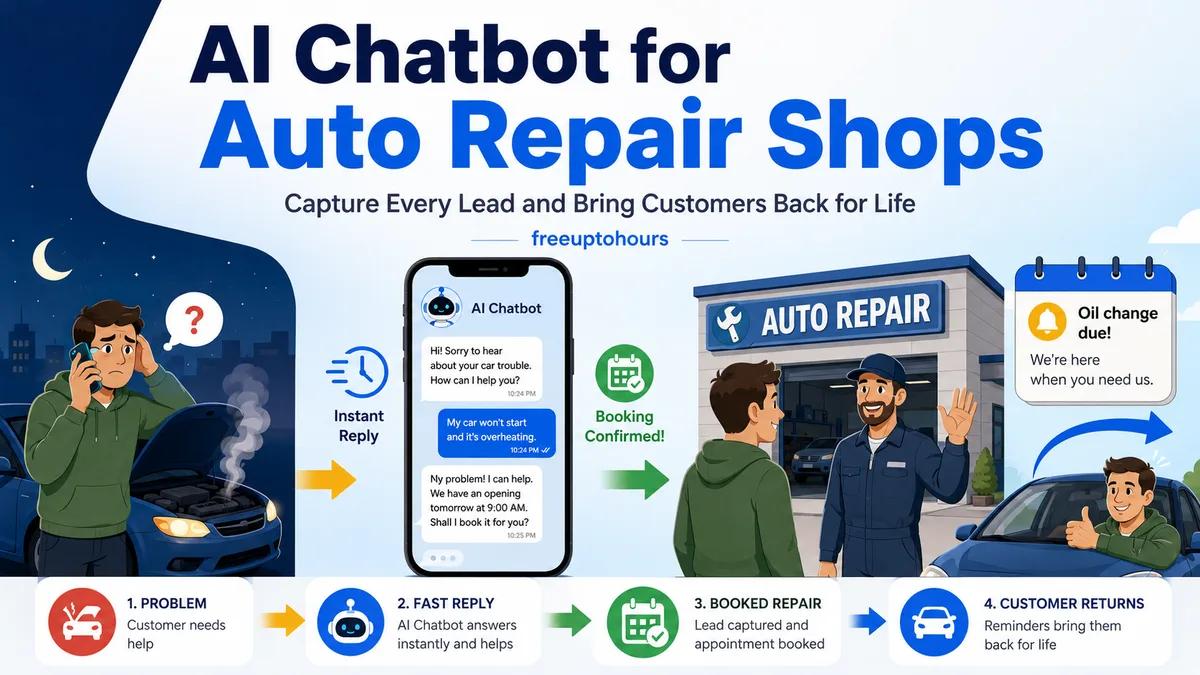
AI Chatbot for Auto Repair Shops: Capture Every Lead and Bring Customers Back for Life
A car overheats on the road at 8 PM. The driver is stressed, maybe stranded, and the first thing they do is message four repair shops at once: "my car is overheating, pwede bukas?" Whoever answers first, with a clear next step, gets the job. The other three reply in the morning to a customer who already booked someone else.
That is the front end of an auto repair business. But there is a second half most shops completely ignore: a car is never a one-time sale. The same customer needs an oil change in a few months, then brakes, then a PMS. The shop that reminds them first keeps them for life. This post is about building both halves, the chatbot that captures every lead and the system that brings customers back, plus the website, Facebook, and Google Business growth that feeds it.
It starts with 200 questions, not a bot
Before I build anything, I do not touch the automation. I sit with the shop owner and pull around 200 FAQs and pain points. Overheating, won't start, brake noise, aircon not cold, what a tune-up covers, every question customers actually ask, and the real answer to each one.
The owner is stressed and busy, but he knows his shop cold, so the knowledge has to come from him. That is what the bot is trained on, his real answers, not a generic script. If you build the bot before you understand the shop, you just automate a wrong answer and deliver it faster. The 200 questions are the foundation everything else stands on.
What the chatbot actually does on an inquiry
Once those FAQs are loaded, the conversation is simple. The bot asks what service they need and what the problem is, then gives the standard price straight from the owner's answers. Oil change, tune-up, the routine jobs, those have clear prices it can quote instantly, day or night.
And here is the honest part: 200 FAQs is not the finish line. When the bot hits something it does not know, you add the answer. Every conversation makes it smarter. It is an ongoing process of fixing and adding until the bot is fully customized to that specific shop. It does not have to be perfect on day one. It just has to get better with every message, and it does.
The estimate problem, handled honestly
Auto repair has a pricing trap that hotels and salons do not. A haircut has a fixed price. But "my car shakes when I brake" could be five different problems at five different prices. So the bot cannot just promise a number and create an angry customer later.
The way I build it, the bot gives the default standard pricing for the routine services, and anything uncertain gets passed to the owner for the real estimate. Only the mechanic can quote properly after seeing the car. So the bot's real job on the tricky ones is to capture the car, the symptom, and the location, then book the visit, and let the human give the accurate quote. The bot never promises something the shop cannot honor, and every one of those conversations still feeds back to make its pricing sharper over time.
Getting found: Google Business and visibility
A chatbot only matters if people are messaging you in the first place, and auto repair is one of the most-searched local services there is. When a driver is stuck, they type "auto repair near me" or "mechanic near me" into Google Maps right then. That is the hottest lead in the world, and it goes to whoever ranks first.
So the growth side is about visibility, and visibility equals growth. You build content for the website blog, landing pages, the Facebook page, and the Google Business profile, all of it working to get the shop seen. Visibility brings leads, and leads convert to sales. This does not replace your word-of-mouth and referrals. It adds to them, so the shop grows beyond what referrals alone could ever do.
The goldmine: bringing customers back automatically
This is the part that can be worth more than any single new lead. A car is not a one-time sale, but customers forget their maintenance. They do not think about an oil change until something feels wrong.
So you set up automatic follow-ups. After an oil change, the system schedules the next reminder for around six months later: "Hi sir, due na po kayo for oil change." Then reminders for brakes, for PMS, customized per customer. A human owner cannot remember every customer's maintenance schedule, but the system never forgets. That recall engine quietly turns one-time repairs into regulars who come back for years. It is the difference between a shop that constantly chases new customers and one that keeps the ones it already earned.
"But you are not a mechanic"
Fair challenge. I run a transient business, not a repair shop, and I cannot fix a transmission. But I am not claiming to. The marketing and the lead-getting tactics are the same across any business, because I have run a real one for six years. What changes per business is the automation, and that always has to be custom-built.
I learned that the hard way. I tried the built-in Meta Business Suite agent before, and it did not work, because I needed a customized Google Sheet for my bookings and their AI could not be customized. So I built my own, and it runs great. Every business needs its own custom automation. That is exactly why I pull the 200 FAQs from the shop owner first: he brings the auto repair expertise, I bring the growth system and the automation. Not being a mechanic is not a problem, because the mechanic is already in the room. I just make sure his knowledge reaches every customer, day and night.
What an auto shop should actually post
For the visibility to work, the content has to be real, and a repair shop has the best raw material there is. The strongest content is before and after: here is what came in, here is what was wrong, here is what we replaced, and here is the result. You explain the actual job in the post.
That is what real E-E-A-T experience content means, and it beats posting a price list or a generic "we are open" graphic. Every repair you document is original data that Google and AI can read, trust, and surface when someone searches for that exact problem. You can even tell the small story: how the customer came in worried, what you found, what it cost, how they drove off happy. Nobody else has your repair stories. That is what makes the shop the trusted expert online, not just another listing.
The roadmap and how to start
Here is the honest order. You do not automate an empty inbox, so first you build visibility: a website that ranks on the first page and Meta ads to bring leads now. That site leads to a homepage, the homepage chat routes the customer into Messenger, and the bot captures everything, the service, the problem, the pricing, the location, and can even take a reservation. That is how the leads multiply. Once the messages are really flowing, the chatbot earns its place, and then the recall system keeps them coming back.
Starting is simple and low-risk. You message me on Facebook Messenger, ask for the free homepage, and send your shop details. In 24 to 48 hours I build a real working homepage for your shop and send it to you, free, and you decide if you want to continue. The full website is ₱7,999 for 5 pages or ₱9,999 for 7, with the domain and hosting free for the first year and ₱3,499 a year after that. The chatbot and automation come after, sized to your shop. It fits a real shop's budget, not a Manila-agency price.
The honest final word
Word-of-mouth really works, and you do not survive an auto repair business without it. But businesses are expanding, and the younger shop owners are already moving online. The shops that win from here combine both: keep the word-of-mouth, and add online visibility, real leads, growth, and automation on top.
You do not need to be techie to do it. You handle the cars. I handle the website, the Google Business ranking, the chatbot, and the recall system that fills your schedule and brings customers back. Every day you wait, you lose leads to the shop that answered first and repeat revenue to the shop that reminded the customer first.
I Rebuilt My Baguio Business With $20 of AI — Now I'm Booked Solid
The origin story behind this system: how six years of running a real business plus a $20 AI subscription became a fully booked, automated operation.
AI Chatbot & Agent for Home Service Businesses
The same speed-wins playbook for plumbers, aircon, and electrical services: how the fastest reply captures the urgent local job.
Car Rental Booking Automation & Business Growth
The vehicle-business cousin of this post: how AI captures bookings and grows a car rental, with the same automation backbone.
Frequently asked questions
What can an AI chatbot do for an auto repair shop?
How does the bot handle repair estimates it cannot price exactly?
Why is Google Business so important for an auto repair shop?
How does automation bring repair customers back?
You run a transient business, not a repair shop. How can you help?
How does an auto shop get started, and what does it cost?
Need this for your business? I build exactly this kind of system for small business owners.
AI Chatbot for Messenger →Want the same system for your business?
I'll set up AI automation for your business — just like I did for mine.