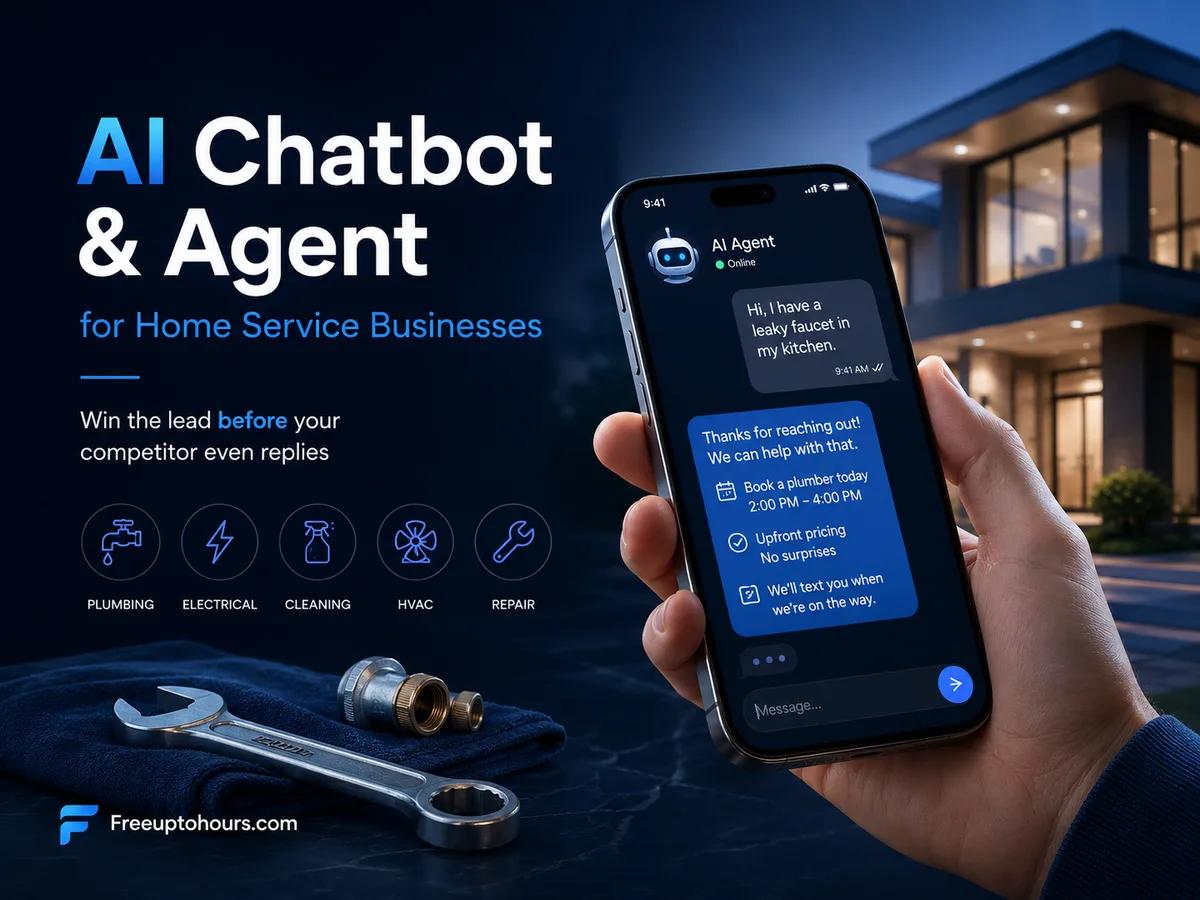
AI Chatbot & Agent for Home Service Businesses: Win the Lead Before Your Competitor Even Replies
It is 9 PM. Someone's aircon just died and the room is an oven. They grab their phone, find three repairmen on Facebook, and message all of them the same line: "Pwede pa ba magpa-clean ng aircon bukas?" Then they wait.
Whoever answers first — with the service, the price, and an open schedule slot — gets the job. The other two reply an hour later to a customer who already booked. That is the entire reality of home service businesses, and it is exactly why an AI agent matters more here than almost anywhere else.
I am going to show you how I build AI chatbots and agents for home service businesses — aircon, plumbing, electrical, cleaning, pest control, appliance repair — running on both WhatsApp and Meta Messenger, fed by Meta ads, a website, and Google Business. It is the same system that pulls around 20,000 messages on my own business, and I build the whole thing with Claude Code and Codex. Let me be honest up front about what I have proven and what I am adapting.
What I have actually proven — and what I am adapting
The closest thing I have built to this is my own transient house business. It gets a lot of leads — around 20,000 messages — and a steady flood of bookings. Home service is a different business, but the machine is the same: catch every inquiry instantly, qualify it, schedule it, and never let a lead go cold.
So read this as my proven system mapped onto your trade. The transient house is the real-world receipt. A plumber or an aircon technician runs on a different engine, but the chassis — instant replies, AI qualification, a Google Sheet of organized leads, content that makes AI recommend you — is identical. I am not theorizing. I am showing you the system I already run, pointed at home services.
Why speed is the whole game — and only AI wins it
Here is the most important piece: the AI agent itself. You load it with the answers to two hundred of the questions your customers actually ask — every service, every price, every "do you cover my area." Then the moment someone messages, it answers instantly. Not in an hour. In seconds.
That speed is everything in home services. The customer in a panic at 9 PM is messaging your competitors at the same time. If you reply manually, a human takes an hour — and by then they have already seen someone else's service, someone else's price, and booked them. But if your AI agent runs 24/7, it answers first, shows your service and your price, and locks the conversation while you sleep. The fastest message conversation is the one that gets the lead and gets the job done.
WhatsApp and Messenger — you need both
Your customers do not all live on the same app, so the agent cannot either. In my experience I still get a huge amount of messages on Meta Messenger — it comes straight off the Facebook ad and the Facebook page. But WhatsApp is getting more and more popular, and you need it too.
So you run both, and one AI agent covers both at once. It does not matter which app the customer picks — they get the same instant answer, the same price, the same schedule offer. And remember: the Facebook ad is what feeds those inboxes in the first place. It is not enough to have just a website and a Google Business profile. Meta ads are very important — they are what actually push the leads into the channels your agent is waiting on.
The lead engine: two lanes working together
Getting leads runs on two lanes, and a home service business needs both.
The fast lane is Meta ads. If you pay, you get leads in your Messenger almost instantly. It is the quickest way to put your service in front of people who need it now and drive them straight into a conversation.
The long lane is your website and daily content, optimized for SEO, GEO, and AEO. Every single day, you post a blog, you post on the website, you post on the Facebook page, and you post on Google Business. That is how you get prioritized by AI search — so when someone asks for the "best recommended plumber" or the "most recommended service" in their area, your name is the one that comes up. That is where the real volume of leads comes from, and once they are flowing, you can hire more people and build the business side.
- Meta ads — pay, and get instant leads into Messenger and WhatsApp today.
- Google Business — catches the person searching "aircon repair near me" on Maps right now.
- Website + daily blogs — builds the authority that makes AI recommend you as the go-to.
- All of it feeds one AI agent that answers instantly across both channels.
Follow one lead from 9 PM to the morning
Here is what actually happens when that aircon customer messages at 9 PM, end to end.
The AI agent checks availability from a Google Sheet and sends the customer the open slots. The customer replies — "I can be available at 3 PM." The agent confirms the schedule, then collects the details: name, phone number, the problem, the location. The customer fills all of it in, and everything drops automatically into the leads section of the Google Sheet. No detail lost, no copying by hand, all while you are asleep.
Then the human takes over in the morning. When you — or your technician — wake up, you check the new leads sitting in the sheet. The smart move is to call and verify the problem first: confirm they really have that issue, confirm the schedule, and then roll out. The AI does all the night-shift capturing and scheduling; the person does the verifying and the actual work. The machine makes sure the lead is there, warm and organized, by the time you open your eyes.
How I build it: Claude Code and Codex
This is the part most people selling chatbots cannot say honestly: I build the entire system myself with Claude Code and Codex. The AI agent, the websites, the apps — all of it. Node.js, LangGraph, the Google Sheets integration, the connections to Messenger and WhatsApp. I am the one who actually builds it, not a middleman reselling someone else's tool.
What that means for you as a home service owner: you do not have ninety days to sit and learn how to code an AI agent. You are busy running the business. So I build it for you, and I maintain it so it keeps growing — and I bring the lead-growth strategy with it, not just the tech. I can do this because I am a business owner too. That is the whole point: business owner to business owner, what we both want is to grow and to automate our operations so the business stops running our lives.
Growth first, automation second
Now the honest part that the chatbot salesmen will not tell you: you do not need the AI agent first. Not to get leads.
What you do first is grow the business. Get a website, a Facebook page, and a Google Business profile, and optimize all of them. Add Meta ads to start getting real results. Build the trust and get the leads flowing. Then — once you are getting serious volume, the kind of message load I have at 20,000 — that is when we install the AI agent or chatbot into your system, because now it has a real problem to solve. Trying to automate an empty inbox is solving a problem you do not have yet.
And the cost is small — this is not a ₱200,000 agency package. Realistically: a ₱7,999 website, ₱5,999 a month for the daily content across blogs, Facebook, and Google Business, plus whatever ad spend you are comfortable with. Every day we add a real E-E-A-T post. That is enough to grow your business first and earn the trust that makes the rest work. The AI agent comes later, when the volume demands it.
What home service owners get wrong
Let me be clear: tarpaulins and word-of-mouth are not useless. They are the traditional way, and they still work — a sign on a busy road or in a popular spot will still catch some people. Keep doing it.
The mistake is relying only on that. A whole generation — Gen Z and the younger crowd — now searches for the most recommended service in their local area before they call anyone. If your name does not pop up in that AI answer, you are simply invisible to them, no matter how good your tarpaulin is. That is why you need to see how powerful it is to have AI recommend your local service business. The tarpaulin catches a few; being the AI recommendation catches the flood. And once that flood of leads comes in, that is when you hire more people and actually scale — leads first, then growth.
Blogs do double duty — and the agent keeps earning
There is a reason I push daily blogs so hard, and it is not only about AI. Yes, the content is what gets AI to check and confirm you are the recommended one. But it does a second job at the same time: real people see what you are doing right now. They see your latest work, your current pricing, your active services — proof that you are a real, working business, not a dead page.
So you keep the website, Facebook, and Google Business updated with your most current services. And once you have real customers, the AI agent keeps earning — it can do follow-ups, show updated pricing, and bring people back. The content convinces both the AI and the humans; the agent makes sure none of it goes to waste.
From my mom's tarpaulin to the #1 AI recommendation
Let me leave you with the story that proves all of this. My mom ran our transient business from 2010 to 2020, the traditional way — word-of-mouth, referrals, and tarpaulins. It worked, for its time.
I had been an IT developer since 2009, so when I took over the business, I did one thing: I put it online. The website, the content, the AI, the whole system. And today I am the number one recommended transient near SM, near Session Road, and near Burnham. Same business my mom built — but with the online layer on top, it became the one AI sends everyone to.
That is the before-and-after waiting for every home service business right now. Keep the tarpaulin. But add the online presence, become the business AI recommends in your town, and you go from scraping by on referrals to booked solid. The owners who do it now win their area before their competitors even realize the game changed.
I Rebuilt My Baguio Business With $20 of AI — Now I'm Booked Solid
The origin story behind this whole system — how an IT developer took over a word-of-mouth business and turned $20 of AI into a fully booked operation.
AI Receptionist on WhatsApp with LangGraph + Google Sheets
The exact technical stack behind the agent in this post — how the WhatsApp AI receptionist, LangGraph, and the Google Sheet leads workflow actually fit together.
How to Get Recommended by ChatGPT in the Philippines
The companion to the "become the recommended one" half of this post — the exact method for getting AI to name your local service business first.
Frequently asked questions
Why does a home service business need an AI chatbot more than other businesses?
Should the AI agent run on WhatsApp or Messenger?
How does the AI agent handle scheduling without double-booking?
Do I need the AI agent first to start getting leads?
What does this cost for a home service business?
Who builds and maintains the system?
Need this for your business? I build exactly this kind of system for small business owners.
AI Chatbot for Messenger →Want the same system for your business?
I'll set up AI automation for your business — just like I did for mine.