Traditional Writer vs Strategy-First AI vs Free AI: What Actually Builds a Brand
I run booking and tourism brands. I have paid writers. I have used free AI at 2 AM because I was tired and a listing needed copy "right now." And I have built a strategy-first workflow on a serious model — Opus 4.8 — that, honestly, surprised me.
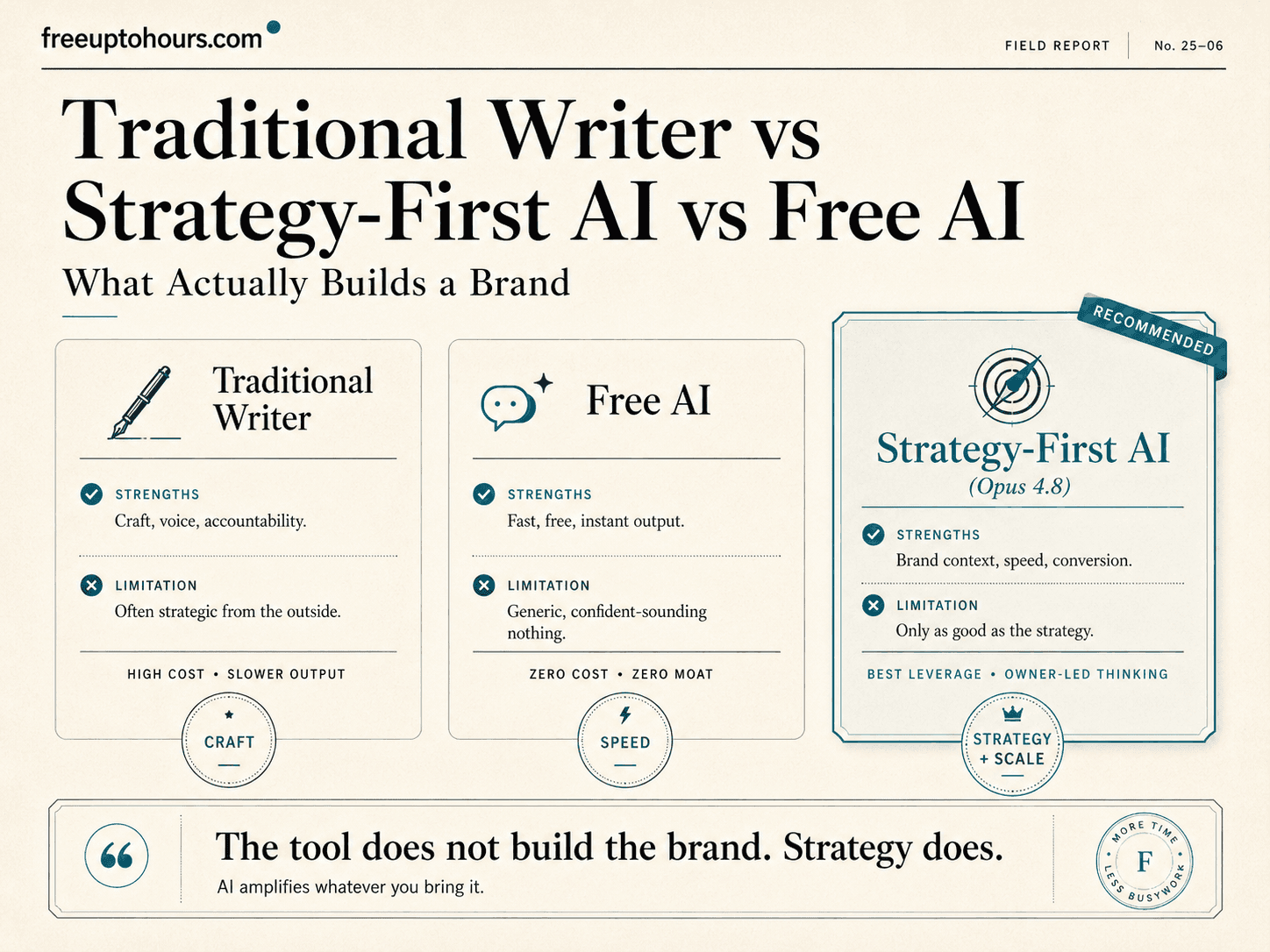
So this is not a theory post. It is what I learned spending real money and real hours on all three methods, and the uncomfortable conclusion I landed on: the model you use matters far less than the brand thinking you do before you open it. Free AI with no strategy produces confident-sounding nothing. A traditional writer produces clean prose that can still miss the business point. And a strong model with a strategist driving it beats both — not because it is "smarter," but because you finally forced yourself to answer the hard questions first.
The Three Ways People Create Content Right Now
Let me define the contenders fairly, because each has a real strength.
1. The Traditional Content Writer
You hire a human. They research, they write, they hand you 800 to 1,500 polished words. Good ones are genuinely valuable — they catch nuance, they have taste, they can interview you and pull out the story you did not know you had. The strength is craft, voice, and accountability.
The catch is that most freelance writers are not in your business. They write about your brand from the outside. They do not know that your guests mostly book 2-night weekends, that your repeat customers care about parking more than aesthetics, or that "near the park" converts better than "city center." So you get beautiful copy that is strategically generic — and you pay per word for the privilege.
2. Free AI With No Strategy (The "Just Generate It" Approach)
Open a free chatbot, type "write me a blog about transient houses," copy, paste, publish. Done in four minutes. The strength is speed and zero cost.
The catch is that it is confident-sounding nothing. The model has no idea who you are, who you serve, what makes you different, or what the reader is actually trying to decide. So it averages the entire internet and hands you the median — the same beige paragraph everyone else with the same lazy prompt is publishing. Google sees a thousand of these a day. Your reader feels the emptiness even if they cannot name it. It does not rank, it does not convert, and worst of all it makes your brand sound like everyone else. The problem was never the AI. It was the missing strategy.
3. Strategy-First AI on a Strong Model (Opus 4.8)
Same AI category — but flipped. Before generating anything, you do the brand work: who you serve, what you uniquely know, the proof you have, the exact decision the reader is stuck on. Then you brief a capable model the way you would brief a great writer who actually works inside your company.
The strength is that you get the writer's craft and the owner's strategic knowledge, fast and cheap, with you in the driver's seat. The catch is that garbage in still equals garbage out. If you skip the thinking, a powerful model just produces more eloquent slop. The tool amplifies whatever you bring it — including the void.
The Part Nobody Wants to Do: 10 Brutal Questions to Answer FIRST
This is the whole game. Whether you hire a writer, prompt a free tool, or run Opus 4.8, answering these first is what separates content that builds a brand from content that fills a page. Be honest — vague answers here produce vague content everywhere downstream.
- Who exactly is this for, and who is it NOT for? "Everyone" is not an answer. Name the one person.
- What specific decision is this reader stuck on right now? People read to decide something — booking, trusting, comparing. Name the decision.
- What do I know that my competitors literally cannot copy? Your real bookings, guest patterns, neighborhood knowledge, mistakes. This is your moat — free AI does not have it, and a hired writer does not either unless you give it to them.
- What is the one thing I want them to believe by the end? If the reader remembers a single sentence, what is it? Write that sentence first.
- What proof do I actually have? Numbers, screenshots, reviews, a real before-and-after, a photo. Authority without proof is just adjectives.
- What is the honest objection I am tempted to hide? Price, location, no pool, far from the market — name it. Addressing the objection out loud builds more trust than any testimonial.
- What would make a reader trust ME over the other 50 listings? If your answer also fits your competitor, it is not differentiation — it is wallpaper.
- What action do I want at the end, and is the content earning it? Book now, message us, save for later — the whole piece should bend toward one ask.
- Does this sound like a real person from my business, or like the internet's average? Read it out loud. If it could have been written by someone who has never seen your property, start over.
- If a stranger read only this piece, would they "get" my brand? Tone, values, who you are. One page should be a fair sample of the whole thing.
Here is the kicker: if you can answer these, even a modest tool produces something genuinely good. That is why the strategy is the product. The model just renders it faster.
Side-by-Side: Where Each Approach Actually Wins
| Factor | Traditional writer | Free AI, no strategy | Strategy-first AI (Opus 4.8) |
|---|---|---|---|
| Speed | Slow (days) | Instant | Fast (you + model in an hour) |
| Cost | High (per word) | Free | Low (your time + subscription) |
| Brand knowledge | External, shallow unless briefed | None | Yours, fully injected |
| Strategic depth | Depends on the writer | Zero | As deep as your 10 answers |
| Consistency at scale | Hard and expensive | Easy but generic | Easy and on-brand |
| Main risk | Generic but clean | Slop that hurts the brand | Garbage in, garbage out if you skip the thinking |
| Who is really driving | The writer | The algorithm's average | You |
Notice the pattern. The free tool gives you speed and loses the brand. The writer gives you craft and often loses the strategy. The strategy-first AI is the only column where you stay in control of the thing that matters — your brand authority — while still getting speed and low cost.
My Rough Example: Strategy-First AI Quietly Beat the Writer
I am not going to pretend I ran a perfect lab study. But here is what happened, honestly. I had a property page that a freelance writer had done for me. Clean, readable, professional — and completely interchangeable with any other transient listing. It described the place. It did not sell the weekend.
Later, I rebuilt a similar page myself. I sat down, answered the 10 questions above for that specific property, and then briefed Opus 4.8 with all of it — the guest type, the real objection (a bit far from the city center), the proof (repeat-guest reviews about quietness and parking), and the one belief I wanted to land: this is the calm weekend you actually need.
The strategy-first version did more with less. It read like me, it answered the objection head-on, it pointed the reader toward booking — and it cost a fraction of what I had paid per word, produced in an evening instead of a week. Not because the AI is a better writer than the human. Because I finally did the strategic work, and the model executed it without watering it down. The writer never had a chance — not because they lacked skill, but because I had never given them what I gave the model: the truth about my business.
The Verdict: It Is Not Writer vs AI. It Is Strategy + Execution.
After all of it, here is where I honestly land: the best content comes from a hybrid — human strategy plus strong-model execution.
- A traditional writer alone gives you craft but usually misses your business reality.
- Free AI alone gives you speed and strips your brand to the internet's beige average.
- A strong model with no strategist just produces prettier slop — garbage in, eloquent garbage out.
- You plus Opus 4.8, after answering the 10 questions, is the combination that builds authority AND moves fast AND stays cheap.
The order matters more than the tool: brand authority first, generation second. Get that backwards and every method fails. Get it right and even simple tools start winning. So if you are a small business owner deciding how to make content, do not start by choosing a writer or a tool. Start by answering the 10 questions about your own business. Then pick the execution method. That is the whole secret, and almost nobody does it in that order.
Digital Marketing Automation Baguio: What to Automate First
Where SEO content fits in the bigger system, and why AI formats your real experience instead of inventing it.
SEO Services for Baguio City Small Businesses
How local content actually earns rankings and trust for a small business.
Content Automation — Strategy-First, Done for You
If you would rather hand off the execution after the brand strategy is set.
Frequently asked questions
Is AI content better than hiring a writer?
Why does free AI content sound generic?
Does the AI model I use actually matter?
What should I do before using AI to write content?
Is strategy-first AI content cheaper than a freelance writer?
Can AI content build brand authority?
Want the same system for your business?
I'll set up AI automation for your business — just like I did for mine.