AI Chatbot for Travel Agencies in the Philippines: Beat the Scam Problem and Get Booked Through Peak Season
Selling a trip is not like selling a quick service. It is a dreamy, high-consideration purchase. Someone planning a Boracay getaway, a Japan tour, or a balikbayan family vacation asks a lot of questions before they commit, and then they hand over a deposit for something they cannot see yet. So trust is everything. And in the Philippines, travel has a trust problem most industries do not: the market is full of scam pages that take deposits and vanish.
That changes what a travel agency needs to win. You need to answer fast and beautifully, you need to look unmistakably legit, and you need to be the agency that AI itself confirms and recommends when a nervous customer checks. Here is how an AI chatbot plus the right website, Google Business, and content do exactly that, from someone who runs a tourism business and sells to travelers every single day.
What the chatbot does for a travel inquiry
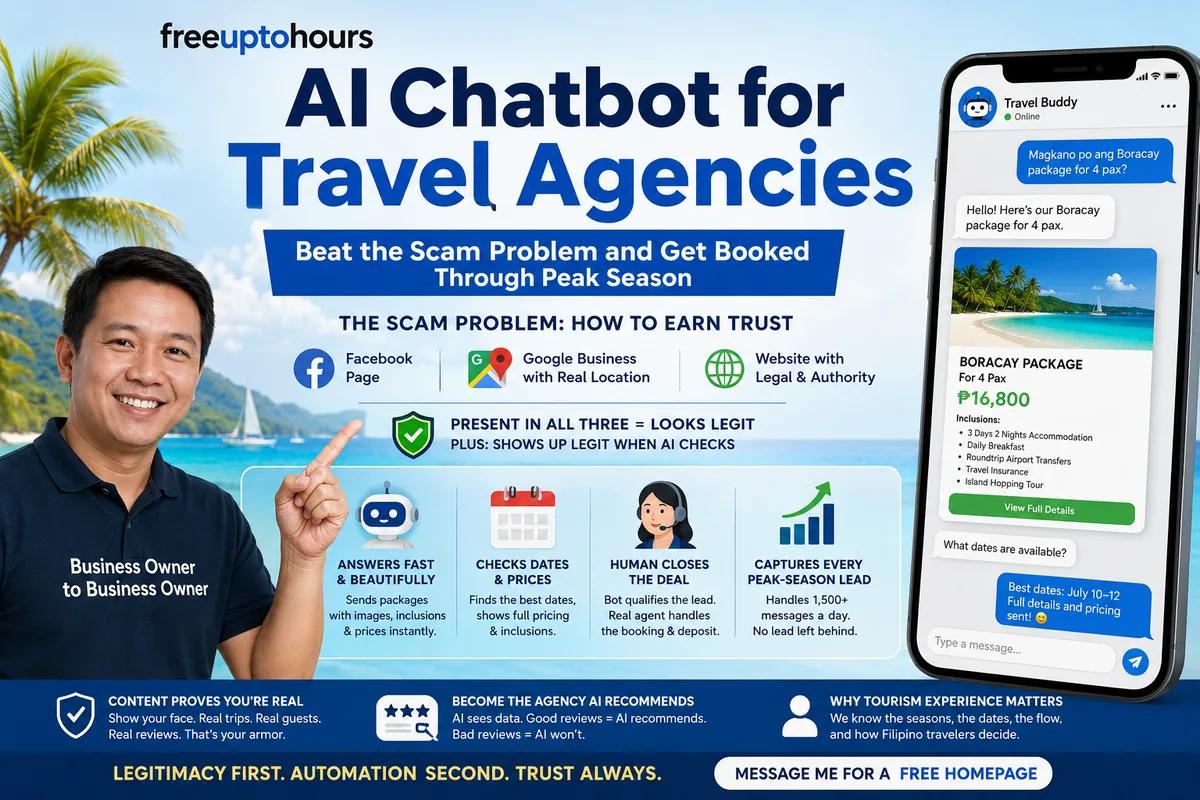
Travel has one big advantage over a business like auto repair: the pricing is constant. Packages have set prices, so when someone messages "magkano po ang Boracay package for 4 pax?" the bot can confidently send the exact package right away. And it should send it the right way, graphically and in text, because travel is an experience you sell with images, not just numbers. It is a design-driven sell.
From there the conversation flows naturally. The customer asks about inclusions and available travel dates, the bot checks the best dates and sends the full pricing and everything that is included. Then it moves them toward the actual booking and deposit. This is where the human steps in: the bot sends all the data and qualifies the lead, but when someone is ready to put money down on a trip they cannot see yet, a real travel agent should close the deal. For a purchase this personal and this expensive, people want a human to reassure them at the moment they pay.
The scam problem, and the three signals of a legit agency
Here is the battle every honest Philippine travel agency fights: proving it is not a scam. So many fake agencies on Facebook take deposits and disappear that customers are rightly nervous, and a Facebook page alone is no longer enough to earn trust.
If you want to check whether a travel agency is really legit, you look for three things, not one. A Facebook page, a Google Business profile with a real location, and a website that shows the authority and the legalities before you pay. An agency with all three looks real. An agency with only a Facebook page looks like every scam page out there. And there is now a fourth layer: customers literally ask AI to check if an agency is legit before they deposit. So being present and verifiable across all three, and showing up legit when AI checks, is what makes a nervous customer feel safe handing over their money.
Content that proves you are real
A travel agency needs more content than almost any other business, because it sells experience, so it has to show experience. And the most powerful thing you can do is simple: show your own face. Post yourself there with the guests, supporting them on the actual trip. In a market this full of scams, that transparency is your armor.
So post the real journeys, the happy clients, even the travel troubles you handled well, the destination guides, the honest reviews. The more real and present you look, the safer customers feel. AI-generated visuals can help fill some gaps, but real photos are what build the trust. Nobody fakes being there with their own travelers, and that is exactly what separates you from the dead, scammy pages that only post price lists and "DM for inquiries."
Surviving the peak-season flood
Travel runs on seasons, and peak season is a flood. Summer, Holy Week, Christmas, the ber-months, the "magkano po" messages pour in faster than any small team can answer, and every missed message is a booking lost to a faster competitor.
This is exactly where the chatbot earns its place, and I know it from my own tourism business. During my strong season, like December, I get up to 1,500 messages in a single day. No human team can keep up with that, but the chatbot replies to all of it, instantly. The only job left for a person is to supervise, to read through the replies and make sure they are right. So instead of drowning during the busiest, most profitable weeks of the year, you capture every single lead while everyone else is overwhelmed.
Becoming the agency AI recommends
Since customers now ask AI whether you are legit, the deposit-deciding moment is whether AI vouches for you. And here is the honest truth about how that works: AI catches on data. If an agency has a lot of real reviews, AI sees it and recommends it. If an agency has a lot of red flags, AI will not recommend it.
You cannot fake your way into an AI recommendation. You earn it. Protect your reputation, deliver genuinely good service, and collect real reviews, and AI will reflect that back by recommending you. That is why this works best for honest agencies: the automation and the content amplify a good reputation, but they cannot rescue a bad one. Do right by your travelers, and you become the one both customers and AI trust.
Why my tourism background matters here
I am not a travel agency, but I run a twin business in tourism, so this is close to home turf. I sell to travelers every day, so I genuinely understand the rhythm a pure tech person would miss.
I know the seasonal patterns, which exact dates run hot, and what pricing or discounts to push at what time of year. I know the booking and deposit flow, and how a Filipino traveler actually searches, hesitates, and decides, because I live it. A travel agency built by someone who understands tourism is tuned to how travel really sells, not just how software works. That lived experience is the difference between automation that fits the business and automation that fights it.
The roadmap: legitimacy first
Here is the honest order for a travel agency. Start with legitimacy, because nothing else matters if customers think you might be a scam. First, have a real location, even a small home office is fine, because without one it is hard for people to trust a travel agency, and it lets you set up Google Business properly. Then build the real reviews, and post consistent content on the website blog, the Facebook page, and TikTok, every day, to grow visibility and trust.
Then, once the inquiries are really flowing, the chatbot and AI automation step in to handle the volume, especially before peak season hits. To become AI-recommended, the formula is simple: good service, good reviews, and a lot of real E-E-A-T content. Get found, get trusted, then automate. Visibility and legitimacy first, automation second.
Who this is for
This is for legit agencies that genuinely want to grow their leads and sales. It is not a trick to make a bad agency look good, because AI reads the reviews and the red flags, and bad service spreads faster, not slower, with more visibility. The prerequisite is real service first.
For an honest agency, the efficiency is huge. When you are getting 1,500 messages a day in peak season, you would normally need around three people just to handle them. With the AI agent doing the heavy lifting, you can hire just one person to supervise and read through the replies. The system amplifies a good agency and lets it scale through its busiest season without breaking.
The honest final word
In a market full of scam pages, being visibly legit and AI-recommended is everything. The chatbot lets you capture every peak-season lead without drowning, the content and reviews build the trust that gets the deposit, and the automation amplifies an agency that already does right by its travelers. And I understand your world, because I live in tourism too.
Start with legitimacy. I want to partner with agencies that run an honest operation, and build them into the legit, AI-recommended business that generates leads, automates the inbox, and earns real trust. That trust is what grows an agency as big as it can go.
I Rebuilt My Baguio Business With $20 of AI — Now I'm Booked Solid
The origin story behind this system: how running a real tourism business plus a $20 AI subscription became a fully booked, automated operation.
How to Get Recommended by ChatGPT in the Philippines
The deeper guide to the deposit-deciding moment: how to become the business AI confirms and recommends when a customer checks if you are legit.
Marketing, Leads, Sales, Then AI: The Real Order to Grow a Business
The growth-first order behind this roadmap: why legitimacy and visibility come first and automation comes last.
Frequently asked questions
What can an AI chatbot do for a travel agency?
How does this help with the travel agency scam problem?
Can a chatbot handle peak season inquiries?
How does a travel agency get recommended by AI?
What should a travel agency post online?
How do I start, and what does it cost?
Need this for your business? I build exactly this kind of system for small business owners.
AI Chatbot for Messenger →Want the same system for your business?
I'll set up AI automation for your business — just like I did for mine.